History
Long before the mineral had a name, the gemstone made from it already did. The Romans admired translucent feldspar with a floating bluish sheen and believed it was condensed moonlight — the origin of the word moonstone. The stone they prized was, in mineralogical terms, a clear variety of potassium feldspar with a particular optical trick: a soft, milky-bluish glow that drifts across the surface as the gem is tilted.
The mineral itself was named in 1780 by Ermenegildo Pini, an Italian Barnabite priest and naturalist who studied the rocks of the Saint Gotthard region in the Swiss Alps. Pini drew the name from the Adula Alps, the mountain group around the pass where he collected his first specimens. He published his findings the following year as Osservazioni mineralogiche sulla montagna di S. Gottardo — Mineralogical Observations on the Mountain of St. Gotthard. The paper appeared in the Milanese review Opuscoli scelti sulle scienze e sulle arti.
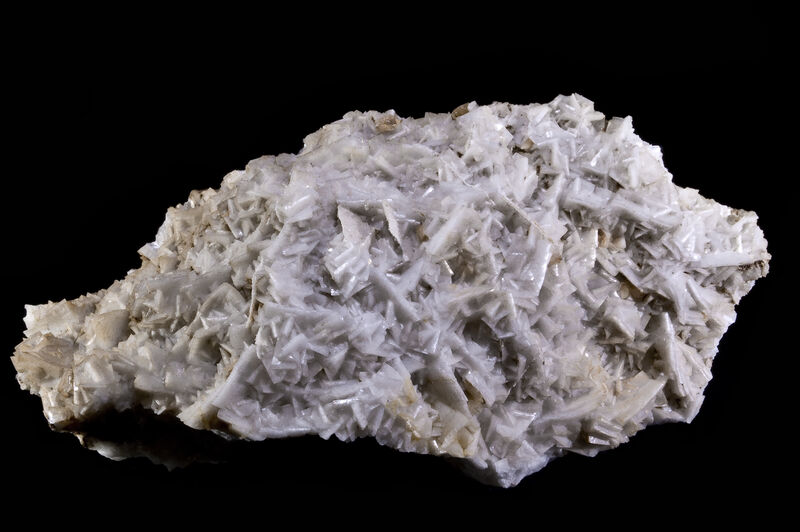
Pini described adularia as a varietal name for a low-temperature habit of potassium feldspar (KAlSi₃O₈), not a separate mineral species — historically classed with orthoclase, the common potassium feldspar of granites. What sets it apart is where it forms. The crystals grow in the cracks and cavities of Alpine schists, deposited from low-temperature hydrothermal fluids rather than from cooling magma, and they appear as clear, glassy, sharply twinned prisms.
Through the 19th and 20th centuries, mineralogists worked out where adularia sat in the K-feldspar family. The visible crystals are pseudo-orthorhombic — they look as if they belong to the orthorhombic crystal system, but a closer look at their optics shows a slight monoclinic or triclinic distortion. Modern work places adularia as a more ordered low-temperature form of orthoclase, sometimes shading into partially-disordered microcline depending on how the crystal cooled and on its trace-element content.
The same century also fixed the cause of the moonstone glow. The phenomenon was given the name adularescence, after the variety it travels with. Its cause is structural rather than chemical: inside the crystal sit microscopically thin alternating layers — exsolution lamellae — of orthoclase and the sodium feldspar albite, and light scattering between those layers produces the floating sheen. Around 1900 the French Art Nouveau jeweller René Lalique used the cabochon-cut variety extensively in his work, alongside many of his contemporaries.
Industrial & practical applications
Adularia has no bulk industrial use. The variety matters in two narrower ways: as the source of one of the world's most distinctive gemstones, and as a marker mineral that geologists read when they hunt for precious-metal ore.
The gem side is moonstone. Crystals that show adularescence — the soft, floating bluish glow — are polished into smooth-domed cabochons and set in fine jewellery. In the United States, moonstone is the state gemstone of Florida. The designation was passed in 1970 to commemorate the Apollo lunar landings, even though the gem does not occur naturally in the state.
The geological side is invisible to the public but commercially important. Many modern precious-metal mines exploit low-sulfidation epithermal gold-and-silver veins — low-temperature deposits laid down by ancient hot-spring systems. Around the ore, these deposits carry a distinctive set of gangue and alteration minerals: quartz, sericite (a fine-grained white mica), illite, pyrite, calcite, and adularia. The combination is named after two of those minerals: adularia-sericite alteration. When exploration geologists sample altered rock and find adularia in the right context, it works as a signal. They may be standing over the upper levels of a former hot-spring system that once carried gold and silver.
Beyond the gem trade and the exploration map, adularia is mostly a collector's mineral. The clear, glassy, sharply-twinned crystals from Alpine clefts are prized for their geometry and provenance rather than for any commercial yield.
Where it forms, where it's found
Varieties
Crystallography
Chemical composition
Synonyms
- Adulaari
- Adulaire
- Adular
- Adulare
- Hystatischer Monophan
Literature, links & citation
- 1781Pini, E. (1781) Osservazioni mineralogiche sulla montagna di S. Gottardo. In: Opuscoli scelti sulle scienze e sulle arti, 4. (first description of adularia)
- 1921Kozu, Shukusuke (1921) X-ray analysis of adularia and moonstone, and the influence of temperature on the atomic arrangement of these minerals, Tohoku Imperial University.
- 1978Dal Negro, A., De Pieri, R., Quareni, S., Taylor, W. H. (1978) The crystal structures of nine K feldspars from the Adamello Massif (Northern Italy) Acta Crystallographica Section B Structural Crystallography and Crystal Chemistry, 34 (9) 2699-2707 doi:10.1107/s056774087800905xDOI: 10.1107/s056774087800905x
- 1984Černý, Petr, Chapman, Ronald (1984) Paragenesis, chemistry and structural state of adularia from granitic pegmatites. Bulletin de Minéralogie, 107 (3) 369-384 doi:10.3406/bulmi.1984.7767DOI: 10.3406/bulmi.1984.7767
- 2006Roth, P. (2006) The early history of tremolite. Axis: 2(3): 1-10. (http://www.minrec.org/pdfs/TREMOLITE%20Edited.pdf)
Entry last updated
@misc{mineral2026,
  author    = {Mineral Index editorial board},
  title     = {Adularia — Mineral Index},
  year      = {2026},
  url       = {https://mineralindex.org/minerals/adularia-28}
}