Where it forms, where it's found
- Geological setting
In a zonal microcline-calcite vein with aegirine-hedenbergite, quartz, and albite in a moraine boulder of intensively altered clay schist.
- Type locality
- Dara-i-Pioz Massif
- Districts of Republican Subordination
- Tajikistan
39.4504°, 70.7163°
1recorded occurrences
Physical
Optical
- Optical type
- Biaxial (-) · 2V measured = 70.3°
- Refractive index
- 1.629 – 1.638
- Surface relief
- Moderate
- Principal indices
- nα 1.629 · nβ 1.635 · nγ 1.638
- Dispersion
- r > v, strong
- UV response
- Light blue under short-wave (254 nm) UV radiation.
Δ = 0Δmax
PPLpleochroism per grain
XPLindependent extinctions · rotate the stage
PPLpleochroism only · colour blends on rotation
XPLinterference colour · extinct every 90°
Retardation90 nm
Order1st order
XPL colour
Crystallography
- Space group
- C2/c
- Cell parameters
- a = 17.01(2) Å · b = 9.751(6) Å · c = 21.00(2) Å
- Cell angles
- β = 112.45(8) °
- Ratio a:b:c
- 1 : 0.573 : 1.235
- Unit cell volume
- 3219 ų
- Z
- 4
- Morphology
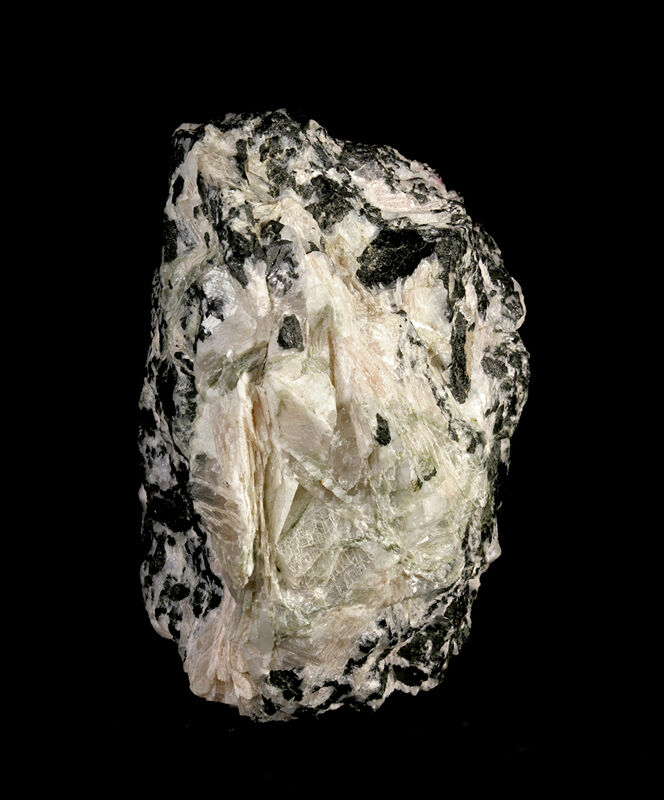
Lamellae up to 50–70 μm with no detectable zoning or zoned crystals. Aggregates of zoned and sectorial grains where separate zones represented by aleksandrovite, baratovite, or katayamalite.
- Type-locality form
Inclusions in baratovite. As lamellae up to 50–70 µm with no detectable zoning, as zoned crystals up to 0.8 mm, and aggregates of zoned and sectorial grains where separate zones represented by aleksandrovite, baratovite, or katayamalite.
Chemical composition
Synonyms
- Aleksandroviet
- Aleksandrovitt
- IMA2009-004
In other languages
- German
- Aleksandrovit · IMA 2009-004
- Italian
- aleksandrovite
Classification
Strunz
10th ed.9.CJ.25
- 9SilicatesClass
- 9.CCyclosilicatesDivision
- 9.CJ[Si6O18]12- 6-membered single rings (sechser-Einfachringe), without insular complex anionsGroup
- 9.CJ.25AleksandroviteSpecies
Group, growth & confusion
Literature, links & citation
Citations
- —IMA Approvals - May 2009
- 2010Pautov, L.A., Agakhanov, A.A., Karpenko, V.Yu. & Gafurov, F.G. (2010) Aleksandrovite KLi3Ca7Sn2[Si6O18]2F2 — a new tin mineral. Novye dannye o mineralakh, 45, 5–16 (in Russian). New data on minerals, 45, 5–16 (in English).
- 2012Belakovskiy, D., Welch, M. D., Camara, F., Gatta, G. D., Tait, K. T. (2012) New Mineral Names. American Mineralogist, 97 (8) 1523-1530 doi:10.2138/am.2012.596DOI: 10.2138/am.2012.596
- 2014(2014) Aleksandrovite. Handbook of Mineralogy. Mineralogical Society of America
Cite this entry
Entry last updated
@misc{mineral2025,
  author    = {Mineral Index editorial board},
  title     = {Aleksandrovite — Mineral Index},
  year      = {2025},
  url       = {https://mineralindex.org/minerals/aleksandrovite-39438}
}