Where it forms, where it's found
- Geological setting
Granite pegmatite.
- Type locality
- Suishoyama pegmatite (Suishouyama
- Suisyoyama
- Suishyoyama)
- Iizaka Village (Iisaka)
- Kawamata
- Date District
- Fukushima Prefecture
- Japan
37.6838°, 140.6150°
30recorded occurrences
Physical
- Hardness
- 1Talc
- 2Gypsum
- 3Calcite
- 4Fluorite
- 5Apatite
- 6Orthoclase
- 7Quartz
- 8Topaz
- 9Corundum
- 10Diamond
- Lustre
- Adamantine
- Transparency
- Transparent · Translucent
- Colour
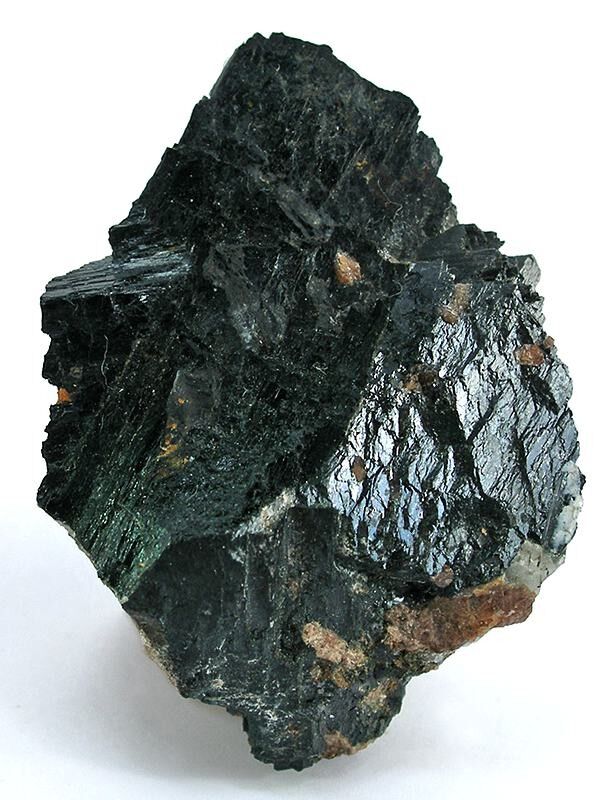
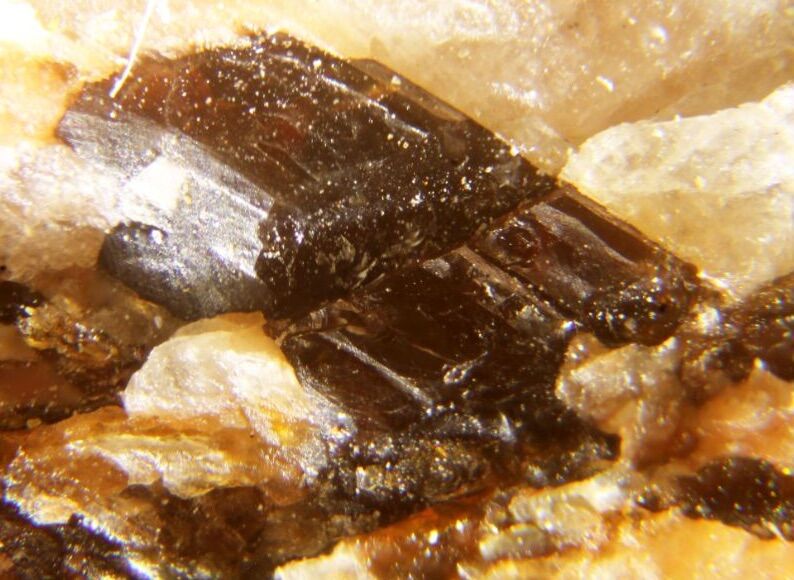
- Reddish-brown · black
Yellowish-brown in thin sections.
- Streak
- Pale brown
- Tenacity
- brittle
- Cleavage
- Imperfect/Fair
Imperfect on (0001), (100).
- Fracture
- Irregular/Uneven · Splintery
- Density
- 4.35 g/cm³
Optical
- Optical type
- Uniaxial (-)
- Refractive index
- 1.728 – 1.752
- Surface relief
- High
- Principal indices
- nω 1.73 – 1.752 · nε 1.728 – 1.75
- Extinction
- Parallel to cleavage.
Δ = 0Δmax
PPLpleochroism per grain
XPLindependent extinctions · rotate the stage
PPLpleochroism only · colour blends on rotation
XPLinterference colour · extinct every 90°
Retardation20 nm
Order1st order
XPL colour
Crystallography
- Space group
- #108
- Cell parameters
- a = 9.43 Å · c = 6.81 Å
- Z
- 2
- Type-locality form
Massive, measuring about 1-2 cm in diameter. Rarely as short prismatic crystals to 3 cm. The outer part of the mineral is always altered into earthy substance of yellowish white or yellowish brown color.
Crystal structure
Chemical composition
Synonyms
- Abukumalit
- Abukumalita
- Abukumalite
- Abukumalith
- Britholiet-(Y)
- Yttrobritholit
- Yttrobritholita
- Yttrobritholite
In other languages
- German
- Britholith-(Y)
- Italian
- Britholite- · Britholite-(Y)
- Japanese
- イットリウムブリソ石
Classification
Strunz
10th ed.9.AH.25
- 9SilicatesClass
- 9.ANesosilicatesDivision
- 9.AHNesosilicates with CO3, SO4, PO4, etc.Group
- 9.AH.25Britholite-(Y)Species
Dana
8th ed.52.04.09.02
- 52Nesosilicates Insular Sio4 Groups and O, Oh, F, H2oClass
- 52.04Insular SiO4 Groups and O, OH, F, and H2O with cations in [6] and/or >[6] coordinationType
- 52.04.09Silicate apatitesGroup
- 52.04.09.02Britholite-(Y)Species
CIM
—17.6.16
- 17Silicates Containing other AnionsClass
- 17.6Silicates with phosphateGroup
- 17.6.16Britholite-(Y)Species
Group, growth & confusion
 Britholite-(Ce)(Ce,Ca)5(SiO4)3(OH)Mineral—
- Fluorbritholite-(Ce)(Ce,Ca)5(SiO4)3FMineral—
- Fluorbritholite-(La)Ca2La3(SiO4)3FMineral—
- Fluorbritholite-(Nd)Ca2Nd3(SiO4)3FMineral—
- Fluorbritholite-(Y)(Y,Ca)5(SiO4)3FMineral—
- Fluorcalciobritholite(Ca,REE)5(SiO4,PO4)3FMineral—
 Tritomite-(Ce)Ce5(SiO4,BO4)3(OH,O)Mineral—
- Tritomite-(Y)Y5(SiO4,BO4)3(O,OH,F)Mineral—
Literature, links & citation
Citations
- 1938Hata, S. (1938): Abukumalite, a new mineral from pegmatites of Isaka, Fukushima prefecture. Scientific Papers of the Institute of Physical and Chemical Research Tokyo, 34, 1018-1023. [as abukumalite]
- 1953Omori, K. and Hasegawa, S. (1953): Yttrialite and abukumalite from pegmatite of Suishoyama, Iisaka village, Fukushima, Japan. Journal of the Japanese Association of Mineralogists, Petrologists and Economic Geologists, 37, 21-29. [as abukumalite]
- 1966Levinson, A. A. (1966) A system of nomenclature for rare-earth minerals. American Mineralogist, 51 (1-2) 152-158
- 1993Noe, D.C., Hughes, J.M., Mariano, A.N., Drexler, J.W., Kato, A. (1993) The crystal structure of monoclinic britholite-(Ce) and britholite-(Y). Zeitschrift für Kristallographie: 206: 233-246.
- 2001(2001) Britholite-(Y). Handbook of Mineralogy. Mineralogical Society of America
Cite this entry
Entry last updated
@misc{mineral2025,
  author    = {Mineral Index editorial board},
  title     = {Britholite-(Y) — Mineral Index},
  year      = {2025},
  url       = {https://mineralindex.org/minerals/britholite-y-776}
}