Where it forms, where it's found
- Geological setting
Found in pelitic sediments, also in evaporites, marbles, also late stage hydrothermal coatings in basalts, etc. Corrensite may persist through chlorite grade metamorphism.
- Type locality
- Zaisersweiher quarry
- Maulbronn
- Enzkreis
- Karlsruhe Region
- Baden-Württemberg
- Germany
48.9988°, 8.8479°
65recorded occurrences
Physical
- Hardness
- 1Talc
- 2Gypsum
- 3Calcite
- 4Fluorite
- 5Apatite
- 6Orthoclase
- 7Quartz
- 8Topaz
- 9Corundum
- 10Diamond
- Transparency
- Translucent
- Colour
- Dark green · Yellow green · Blackish green · Brown · Light golden brown · gray white
- Streak
- White to light gray
- Tenacity
- flexible
- Cleavage
- Perfect
(001) perfect, but rarely visible on casual inspection due to small particle size.
- Fracture
- Micaceous
Optical
- Optical type
- Biaxial (-) · 2V measured = 10°
- Refractive index
- 1.56 – 1.612
- Surface relief
- Moderate
- Principal indices
- nα 1.56 – 1.585 · nβ 1.582 – 1.612 · nγ 1.582 – 1.612
- Birefringence
- May be 0.01-0.03, but 0.00 reported
- Dispersion
- r < v strong
Δ = 0Δmax
PPLpleochroism per grain
XPLindependent extinctions · rotate the stage
PPLpleochroism only · colour blends on rotation
XPLinterference colour · extinct every 90°
Retardation100 nm
Order1st order
XPL colour
Crystallography
- Cell parameters
- a = 5.337 Å · b = 9.215 Å · c = 29.0 Å
- Ratio a:b:c
- 1 : 1.727 : 5.434
- Morphology
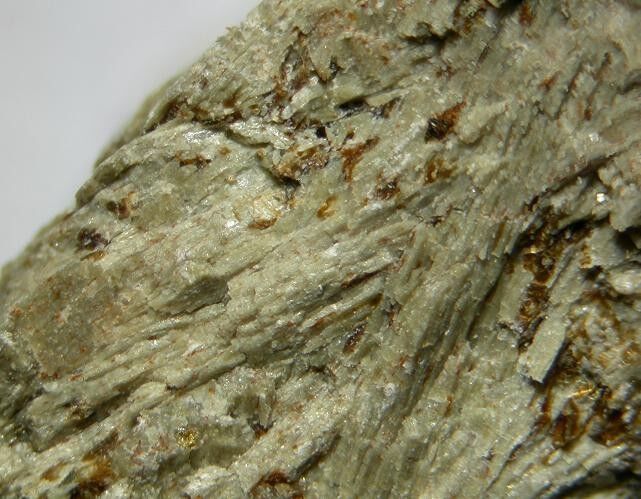
Fine-grained, occasionally as barely visible flakes.
- Type-locality form
Dense fine-grained mixtures, also thin dustings on late minerals in cavities
- Comment
Various unit cells have been proposed including hexagonal, also monoclinic
Chemical composition
- Impurities
- Ti
- Fe
- Mn
- K
Synonyms
- Corrensiet
- HLC Corrensite
- LLC Corrensite
In other languages
- German
- Corrensit
- Italian
- Corrensite
- Chinese
- 绿泥间蛭石
Classification
Strunz
10th ed.9.EC.60
- 9SilicatesClass
- 9.EPhyllosilicatesDivision
- 9.ECPhyllosilicates with mica sheets, composed of tetrahedral and octahedral netsGroup
- 9.EC.60CorrensiteSpecies
Dana
8th ed.71.04.02.05
- 71Phyllosilicates Sheets of Six-membered RingsClass
- 71.04Sheets of 6-membered rings interlayered 1:1, 2:1, and octahedraType
- 71.04.02Interstratified Chlorite-Smectite groupGroup
- 71.04.02.05CorrensiteSpecies
CIM
—16.19.23
- 16Silicates Containing Aluminum and other MetalsClass
- 16.19Aluminosilicates of Fe and MgGroup
- 16.19.23CorrensiteSpecies
Group, growth & confusion
Literature, links & citation
Citations
- 1954Lippmann, Friedrich (1954) Über einen Keuperton von Zaisersweiher bei Maulbronn. Heidelberger Beiträge zur Mineralogie und Petrographie, 4 (1-2). 130-134 doi:10.1007/bf01111150DOI: 10.1007/bf01111150
- 1960Martin Vivaldi, J. L. (1960) Corrensite and Swelling Chlorite. Clay Minerals, 4 (24) 173-181 doi:10.1180/claymin.1960.004.24.02DOI: 10.1180/claymin.1960.004.24.02
- 1961Fleischer, M. (1961) New mineral names. American Mineralogist, 46 (5-6). 765-770
- 1974Kopp, Otto C., Fallis, and Susan M. (1974) Corrensite in the Wellington Formation, Lyons, Kansas. American Mineralogist, 59 (5-6) 623-624
- 1975Furbish, William J. (1975) Corrensite of deuteric origin. American Mineralogist, 60 (9-10) 928-930
Cite this entry
Entry last updated
@misc{mineral2025,
  author    = {Mineral Index editorial board},
  title     = {Corrensite — Mineral Index},
  year      = {2025},
  url       = {https://mineralindex.org/minerals/corrensite-1135}
}