History
Late in the 18th century, copper miners at the Altyn-Tyube mine in what is now Kazakhstan thought they had found emerald. The crystals were a striking transparent green — the exact colour and clarity a Russian buyer would expect from emerald. Specimens were dispatched to Moscow for analysis.
The verdict came back unflattering. The green stone had a Mohs hardness — its resistance to scratching — of only about 5, soft enough to mark with a steel knife. Emerald sits much higher at 8. That difference alone ruled out emerald. In 1797, the French mineralogist René Just Haüy concluded the Altyn-Tyube material was an unknown species and named it dioptase.
The name comes from the Greek dia — through — and a verb meaning to see. It points to the crystal's clearest peculiarity. Its cleavage planes — the flat surfaces along which it would split if struck — are visible through the transparent body of an unbroken specimen. The viewer can see, from the outside, where the stone would prefer to break.
Industrial & practical applications
Dioptase has no industrial role. It is a copper-bearing mineral, but it occurs in quantities far too small, and in deposits far too scattered, to interest any copper smelter. What demand exists is from collectors.
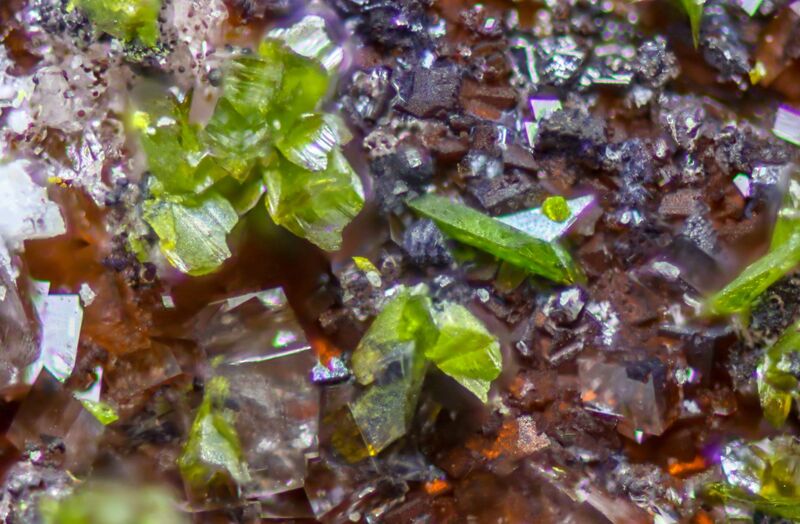
Among mineral collectors, dioptase is prized for the deep emerald-green of its crystals. The Tsumeb mine in Namibia has long been considered the source of the finest specimens. The original locality at Altyn-Tyube in Kazakhstan, several sites in Arizona, and deposits in the Republic of the Congo also feed the cabinet trade.
The mineral is occasionally cut into small emerald-like gems, but two properties hold it back from any serious place in jewellery. Its Mohs hardness of 5 — about the hardness of tooth enamel — means it scratches easily in everyday wear. Its perfect cleavage — the tendency to split along flat internal planes — runs in three directions, so a sharp knock can break the stone open. Faceted dioptase is therefore a specialist gem, kept for display rather than rings.
A more curious use is as a green pigment: pulverised crystals yield an intense colour. The powder is toxic because of its copper content, and accidental ingestion can cause serious harm. The toxicity has kept the pigment use marginal.
Where it forms, where it's found
- Geological setting
A secondary mineral in the oxidized zones of copper deposits.
In the oxidized zone of some copper deposits.
- Type locality
- Altyn-Tyube dioptase deposit (Altyn-Tube)
- Altyn-Tyube area
- Bukhar-Zhyrau District
- Karaganda Region
- Kazakhstan
49.8164°, 73.9950°
Physical
Optical
- Optical type
- Uniaxial (+)
- Refractive index
- 1.652 – 1.71
- Surface relief
- High
- Principal indices
- nω 1.652 – 1.658 · nε 1.704 – 1.71
- Pleochroism
- Weak
absorption reported as O>E; however, absorption observed as O = very pale powder blue, E = pale cyan; E>O
- UV response
- Nonfluorescent in UV.
Crystallography
- Space group
- #80
- Cell parameters
- a = 14.566 Å · c = 7.778 Å
- Z
- 18
- Morphology
Long to short prismatic [0001], dominant forms (110), and (021), (131).
- Twinning
On (101), uncommon.
Chemical composition
Synonyms
- Achirit
- Achirita
- Achirite
- Achrit
- Achrita
- Achrite
- Aschirit
- Aschirita
- Aschirite
- Ashirite
- Dioptasit
- Dioptasita
- Dioptasite
- Emerald-copper
- Emerald-malachite
- Emeraudine
- Kirghisit
- Kirghisita
- Kirghisite
- Kupfer-Smaragd
- Kupfergrün crystallisirtes
- Rhombohedral Emerald Malachite
- Smaragdo-chalcite (of Mohs)
In other languages
- French
- achirite · achrite · aschirite · CuSiO3,H2O · dioptase · dioptasite · kirghisite · rhombohedral emerald malachite · smaragdo-chalcite
- German
- Dioptas · Kieselkupfersmaragd · Kupfersmaragd
- Spanish
- Dioptasa
- Italian
- dioptasio
- Japanese
- 翠銅鉱
- Chinese
- 綠銅礦 · 青銅礦
- Simplified Chinese
- 青铜矿
- Traditional Chinese
- 青銅礦
- Russian
- диоптаз · киргизит · медный изумруд · пхирит · пширит
- Arabic
- دیوبتاز
Classification
9.CJ.30
- 9SilicatesClass
- 9.CCyclosilicatesDivision
- 9.CJ[Si6O18]12- 6-membered single rings (sechser-Einfachringe), without insular complex anionsGroup
- 9.CJ.30DioptaseSpecies
61.01.03.01
- 61Cyclosilicates Six-membered RingsClass
- 61.01Six-Membered Rings with [Si6O18] rings; possible (OH) and Al substitutionType
- 61.01.03— unnamed intermediate level —Group
- 61.01.03.01DioptaseSpecies
14.2.1
- 14Silicates not Containing AluminumClass
- 14.2Silicates of CuGroup
- 14.2.1DioptaseSpecies
Group, growth & confusion
Literature, links & citation
- —Traite de Minéralogie: III: 477.
- —Soviet Physics – Doklady: 23: 215-217.
- 1793Delamétherie, J.C. (1793) De la cristallisation d'une émeraude. Observations sur la Physique, sur l’Histoire Naturelle et sur les Arts: 42: 154-154.
- 1796Haüy, René Just (1796) Extrait du Traité Élémentaire de Minéralogie que le C.en Haüy s'occupe de rédiger. Journal des mines, 5 (28). 249-334
- 1798Haüy, C. (1798) Sur la dioptase. Bulletin des Science, par la Société Philomathique: 1798: 101-101.
Entry last updated
@misc{mineral2026,
  author    = {Mineral Index editorial board},
  title     = {Dioptase — Mineral Index},
  year      = {2026},
  url       = {https://mineralindex.org/minerals/dioptase-1295}
}