Where it forms, where it's found
- Geological setting
hyperalkaline pegmatite
- Type locality
- Kukisvumchorr Mt
- Murmansk Oblast
- Russia
67.7280°, 33.6664°
1recorded occurrences
Physical
- Hardness
- 1Talc
- 2Gypsum
- 3Calcite
- 4Fluorite
- 5Apatite
- 6Orthoclase
- 7Quartz
- 8Topaz
- 9Corundum
- 10Diamond
- Transparency
- Transparent
- Colour
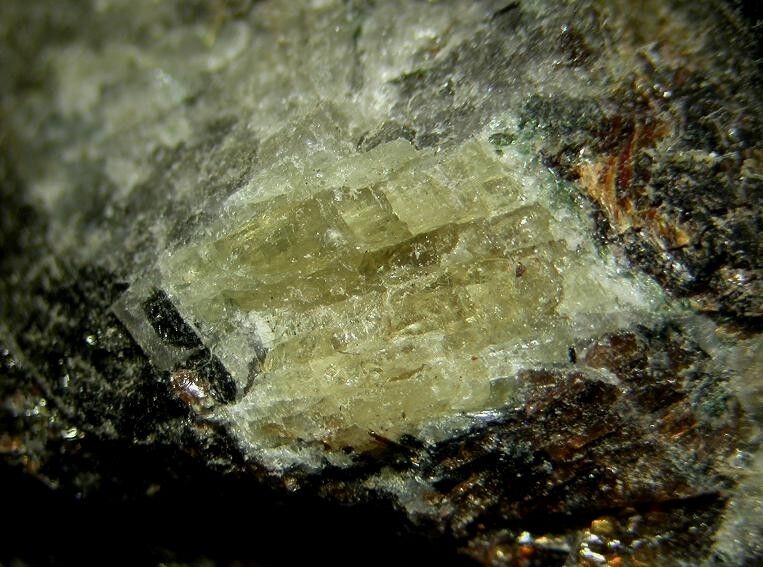
- Purple
- Streak
- White
- Tenacity
- brittle
- Cleavage
- Perfect
eminent on the pseudoprism formed by planes (100) and (20); perfect cleavage are parallel to (001).
Fracture hackly along axis b and stepped along directions a and c;
- Fracture
- Hackly · Step-Like
- Density
- 2.68 g/cm³
Optical
- Optical type
- Biaxial (+) · 2V measured = 60° · 2V calc = 63°
- Refractive index
- 1.538 – 1.549
- Surface relief
- Moderate
- Principal indices
- nα 1.538 · nβ 1.546 · nγ 1.549
- Pleochroism
- Strong
Nm is purple; Ng is lilac; and Np is amber-yellow.
- Dispersion
- medium, r > v
- UV response
- none
Δ = 0Δmax
PPLpleochroism per grain
XPLindependent extinctions · rotate the stage
PPLpleochroism only · colour blends on rotation
XPLinterference colour · extinct every 90°
Retardation110 nm
Order1st order
XPL colour
Crystallography
- Cell parameters
- a = 18.846(4) Å · b = 7.242(1) Å · c = 12.65(2) Å
- Cell angles
- β = 111.84 °
- Ratio a:b:c
- 1 : 0.384 : 0.671
- Z
- 2
- Parting
- parting is parallel to (001).
- Type-locality form
short columnar crystals up to 0.2–0.3 × 1–2 mm in size and as intergrowths of these crystals up to 2–3 mm in size
Crystal structure
Chemical composition
Synonyms
- Fluorcanasiet
- IMA2007-031
- UM2003-35-SiO:CaFHKMnNa
In other languages
- German
- Fluorcanasit · IMA 2007-031
- Italian
- fluorcanasite
Classification
Strunz
10th ed.9.DG.80
- 9SilicatesClass
- 9.DInosilicatesDivision
- 9.DGInosilicates with 3-periodic single and multiple chainsGroup
- 9.DG.80FluorcanasiteSpecies
Group, growth & confusion
Literature, links & citation
Citations
- 2009Khomyakov A P, Nechelyustov G N, Krivokoneva G K, Rastsvetaeva R K, Rozenberg K A, Rozhdestvenskay I V (2009) Fluorcanasite, K3Na3Ca5Si12O30(F,OH)4·H2O - a new mineral from Khibiny Alkaline Massif (Kola Peninsula, Russia) and new data on canasite. Zapiski Rossiiskogo Mineralogicheskogo Obshchetstva 138, issue 2, 52-66
- 2009Khomyakov A P, Nechelyustov G N, Krivokoneva G K, Rastsvetaeva R K, Rozenberg K A, Rozhdestvenskaya I V (2009) Fluorcanasite, K3Na3Ca5Si12O30(F,OH)4·H2O, a new mineral species from the Khibiny Alkaline Pluton, Kola Peninsula, Russian, and new data on canasite. Geology of Ore Deposits 51, 757-76
- 2022(2022) Fluorcanasite. Handbook of Mineralogy. Mineralogical Society of America
Cite this entry
Entry last updated
@misc{mineral2025,
  author    = {Mineral Index editorial board},
  title     = {Fluorcanasite — Mineral Index},
  year      = {2025},
  url       = {https://mineralindex.org/minerals/fluorcanasite-32288}
}