Where it forms, where it's found
- Geological setting
Apparently secondary in origin and most likely formed from the breakdown of primary nickeline under dry (low relative humidity, RH) and oxidizing (high oxygen fugacity) conditions.
- Type locality
- Johanngeorgenstadt
- Erzgebirgskreis
- Saxony
- Germany
50.4358°, 12.7069°
1recorded occurrences
Safety & handling
Physical
Optical
- Optical type
- Biaxial (-) · 2V measured = 78° · 2V calc = 77.3°
- Refractive index
- 1.83 – 1.88
- Surface relief
- Very high
- Principal indices
- nα 1.83 · nβ 1.86 · nγ 1.88
- Pleochroism
- Strong
X violet, Y light olive, Z yellow; X>Y>Z
- Dispersion
- Could not be observed
- UV response
- None observed
- Notes
Optical orientation could not be determined
Δ = 0Δmax
PPLpleochroism per grain
XPLindependent extinctions · rotate the stage
PPLpleochroism only · colour blends on rotation
XPLinterference colour · extinct every 90°
Retardation500 nm
Order1st order
XPL colour
Crystallography
- Space group
- C2/c
- Cell parameters
- a = 11.993(3) Å · b = 12.753(3) Å · c = 6.696(2) Å
- Cell angles
- β = 113.302(8) °
- Ratio a:b:c
- 1 : 1.063 : 0.558
- Unit cell volume
- 935.9 ų
- Z
- 4
- Morphology
No discernible forms.
- Twinning
None observed
- Type-locality form
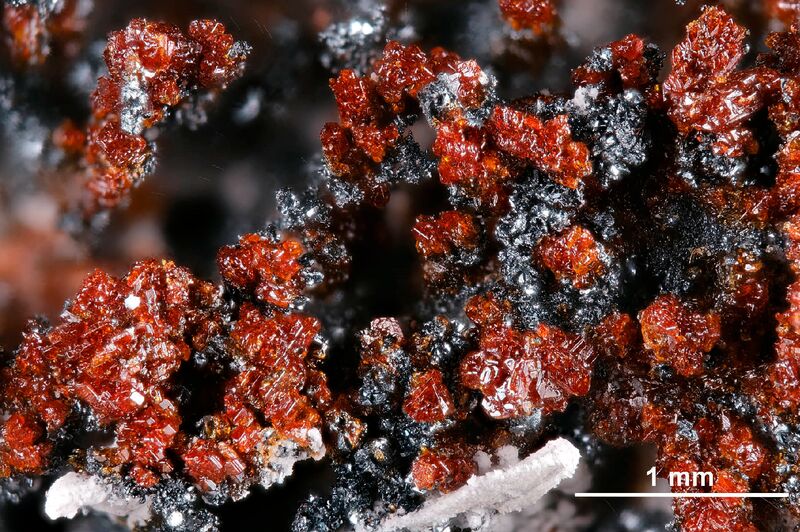
Sugary aggregates of pink-orange irregular, rounded grains or short prisms that are about 70 µm in diameter
Chemical composition
Synonyms
- Johanngeorgenstadtiet
In other languages
- German
- IMA 2019-122 · Johanngeorgenstadtit
Classification
Strunz
10th ed.8.AB
- 8Phosphates, Arsenates, VanadatesClass
- 8.APhosphates, etc. without additional anions, without H2ODivision
- 8.ABWith medium-sized cationsGroup
- 8.ABJohanngeorgenstadtiteSpecies
Group, growth & confusion
Literature, links & citation
Citations
- 2020Miyawaki, Ritsuro, Hatert, Frédéric, Pasero, Marco, Mills, Stuart J. (2020) IMA Commission on New Minerals, Nomenclature and Classification (CNMNC) - Newsletter 54. European Journal of Mineralogy, 32 (2) 275-283 doi:10.5194/ejm-32-275-2020 DOI: 10.5194/ejm-32-275-2020
- 2020Kampf, Anthony R., Nash, Barbara P., Plášil, Jakub, Smith, Jason B., Feinglos, Mark N. (2020) Niasite and johanngeorgenstadtite, Ni2+4.5(AsO4)3 dimorphs from Johanngeorgenstadt, Germany. European Journal of Mineralogy, 32 (3) 373-385 doi:10.5194/ejm-32-373-2020 DOI: 10.5194/ejm-32-373-2020
- 2022(2022) Johanngeorgenstadtite. Handbook of Mineralogy. Mineralogical Society of America
Cite this entry
Entry last updated
@misc{mineral2025,
  author    = {Mineral Index editorial board},
  title     = {Johanngeorgenstadtite — Mineral Index},
  year      = {2025},
  url       = {https://mineralindex.org/minerals/johanngeorgenstadtite-54364}
}