Where it forms, where it's found
- Type locality
- Shinkolobwe Mine
- Shinkolobwe
- Kambove Territory
- Haut-Katanga
- DR Congo
-11.0486°, 26.5508°
26recorded occurrences
Radioactivity
Physical
- Transparency
- Transparent
- Colour
- Red-orange · orange · brownish orange.
- Cleavage
- Perfect
(001), perfect; (010), good.
- Density
- 5.08 g/cm³
Optical
- Optical type
- Biaxial (-) · 2V measured = 40 – 50° · 2V calc = 44°
- Refractive index
- 1.785 – 1.917
- Surface relief
- Very high
- Principal indices
- nα 1.785 · nβ 1.895 – 1.906 · nγ 1.915 – 1.917
- Pleochroism
- Weak
X = pale yellow; Y = Z = deep golden yellow
- Dispersion
- extreme
Δ = 0Δmax
PPLpleochroism per grain
XPLindependent extinctions · rotate the stage
PPLpleochroism only · colour blends on rotation
XPLinterference colour · extinct every 90°
Retardation1310 nm
Order3rd order
XPL colour
Crystallography
- Cell parameters
- a = 13.98(10) Å · b = 12.17(27) Å · c = 14.56(36) Å
- Ratio a:b:c
- 1 : 0.871 : 1.041
- Z
- 2
- Twinning
Very common on (110) or (10) as twin and composition planes, contact and repeated, individuals with parallel to (001).
- Type-locality form
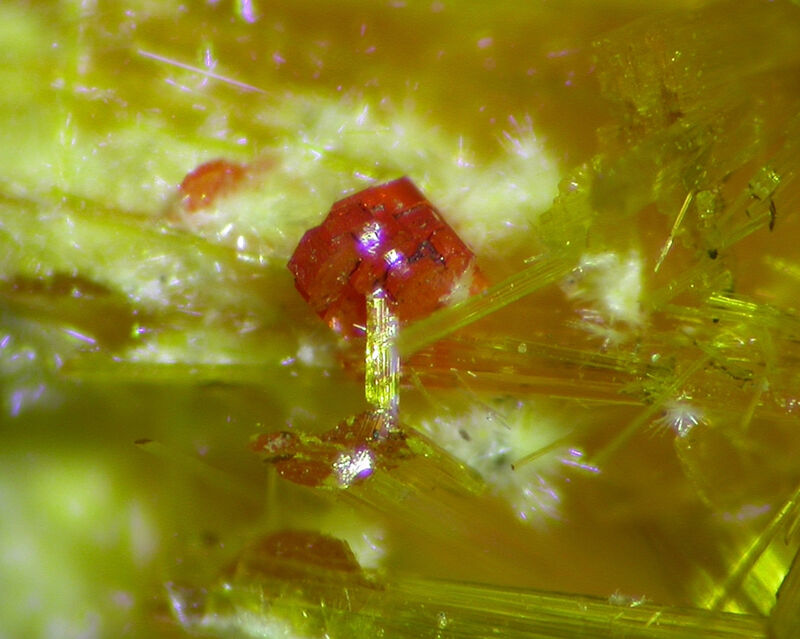
Small (0.1 mm), pseudo-hexagonal, orange-red scales.
- Comment
Space Group: P cna, probable, pseudocell.
Crystal structure
Chemical composition
Synonyms
- Masuyiet
In other languages
- German
- Masuyit
- Spanish
- Masuyita
- Italian
- Masuyite
- Arabic
- ماسوييت
Classification
Strunz
10th ed.4.GB.35
- 4OxidesClass
- 4.GUranyl HydroxidesDivision
- 4.GBWith additional cations (K, Ca, Ba, Pb, etc.); with mainly UO2(O,OH)5 pentagonal polyhedraGroup
- 4.GB.35MasuyiteSpecies
Dana
8th ed.05.02.02.01
- 05Oxides Containing Uranium or ThoriumClass
- 05.02AXO3·xH2OType
- 05.02.02— unnamed intermediate level —Group
- 05.02.02.01MasuyiteSpecies
CIM
—7.16.27
- 7Oxides and HydroxidesClass
- 7.16Oxides of UGroup
- 7.16.27MasuyiteSpecies
Group, growth & confusion
Literature, links & citation
Citations
- —www.mindat.org (n.d.) https://www.mindat.org/mesg-7-446504.html
- 1947Vaes, J.F. (1947) Six nouveaux minéraux d'urane provenant de Shinkolobwe (Katanga). Annales de la Société Géologique Belge: 70: B212-B229.
- 1948Fleischer, M. (1948) New mineral names. American Mineralogist, 33 (5-6). 384-386
- 1996Deliens, M., Piret, P. (1996) Les masuyites de Shinkolobwe constituent un groupe formé par deux variétés distinctes par leur composition chimique et leurs propriétés radiocristallographiques. Bulletin de l'Institut Royal des Sciences Naturelles de Belgique: 66: 187-192. (in French)
- 1999Burns, P. C., Hanchar, J. M. (1999) The structure of masuyite, Pb[(UO2)3O3(OH)2](H2O)3, and its relationship to protasite. The Canadian Mineralogist, 37 (6) 1483-1491
Cite this entry
Entry last updated
@misc{mineral2025,
  author    = {Mineral Index editorial board},
  title     = {Masuyite — Mineral Index},
  year      = {2025},
  url       = {https://mineralindex.org/minerals/masuyite-2589}
}