Where it forms, where it's found
- Geological setting
Quartz vein, near contact with fine-grained topaz-quartz greisen.
Molybdite is commonly found in fumerolitic conditions such as mine dump fires or volcanic fumeroles. Sometimes found as secondary alterations of molydenum-bearing ores. Occurrences of hydrothermal origin are scarce.
- Type locality
- Quartz vein outcrops
- Knöttel area
- Krupka
- Teplice District
- Ústí nad Labem Region
- Czech Republic
148recorded occurrences
Physical
Optical
- Optical type
- Biaxial (+)
- Birefringence
- very high (Čech 1964)
- Pleochroism
- Non-pleochroic
- Extinction
- parallel (Čech 1964)
- UV response
- Not fluorescent in UV
Crystallography
- Space group
- #62
- Cell parameters
- a = 3.96 Å · b = 13.85 Å · c = 3.69 Å
- Ratio a:b:c
- 1 : 3.497 : 0.932
- Z
- 1
- Morphology
Platy to very elongated crystals
- Type-locality form
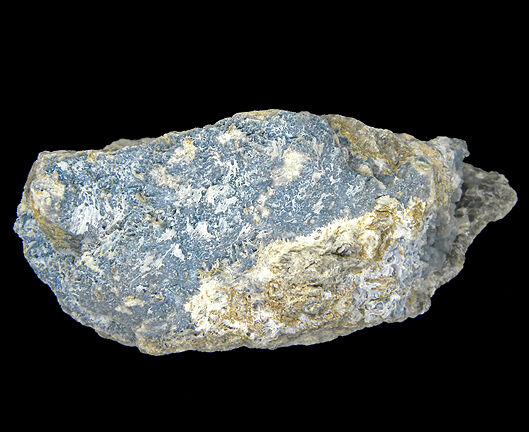
greenish-yellow to colorless flat needles or thin plates
- Comment
Pbnm
Crystal structure
Chemical composition
Synonyms
- Acide molybdique
In other languages
- German
- Molybdit
- Spanish
- Molibdita
- Italian
- molybdite
- Portuguese
- molibdita
- Russian
- Молибдит
- Arabic
- موليبديت
Classification
Strunz
10th ed.4.E0.10
- 4OxidesClass
- 4.EMetal: Oxygen = < 1 :2Division
- 4.E0— unnamed intermediate level —Group
- 4.E0.10MolybditeSpecies
Dana
8th ed.04.05.01.01
- 04Simple OxidesClass
- 04.05AX3Type
- 04.05.01— unnamed intermediate level —Group
- 04.05.01.01MolybditeSpecies
CIM
—7.15.2
- 7Oxides and HydroxidesClass
- 7.15Oxides of Mo and WGroup
- 7.15.2MolybditeSpecies
Group, growth & confusion
Literature, links & citation
Citations
- 1858Greg, Robert Philips, Lettsom, William G. (1858) Manual of the Mineralogy of Great Britain and Ireland. John Van Voorst, London.
- 1907Schaller, W.T. (1907) Chemical Composition of Molybdic Ocher. American Journal of Science: 23: 297-303.
- 1963Kihlborg, L. (1963) Least squares refinement of the crystal structure of molybdenum trioxide. Arkiv för Kemi: 21: 357-364.
- 1963Čech, F., Povondra, P. (1963) Natural occurrence of molybdenum trioxide, MoO3, in Krupka (Molybdite, a new mineral). Acta Universitatis Carolinae - Geologica: 1: 1-14.
- 1964Fleischer, M. (1964) New Mineral Names. American Mineralogist, 49 (9-10) 1497-1502
Cite this entry
Entry last updated
@misc{mineral2025,
  author    = {Mineral Index editorial board},
  title     = {Molybdite — Mineral Index},
  year      = {2025},
  url       = {https://mineralindex.org/minerals/molybdite-2748}
}