Where it forms, where it's found
- Geological setting
Intimately intergrown with trébeurdenite, was discovered in intertidal gleys from Mont Saint-Michel Bay, France.
- Type locality
- Mont Saint-Michel marshes
- Le Mont-Saint-Michel
- Avranches
- Manche
- Normandy
- France
48.6224°, -1.5199°
8recorded occurrences
Physical
Crystallography
- Cell parameters
- a = 3.032(7) Å · b = 3.079 Å · c = 22.258(4) Å
- Ratio a:b:c
- 1 : 1.016 : 7.341
- Type-locality form
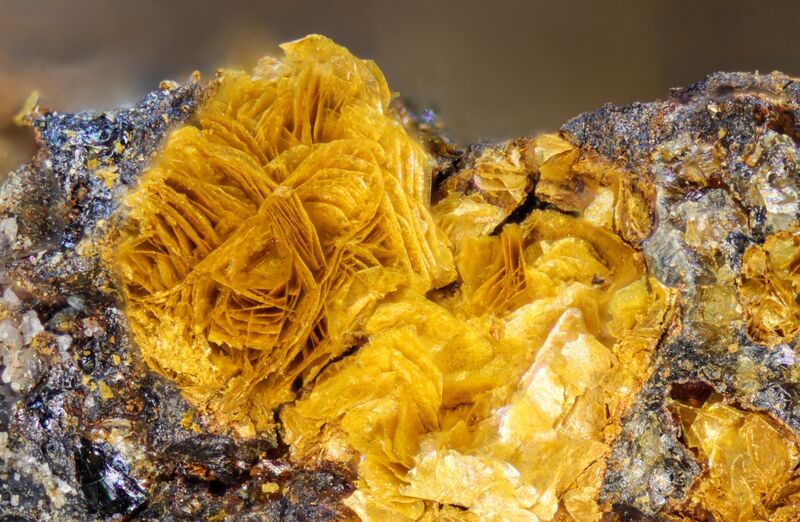
As μm-scale platelets in gleys with restricted access to atmospheric O.
- Comment
Possible space group: P3İm1 and P3m1
Chemical composition
Synonyms
- IMA2012-049
- Moessbauerite
- Mössbaueriet
In other languages
- German
- IMA 2012-049 · Mössbauerit
- Italian
- mössbauerite
Classification
Strunz
10th ed.4.FL.05
- 4OxidesClass
- 4.FHydroxides (without V or U)Division
- 4.FLHydroxides with H2O +- (OH); sheets of edge-sharing octahedraGroup
- 4.FL.05MössbaueriteSpecies
Group, growth & confusion
Literature, links & citation
Citations
- 2012Génin, Jean-Marie R.; Guérin, O.; Herbillon, A. J.; Kuzmann, E.; Mills, S. J.; Morin, G.; Ona-Nguema, G.; Ruby, C.; Upadhyay, C. (2012) Redox topotactic reactions in Fe II − III (oxy)hydroxycarbonate new minerals related to fougèrite in gleysols: “trébeurdenite and mössbauerite”. Hyperfine Interactions, 204 (1-3). 71-81 doi:10.1007/s10751-011-0500-8DOI: 10.1007/s10751-011-0500-8
- 2012Mills, S. J.; Christy, A. G.; Génin, J.-M. R.; Kameda, T.; Colombo, F. (2012) Nomenclature of the hydrotalcite supergroup: natural layered double hydroxides. Mineralogical Magazine, 76 (5). 1289-1336 doi:10.1180/minmag.2012.076.5.10DOI: 10.1180/minmag.2012.076.5.10
- 2013Génin, J.-M.R. (2013) From fougèrite to mössbauerite through trébeurdenite; redox reactions in gleysols and role of bacteria. Mössbauer Effect Reference Data Journal: 36(6): 113-160.
- 2013Williams, P. A., Hatert, F., Pasero, M., Mills, S. J. (2013) IMA Commission on New Minerals, Nomenclature and Classification. CNMNC Newsletter No. 15. Mineralogical Magazine, 77 (1) 1-12 doi:10.1180/minmag.2013.077.1.01DOI: 10.1180/minmag.2013.077.1.01
- 2014Génin, J.-M. R., Mills, S. J., Christy, A. G., Guérin, O., Herbillon, A. J., Kuzmann, E., Ona-Nguema, G., Ruby, C., Upadhyay, C. (2014) Mössbauerite, Fe63+O4(OH)8[CO3]·3H2O, the fully oxidized ‘green rust’ mineral from Mont Saint-Michel Bay, France. Mineralogical Magazine, 78 (2) 447-465 doi:10.1180/minmag.2014.078.2.14 DOI: 10.1180/minmag.2014.078.2.14
Cite this entry
Entry last updated
@misc{mineral2026,
  author    = {Mineral Index editorial board},
  title     = {Mössbauerite — Mineral Index},
  year      = {2026},
  url       = {https://mineralindex.org/minerals/mossbauerite-43298}
}