Where it forms, where it's found
- Geological setting
In fissure fillings in tephroite skarn at the Harstigen mine.
- Type locality
- Harstigen Mine
- Pajsberg
- Persberg ore district
- Filipstad
- Värmland County
- Sweden
59.7853°, 14.3139°
89recorded occurrences
Safety & handling
Physical
Optical
- Optical type
- Isotropic
- Surface relief
- Very high
- Principal indices
- n 2.061
- Tropism
- Isotropic
- Notes
calculated refractive index of 2.061
PPL intrinsic colour; no change on stage rotation
XPL extinct at every orientation
- Single index
- n = 2.061
Crystallography
- Space group
- #222
- Cell parameters
- a = 10.3783(6) Å
- Unit cell volume
- 1117.84 ų
- Z
- 8
- Morphology
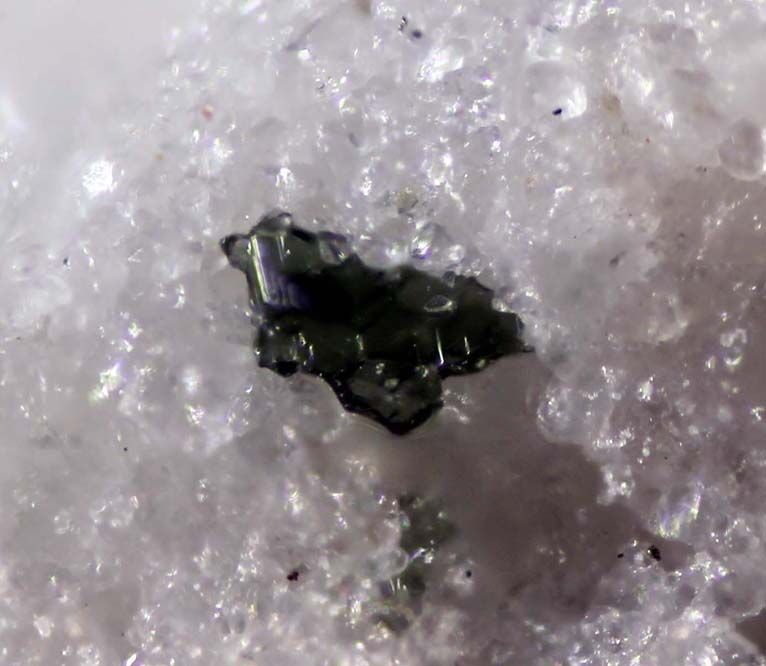
Rounded grains; imperfect octahedra.
- Type-locality form
Yellow to brownish yellow rounded grains or imperfect octahedra < 0.4 mm
Crystal structure
Chemical composition
- Impurities
- Ca
- Fe(III)
- Mn
- Na
Synonyms
- IMA2013-042
- Oxyplumboroméiet
In other languages
- German
- Bindheimit · IMA 2013-042 · Monimolit · Oxyplumboroméit
- Spanish
- Oxiplumboromeíta
- Italian
- ossiplumboroméite
Classification
Strunz
10th ed.4.DH
- 4OxidesClass
- 4.DMetal: Oxygen = 1:2 and similarDivision
- 4.DHWith large (+- medium-sized) cations; sheets of edge-sharing octahedraGroup
- 4.DHOxyplumboroméiteSpecies
Group, growth & confusion
Literature, links & citation
Citations
- 2005Christy, A. G., Gatedal, K. (2005) Extremely Pb-rich rock-forming silicates including a beryllian scapolite and associated minerals in a skarn from Långban, Värmland, Sweden. Mineralogical Magazine, 69 (6) 995-1018 doi:10.1180/0026461056960304DOI: 10.1180/0026461056960304
- 2010Atencio, D., Andrade, M. B., Christy, A. G., Giere, R., Kartashov, P. M. (2010) The pyrochlore supergroup of minerals: nomenclature. The Canadian Mineralogist, 48 (3) 673-698 doi:10.3749/canmin.48.3.673 DOI: 10.3749/canmin.48.3.673
- 2013Christy, A. G., Atencio, D. (2013) Clarification of status of species in the pyrochlore supergroup. Mineralogical Magazine, 77 (1) 13-20 doi:10.1180/minmag.2013.077.1.02 DOI: 10.1180/minmag.2013.077.1.02
- 2013Hålenius, U., Bosi, F. (2013) Oxyplumboroméite, Pb2Sb2O7, a new mineral species of the pyrochlore supergroup from Harstigen mine, Värmland, Sweden. Mineralogical Magazine, 77 (7) 2931-2939 doi:10.1180/minmag.2013.077.7.04DOI: 10.1180/minmag.2013.077.7.04
- 2013Williams, P. A., Hatert, F., Pasero, M., Mills, S. J. (2013) New minerals and nomenclature modifications approved in 2013. CNMNC Newsletter No.17. Mineralogical Magazine, 77 (7) 2997-3005 doi:10.1180/minmag.2013.077.7.09DOI: 10.1180/minmag.2013.077.7.09
Cite this entry
Entry last updated
@misc{mineral2025,
  author    = {Mineral Index editorial board},
  title     = {Oxyplumboroméite — Mineral Index},
  year      = {2025},
  url       = {https://mineralindex.org/minerals/oxyplumboromeite-43911}
}