Where it forms, where it's found
- Geological setting
volcanic sublimate at Vesuvius volcano on 1944 eruption lava scoria. Parascandolaite formed by reaction of the fumarolic gases containing hydrofluoric acid with the K-rich host rock.
Microinclusions in diamond
- Type locality
- Mount Vesuvius
- Metropolitan City of Naples
- Campania
- Italy
5recorded occurrences
Physical
- Transparency
- Transparent
- Colour
- Colourless · white
- Cleavage
- Perfect
on (100)
- Density
- 3.11 g/cm³
Optical
- Optical type
- Isotropic
- Principal indices
- n 1.395
- UV response
- No fluorescence was observed under either short- or long-wave ultraviolet radiation.
PPL intrinsic colour; no change on stage rotation
XPL extinct at every orientation
- Single index
- n = 1.395
Crystallography
- Space group
- Pm-3m
- Cell parameters
- a = 4.0032(9) Å
- Unit cell volume
- 64.14 ų
- Z
- 1
- Morphology
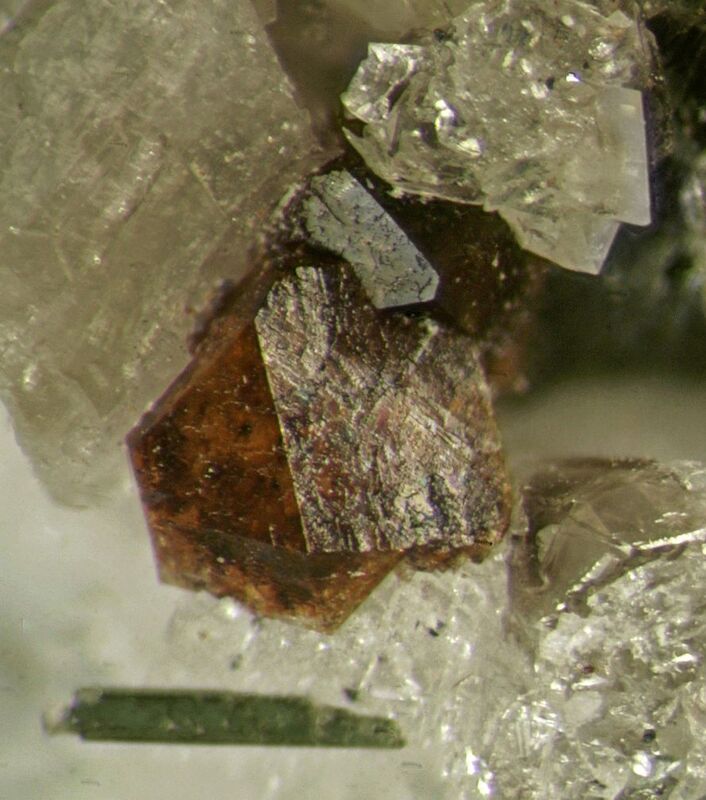
Cubic crystals.
- Twinning
No twinning was observed.
- Type-locality form
cubic crystals up to 0.5 mm in length
Chemical composition
Synonyms
- IMA2013-092
- Parascandolaiet
In other languages
- German
- IMA 2013-092 · Parascandolait
- Italian
- parascandolaite
Classification
Strunz
10th ed.3.AA.35
- 3HalidesClass
- 3.ASimple halides, without H2ODivision
- 3.AAM:X = 1:1, 2:3, 3:5, etc.Group
- 3.AA.35ParascandolaiteSpecies
Group, growth & confusion
Literature, links & citation
Citations
- 1975Alcala, R., Koumvakalis, N., Sibley, W. A. (1975) The self-trapped hole and thermoluminescence in KMgF3. physica status solidi (a), 30 (2). 449-456 doi:10.1002/pssa.2210300203DOI: 10.1002/pssa.2210300203
- 1979Jones, Leonie E. A. (1979) Pressure and temperature dependence of the single crystal elastic moduli of the cubic perovskite KMgF3. Physics and Chemistry of Minerals, 4 (1) 23-42 doi:10.1007/bf00308357DOI: 10.1007/bf00308357
- 1996Komar, V.K., Gektin, A.V., Ivanov, N.P., Nesterenko, Y.A., Shiran, N.V. (1996) Growth and study of properties of pure and rare-earth-doped KMgF3 crystals. Journal of Crystal Growth, 166 (1). 419-422 doi:10.1016/0022-0248(96)00095-4DOI: 10.1016/0022-0248(96)00095-4
- 2001Lal, Banwari, Bamzai, K.K, Kotru, P.N (2001) Topographic and etching investigations on melt grown doped KMgF3 crystals. Materials Chemistry and Physics, 69. 99-112 doi:10.1016/s0254-0584(00)00360-6DOI: 10.1016/s0254-0584(00)00360-6
- 2003Lal, Banwari, Bamzai, K.K, Kotru, P.N (2003) Mechanical characteristics of melt grown doped KMgF3 crystals. Materials Chemistry and Physics, 78. 202-207 doi:10.1016/s0254-0584(02)00342-5DOI: 10.1016/s0254-0584(02)00342-5
Cite this entry
Entry last updated
@misc{mineral2025,
  author    = {Mineral Index editorial board},
  title     = {Parascandolaite — Mineral Index},
  year      = {2025},
  url       = {https://mineralindex.org/minerals/parascandolaite-45939}
}