Where it forms, where it's found
- Geological setting
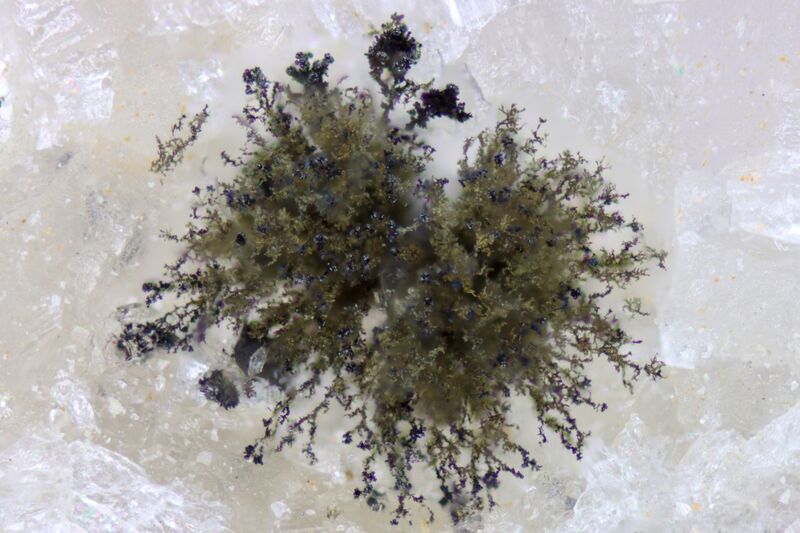
Selective replacement of small (~0.5 mm diameter) spheroidal quartz aggregates, feldspar grains, fractured quartz grains and carbonate cement within sandstones and quartzites of a redbed formation, a marginal continental, shallow water sequence.
- Type locality
- Spionkop Creek
- Yarrow Creek-Spionkop Creek deposit
- Pincher Creek
- Alberta
- Canada
49.2345°, -114.0509°
92recorded occurrences
Physical
- Hardness
- 1Talc
- 2Gypsum
- 3Calcite
- 4Fluorite
- 5Apatite
- 6Orthoclase
- 7Quartz
- 8Topaz
- 9Corundum
- 10Diamond
- Transparency
- Opaque
- Colour
- Blue
- Tenacity
- brittle
- Density
- 5.13 g/cm³
Optical
- Anisotropism
- Orange
- Tropism
- Anisotropic
- Reflectance R%
- (26.1,33.4,13.1,19.9) 400, (25.8,32.9,12.5,19.3) 420, (25.1,32.3,11.7,18.6) 440, (24.2,31.45,10.6,17.4) 460, (23.6,31.0,10.0,16.8) 470, (23.0,30.5,9.46,16.2) 480, (21.8,29.5,8.32,15.1) 500, (20.5,28.5,7.38,14.1) 520, (19.0,27.4,6.39,13.0) 540, (18.6,27.1,6.10,12.3) 546, (17.6,26.4,5.49,12.1) 560, (16.3,25.4,4.64,11.3) 580, (15.6,24.9,4.27,10.9) 589, (14.9,24.45,3.86,10.6) 600, (13.6,23.8,3.21,10.1) 620, (12.4,23.8,2.63,10.2) 640, (11.8,24.05,2.37,10.3) 650, (11.2,24.3,2.12,10.6) 660, (10.0,24.55,1.75,10.7) 680, (9.06,24.3,1.55,10.5) 700
- UV response
- Not fluorescent in UV
- Notes
Distinguished from yarrowite because yarrowite is a darker shade of blue and is more strongly bireflectant and anisotropic.
Crystallography
- Cell parameters
- a = 22.962 Å · c = 41.429 Å
- Z
- 18
- Comment
Possible space group is <i>P</i>-3<i>m</i>1.
Chemical composition
- Impurities
- Fe
- Zn
Synonyms
- IMA1978-023
- Spionkopiet
In other languages
- German
- IMA 1978-023 · Spionkopit
- Italian
- Spionkopite
Classification
Strunz
10th ed.2.CA.05c
- 2Sulfides and SulfosaltsClass
- 2.CMetal Sulfides, M: S = 1: 1 (and similar)Division
- 2.CAWith CuGroup
- 2.CA.05cSpionkopiteSpecies
Dana
8th ed.02.04.07.07
- 02SulfidesClass
- 02.04AmBnXp, with (m+n):p = 2:1Type
- 02.04.07Chalcocite Group ([Cu]2-x S] formulae)Group
- 02.04.07.07SpionkopiteSpecies
CIM
—3.1.6
- 3Sulphides, Selenides, Tellurides, Arsenides and Bismuthides (except the arsenides, antimonides and bismuthides of Cu, Ag and Au, which are included in Section 1)Class
- 3.1Sulphides etc. of CuGroup
- 3.1.6SpionkopiteSpecies
Group, growth & confusion
Literature, links & citation
Citations
- 1980Goble, R.J. (1980) Copper sulfides from Alberta: Yarrowite Cu9S8 and Spionkopite Cu39S28. The Canadian Mineralogist, 18, 511-518. https://rruff.info/rruff_1.0/uploads/CM18_511.pdf
- 1981Fleischer, Michael, Cabri, Louis J. (1981) New Mineral Names. American Mineralogist, 66 (11-12) 1274-1280
- 1985Goble, R.J. (1985) The relationship between crystal structure, bonding and cell dimensions in the copper sulfides. The Canadian Mineralogist: 23: 61-76. https://rruff.info/rruff_1.0/uploads/CM23_61.pdf
- 1986Whiteside, L.S., Goble, R.J. (1986) Structural and compositional changes in copper sulfides during leaching and dissolution. The Canadian Mineralogist: 24: 247-258. https://rruff.info/rruff_1.0/uploads/CM24_247.pdf
- 1993Criddle, A. J., Stanley, C. J. (1993) Data file. In Quantitative Data File for Ore Minerals. Springer Netherlands. p.1-635. doi:10.1007/978-94-011-1486-8_1DOI: 10.1007/978-94-011-1486-8_1
Cite this entry
Entry last updated
@misc{mineral2025,
  author    = {Mineral Index editorial board},
  title     = {Spionkopite — Mineral Index},
  year      = {2025},
  url       = {https://mineralindex.org/minerals/spionkopite-3730}
}