Where it forms, where it's found
- Geological setting
Epithermal deposit.
- Type locality
- Layo deposit
- Chachas District
- Castilla Province
- Arequipa
- Peru
-15.1878°, -72.2417°
18recorded occurrences
Safety & handling
Physical
Optical
- Optical colour
- Grey with bluish shade
- Tropism
- Isotropic
- Reflectance R%
- (30.7) 400, (30.4) 420, (30.0) 440, (29.3) 460, (29.1) 470, (28.9) 480, (28.7) 500, (28.6) 520, (28.4) 540, (28.4) 546, (28.2) 560, (27.7) 580, (27.4) 589, (27.0) 600, (26.2) 620, (25.4) 640, (25.0) 650, (24.6) 660, (23.9) 680, (23.4) 700
Reflected-light panel
R̄ 27.6 %isotropic · single curve
Specimen
White reference
Crystallography
- Space group
- I-4 3m
- Cell parameters
- a = 10.1710(10) Å
- Z
- 2
- Type-locality form
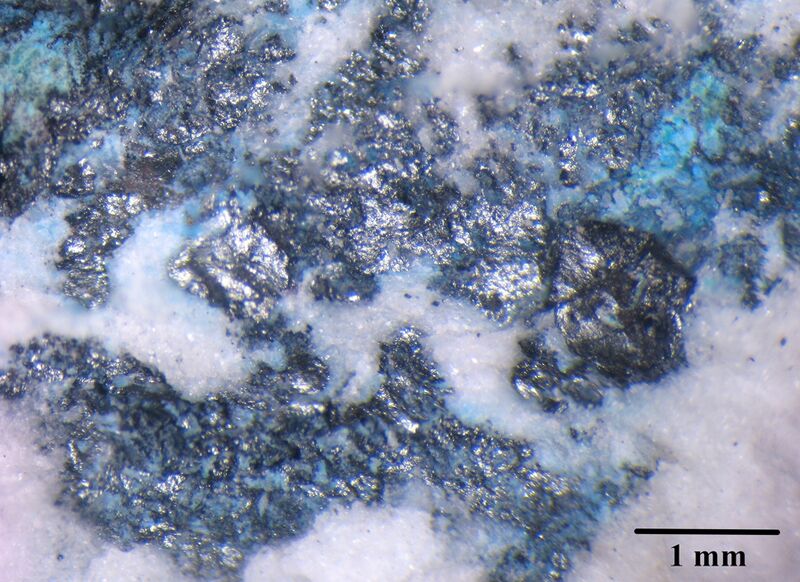
Anhedral grains, up to 0.1 mm across.
- Comment
For natural "copper-rich unsubstituted tennantite, Cu12.5As4S13", from Argentina, Makovicky et al. (2005) give a = 10.1756 Å.
Chemical composition
Synonyms
- "Cu-excess" tennantite
- IMA2020-096
- Tennantiet-(Cu)
In other languages
- German
- IMA 2020-096 · Tennantit-(Cu)
- Italian
- Tennantite- · Tennantite-(Cu)
Classification
Strunz
10th ed.2.GB
- 2Sulfides and SulfosaltsClass
- 2.GSulfarsenites, sulfantimonites, sulfbismuthitesDivision
- 2.GBNeso-sulfarsenites, etc. with additional SGroup
- 2.GBTennantite-(Cu)Species
Group, growth & confusion
Literature, links & citation
Citations
- 1985Cesbron, Fabien, Giraud, Roger, Picot, Paul, Pillard, François (1985) La vinciennite, Cu10Fe4Sn(As,Sb)S16, une nouvelle espèce minérale. Etude paragénétique du gîte type de Chizeuil, Saône-et-Loire. Bulletin de Minéralogie, 108 (3) 447-456 doi:10.3406/bulmi.1985.7841DOI: 10.3406/bulmi.1985.7841
- 1994Marcoux, E., Milési, J. P., Moëlo, Y. (1994) Vinciennite and Cu-excess tennantite from the Layo (Cu, Sn, As, Au) epithermal deposit (Southern Peru) Mineralogy and Petrology, 51 (1) 21-36 doi:10.1007/bf01164912DOI: 10.1007/bf01164912
- 2005Makovicky, E., Karanović, L., Poleti, D., Balić-Zunić, T., Paar, W. H. (2005) Crystal structure of copper-rich unsubstituted tennantite, Cu12.5As4S13. The Canadian Mineralogist, 43 (2) 679-688 doi:10.2113/gscanmin.43.2.679 DOI: 10.2113/gscanmin.43.2.679
- 2005Di Benedetto, F., Bernardini, G. P., Cipriani, C., Emiliani, C., Gatteschi, D., Romanelli, M. (2005) The distribution of Cu(II) and the magnetic properties of the synthetic analogue of tetrahedrite: Cu12Sb4S13. Physics and Chemistry of Minerals, 32 (3) 155-164 doi:10.1007/s00269-005-0449-8DOI: 10.1007/s00269-005-0449-8
- 2012Catchpole, H., Kouzmanov, K., Fontboté, L. (2012) Copper-excess stannoidite and tennantite-tetrahedrite as proxies for hydrothermal fluid evolution in a zoned Cordillerian base metal district, Morococha, Central Peru. The Canadian Mineralogist, 50 (3). 719-743 doi:10.3749/canmin.50.3.719DOI: 10.3749/canmin.50.3.719
Cite this entry
Entry last updated
@misc{mineral2026,
  author    = {Mineral Index editorial board},
  title     = {Tennantite-(Cu) — Mineral Index},
  year      = {2026},
  url       = {https://mineralindex.org/minerals/tennantite-cu-55386}
}