Where it forms, where it's found
- Geological setting
Oxidation zone of siderite-rich ore.
- Type locality
- Karasug REE-Sr-Ba-Fe-fluorite deposit
- Chaa-Kholsky District
- Tuva
- Russia
51.3200°, 92.1000°
1recorded occurrences
Physical
Optical
- Optical type
- Biaxial (-) · 2V measured = 70° · 2V calc = 70°
- Refractive index
- 1.452 – 1.458
- Principal indices
- nα 1.452 · nβ 1.456 · nγ 1.458
- Dispersion
- r > v distinct
Δ = 0Δmax
PPLpleochroism per grain
XPLindependent extinctions · rotate the stage
PPLpleochroism only · colour blends on rotation
XPLinterference colour · extinct every 90°
Retardation60 nm
Order1st order
XPL colour
Crystallography
- Space group
- P21/c
- Cell parameters
- a = 8.73 Å · b = 10.62 Å · c = 5.02 Å
- Cell angles
- β = 102.72 °
- Ratio a:b:c
- 1 : 1.216 : 0.575
- Morphology
Prisms (100) and (001).
- Type-locality form
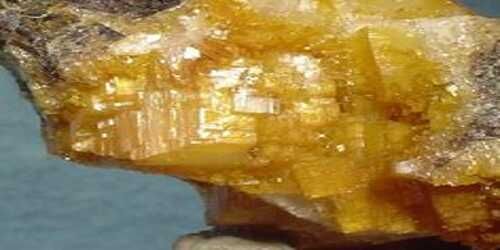
Occurs as small crystals, up to 5 mm in diameter.
Crystal structure
Chemical composition
Synonyms
- Tikhonenkoviet
In other languages
- German
- Tikhonenkovit
- Italian
- Tikhonenkovite
- Chinese
- 水氟铝锶石
Classification
Strunz
10th ed.3.CC.10
- 3HalidesClass
- 3.CComplex halidesDivision
- 3.CCSoro-aluminofluoridesGroup
- 3.CC.10TikhonenkoviteSpecies
Dana
8th ed.11.06.16.01
- 11Halide ComplexesClass
- 11.06Aluminofluorides - Isolated OctahedraType
- 11.06.16— unnamed intermediate level —Group
- 11.06.16.01TikhonenkoviteSpecies
CIM
—8.4.14
- 8Halides - Fluorides, Chlorides, Bromides and Iodides; also Fluoborates and FluosilicatesClass
- 8.4Halides of the alkaline earths and MgGroup
- 8.4.14TikhonenkoviteSpecies
Group, growth & confusion
Literature, links & citation
Citations
- 1964Khomyakov, A.P., Stepanov, V.I., Moleva, V.A. and Pudovkina, Z.V. (1964) The new mineral tikhonenkovite, SrAlF4(OH)•H2O. Doklady Akademii Nauk USSR: 156: 345-347.
- 1964Khomyakov, A.P., Stepanov, V.I., Moleva, V.A. and Pudovkina, Z.V. (1964) The new mineral tikhonenkovite, SrAlF4(OH)•H2O. Doklady Akademii Nauk USSR: 156: 345-347. (in Russian)
- 1964American Mineralogist (1964): 49: 1774 (abstract).
- 1991Krogh Andersen, E., Ploug-Sørensen, G., Leonardsen, E. (1991) The structure of acuminite, a strontium aluminium fluoride mineral. Zeitschrift für Kristallographie - Crystalline Materials, 194 (3-4) 221 doi:10.1524/zkri.1991.194.3-4.221 DOI: 10.1524/zkri.1991.194.3-4.221
- 2005(2005) Tikhonenkovite. Handbook of Mineralogy. Mineralogical Society of America
Cite this entry
Entry last updated
@misc{mineral2025,
  author    = {Mineral Index editorial board},
  title     = {Tikhonenkovite — Mineral Index},
  year      = {2025},
  url       = {https://mineralindex.org/minerals/tikhonenkovite-3961}
}