History
Amazonite takes its name from the Amazon River, where green stones were once believed to have been gathered. The link is almost certainly a misnomer. No deposit of this material has been confirmed along the Amazon, and it stays uncertain whether the green stones traded there were amazonite at all. The name likely transferred from some other green stone of the region.
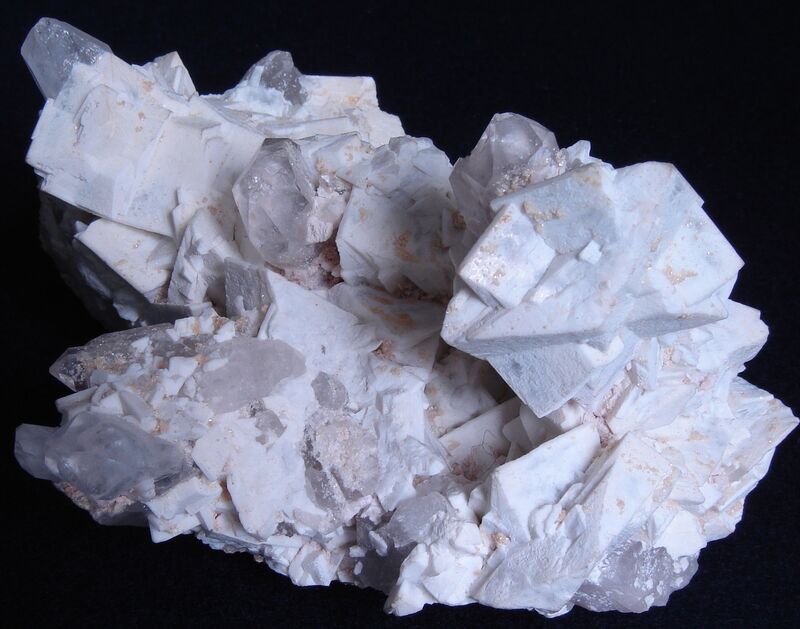
The mineral itself is not a separate species. It is the green to blue-green variety of microcline, a potassium feldspar — one of the rock-forming minerals built around potassium, aluminium and silica. For many years the source of its colour was a puzzle. People assumed copper was responsible, since copper compounds are so often blue or green. A 1985 study pointed instead to small amounts of lead and water held inside the feldspar, and later work added other trace elements to the picture.
Long before any of this chemistry was understood, the stone was being worked. Amazonite has been used for jewellery for more than three thousand years, shown by finds in Middle and New Kingdom Egypt and in Mesopotamia. In Bronze Age Egypt it was mined in the southern Eastern Desert, at Gebel Migif. Curiously, despite this long working life, the stone is not mentioned by any ancient or medieval written source.
In early modern times the supply came almost entirely from one place — the area of Miass in the Ilmensky Mountains, about 80 kilometres southwest of Chelyabinsk in Russia, where it sits in granitic rock. It was first described as a distinct mineral in the 18th century. The formal name came later still: in 1847 the German mineralogist Johann Friedrich August Breithaupt named it for a type area he placed only vaguely, "near" the Amazon River. Another classic source is Pikes Peak, in El Paso County, Colorado, where it occurs in coarse granite and pegmatite, the coarse-grained rock that fills late cracks in cooling magma.
Industrial & practical applications
Amazonite is valued for its colour, not its chemistry. Its one practical use is ornamental: it is occasionally cut and worked as a gemstone. Its modest hardness — enough to take a polish but soft enough to scratch — suits it to smooth, rounded cuts and polished pieces rather than the sharp facets cut into harder gems.
It has no industrial role of its own. As the green variety of microcline, it shares the makeup of common potassium feldspar, a rock-forming mineral of granite and pegmatite. But amazonite is gathered for its blue-green appeal, not crushed and processed as bulk industrial feldspar. Beyond the lapidary bench, its main demand comes from mineral collectors, who prize good crystals as specimens.
Where it forms, where it's found
Chemical composition
Synonyms
- Amasoniit
- Amazon Jade
- Amazon Stone
- Amazoniet
- Amazonit
- Amazonita
- Amazonitas
- Amazonsten
Literature, links & citation
- 1967Arnaudov, V., Pavlova, M., Petrusenko, S. (1967) Lead content in certain amazonites. Izvestiya na Geologicheskiya Institut, Bulgarska Akademiya na Naukite: 16: 41-44. [in Bulgarian]
- 1969Plyusnin, G.S. (1969) Color of amazonites. Zapiski Vsesoyuznogo Mineralogicheskogo Obshchestva: 98: 3-17. [in Russian]
- 1971Čech, F., Mísař, Z., Povondra, P. (1971) A green lead-containing orthoclase. TMPM Tschermaks Mineralogische und Petrographische Mitteilungen, 15 (3). 213-231 doi:10.1007/bf01087023DOI: 10.1007/bf01087023
- 1979Foord, Eugene E., Martin, Robert F. (1979) Amazonite from the Pikes Peak Batholith [Colorado]. The Mineralogical Record, 10 (6) 373-384
- 1979Foord, Eugene E. (1979) X-ray, chemical and morphological studies on amazonite from the Pike's Peak region, Colorado. Friends of Mineralogy Colorado Chapter Newsletter 2(1) (February 1979), 2. [http://friendsofmineralogycolorado.org/wp-content/uploads/2015/11/1979_02_Feb_FMCC_newsletter_v_2_no_1.pdf]
Entry last updated
@misc{mineral2026,
  author    = {Mineral Index editorial board},
  title     = {Amazonite — Mineral Index},
  year      = {2026},
  url       = {https://mineralindex.org/minerals/amazonite-184}
}