History
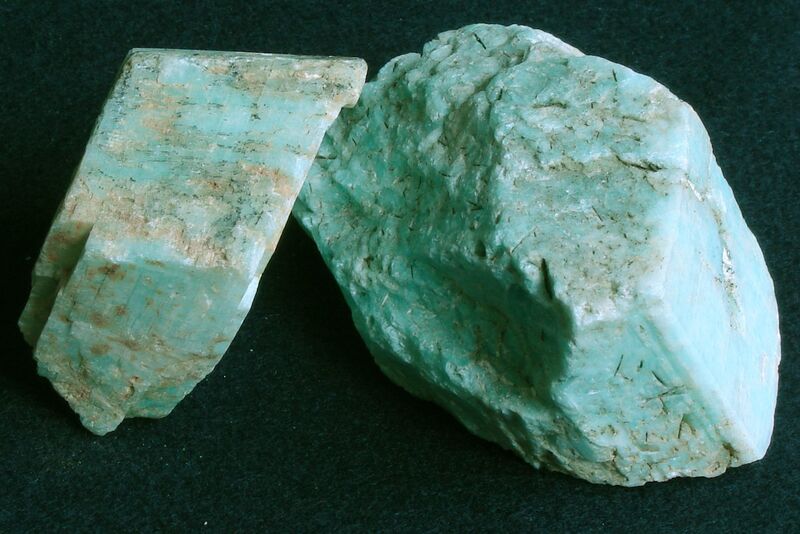
Long before microcline had a name, its most beautiful variety was already in use. Green beads of amazonite — a blue-green form of microcline — turn up in archaeological finds from Middle and New Kingdom Egypt and from Mesopotamia, evidence of jewellery making with the stone going back more than three thousand years. Curiously, no ancient or medieval text describes the stone as a named material; it travelled across cultures as an object rather than as an entry in a mineralogical record.
The mineral itself was named only in 1830, by the German mineralogist Johann Friedrich August Breithaupt. He drew the word from two Greek roots — mikrós, little, and klínein, to lean — to record a small but stubborn fact about its crystals. Their angles are almost right angles, but not quite. The departure from a perfect 90 degrees is too small to spot by eye and large enough to matter to a crystallographer. Breithaupt applied the name to two Norwegian specimens. One was a reddish-brown feldspar from Arendal. The other showed a bluish schiller — a soft internal sheen — and came from Stavern, then known as Fredrichsvärn.
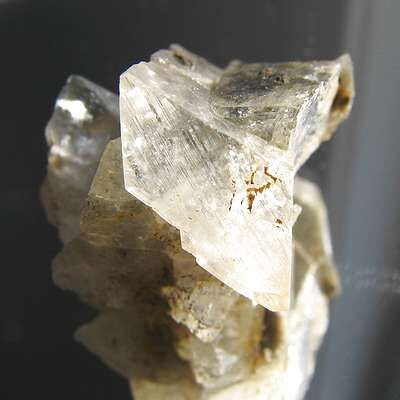
For decades after Breithaupt, the new mineral lived in the shadow of orthoclase, another potassium feldspar that microcline strongly resembles by eye. The two share a chemical formula (KAlSi₃O₈), a hardness, and almost the same density. The case for treating microcline as a distinct species was finally settled in 1876 by the French mineralogist Alfred Des Cloizeaux, working with a polarising microscope — an instrument that filters light to reveal a crystal's internal symmetry. Under that filtered light, microcline shows a pattern that orthoclase never does. It is a fine cross-hatched mesh of repeated twins, called tartan twinning or gridiron twinning, produced by two twin laws acting at once — the albite law and the pericline law. That plaid signature is still the diagnostic test for microcline in thin section.
The amazonite puzzle
Amazonite kept one mystery for much longer. Its name comes from the Amazon River, after green stones once said to be traded out of the basin. No amazonite has ever been found there, and the stones the explorers brought back were almost certainly something else. What gives amazonite its colour was unresolved until the late 20th century. A 1985 study tied the blue-green hue to traces of structural lead locked inside the feldspar, together with trapped water. A 1998 theoretical study by A. Julg refined the model. It focused on how lead substituting for potassium alters the way the crystal absorbs light. A 2010 study added a contributing role for divalent iron. Three decades of work, to explain why a feldspar is green.
Industrial & practical applications
Most of the world's microcline never leaves a factory floor. It is the potassium-rich workhorse of two giant industries — ceramics and glass — where it serves the same chemical purpose: a flux that lowers melting points and binds the rest of the recipe together when fired.
In ceramics and glass
In ceramic bodies, finely ground microcline melts before the clay and silica around it, then cools to a glassy phase that locks the grains in place. The mineral is therefore a structural ingredient, not a coating — a tile, a basin, a porcelain cup all owe a share of their strength to feldspar fused inside them. The proportions vary by product. Tableware bodies typically run 15–30% feldspar; high-tension electrical porcelains 25–35%; sanitaryware around 25%; wall tile from 0–10%; and dental porcelain up to 80%.
Glassmaking pulls on a different property of the same mineral. Microcline supplies the potassium-oxide flux (K₂O) that lowers melting points, and the alumina (Al₂O₃) that hardens the finished glass and slows its chemical attack.
About two-thirds of all feldspar consumed in the United States goes to glass — bottles, jars, fibreglass insulation, container glass of every description.
Smaller uses
Crushed microcline shows up in a more domestic register as the mild abrasive in scouring powders. The household cleaners Bon Ami and Bar Keepers Friend both use feldspar to give them their scrubbing action. Microcline is hard enough to lift stains, soft enough not to scratch a porcelain sink.
Geologists and archaeologists rely on microcline for a third reason: dating. A small fraction of its potassium atoms is a radioactive isotope that decays to argon at a known rate. A feldspar crystal locked inside a lava flow therefore records the age of the eruption. Microcline is one of the standard minerals for potassium–argon and argon–argon dating. Its lattice also traps electrons in a way useful for luminescence dating of buried sediments.
A green variety, amazonite, is cut and polished as a gemstone — usually as cabochons or beads for jewellery rather than as faceted stones.
Microcline also has a registered role as a food additive. In its powdered form, potassium aluminium silicate carries the European E-number E555 and is used as an anti-caking agent. The safety of the additive was reviewed by the European Food Safety Authority in 2008 and again in 2018.
Where it forms, where it's found
- Geological setting
Plutonic felsic rocks, pegmatites, high-grade metamorphic veins, hydrothermal veins
- Type locality
- Arendal
- Agder
- Norway
Varieties
Physical
- Hardness
- 1Talc
- 2Gypsum
- 3Calcite
- 4Fluorite
- 5Apatite
- 6Orthoclase
- 7Quartz
- 8Topaz
- 9Corundum
- 10Diamond
- Lustre
- Vitreous
- Transparency
- Transparent · Translucent
- Colour
- White · grey · greyish yellow · yellowish · tan · salmon-pink · bluish green · green.
- Streak
- White
- Tenacity
- brittle
- Cleavage
- Perfect
on [001], good on [010]
- Fracture
- Irregular/Uneven
- Density
- 2.54 g/cm³
Optical
- Optical type
- Biaxial (-) · 2V measured = 66 – 103° · 2V calc = 80°
- Refractive index
- 1.514 – 1.539
- Surface relief
- Moderate
- Principal indices
- nα 1.514 – 1.529 · nβ 1.518 – 1.533 · nγ 1.521 – 1.539
- Dispersion
- r > v weak
- Luminescence
- None
Crystallography
- Cell parameters
- a = 8.5784 Å · b = 12.96 Å · c = 7.2112 Å
- Cell angles
- α = 90.3 ° · β = 116.05 ° · γ = 89 °
- Ratio a:b:c
- 1 : 1.511 : 0.841
- Z
- 4
- Morphology
Prismatic crystals (to 50 m and 13,500 t), granular, massive. Commonly forms perthitic intergrowths.
- Twinning
Carlsbad, Baveno, Manebach, polysynthetic on albite and pericline laws.
- Parting
- on (100)(110)(10)(01)
- Comment
Non-standard unit-cell setting (space group C-1, chosen by convention to facilitate comparison with C-centred monoclinic orthoclase and sanidine); reduced cell has the following unit-cell parameters: 7.211, 7.708, 7.833 Å, 113.0, 104.17 103.88° (space group P-1).
Chemical composition
- Impurities
- Fe
- Ca
- Na
- Li
- Cs
- Rb
- H2O
- Pb
Synonyms
- Microline
- Mikrokliner Felsit
In other languages
- French
- microcline
- German
- Grüner Feldspat · Mikroklin
- Spanish
- microclina
- Italian
- microcline · microclino
- Portuguese
- microclina
- Japanese
- マイクロクライン · マイクロクリン · 微斜カリ長石 · 微斜長石
- Chinese
- 微斜長石
- Simplified Chinese
- 微斜长石
- Traditional Chinese
- 微斜長石
- Russian
- Микроклин
- Arabic
- ميكروكلين
Classification
9.FA.30
- 9SilicatesClass
- 9.FTektosilicates without zeolitic H2ODivision
- 9.FATektosilicates without additional non-tetrahedral anionsGroup
- 9.FA.30MicroclineSpecies
76.01.01.05
- 76Tectosilicates Al-si FrameworkClass
- 76.01Al-Si Framework with Al-Si frameworksType
- 76.01.01K (Na,Ba) feldsparsGroup
- 76.01.01.05MicroclineSpecies
16.3.5
- 16Silicates Containing Aluminum and other MetalsClass
- 16.3Aluminosilicates of KGroup
- 16.3.5MicroclineSpecies
Group, growth & confusion
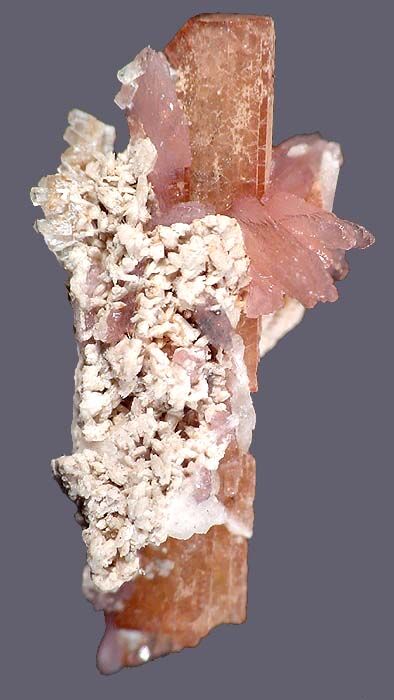 Ancylite-(Ce)CeSr(CO3)2(OH) · H2OMineral—
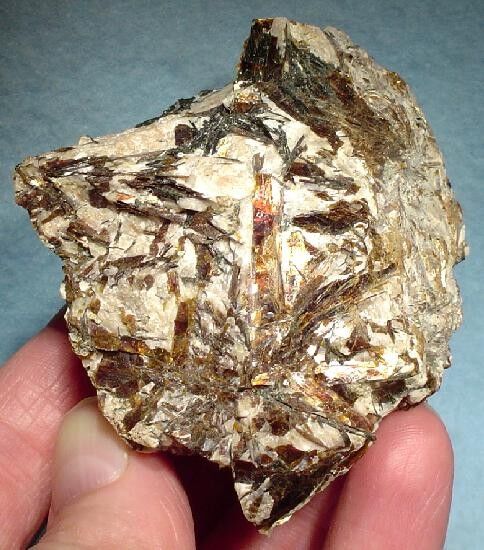 AstrophylliteK2NaFe2+7Ti2(Si4O12)2O2(OH)4FMineral—
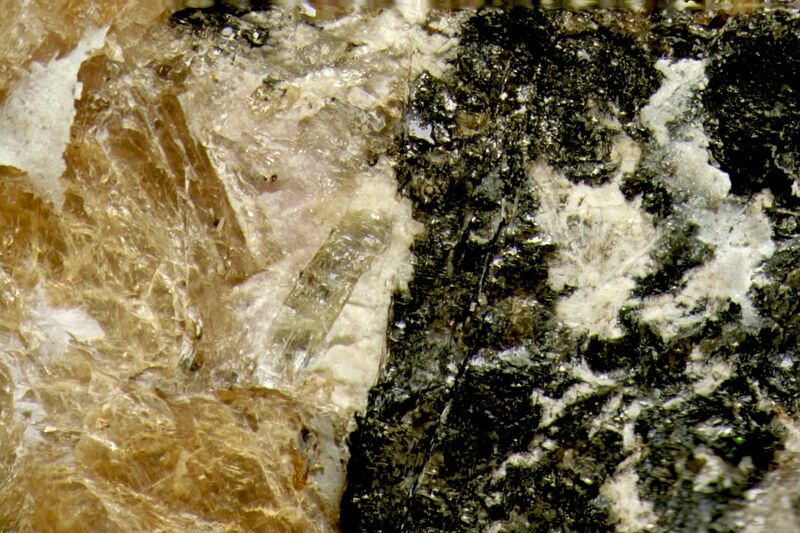 Belovite-(Ce)NaCeSr3(PO4)3FMineral—
- Calciomurmanite(Na,◻)2Ca(Ti,Mg,Nb)4[Si2O7]2O2(OH,O)2(H2O)4Mineral—
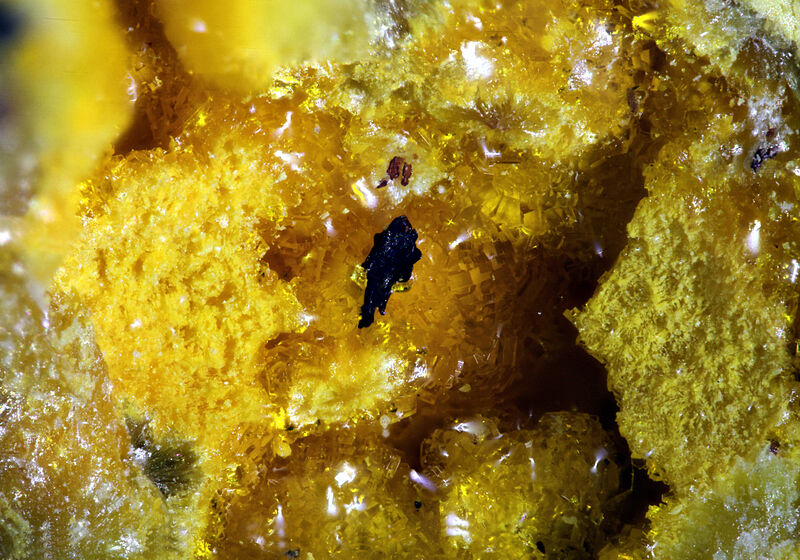 CompreignaciteK2(UO2)6O4(OH)6 · 7H2OMineral—
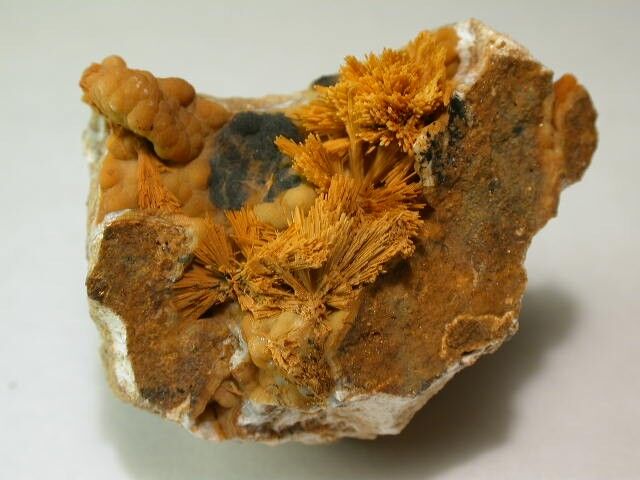 CrandalliteCaAl3(PO4)(PO3OH)(OH)6Mineral—
- HomiliteCa2Fe2+B2Si2O10Mineral—
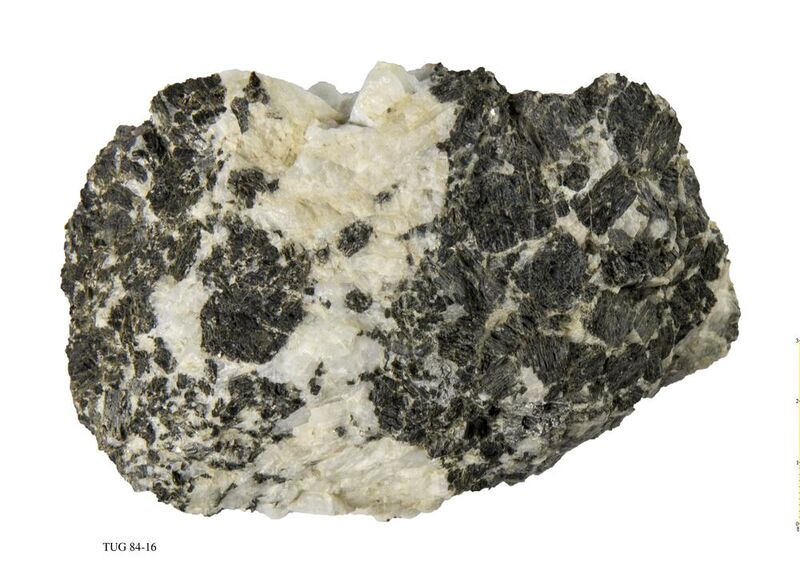 HornblendeAnCa2(Z2+5-mZ3+m)(Si8-(n+m)Al(n+m))(OH,F,Cl)2Variety—
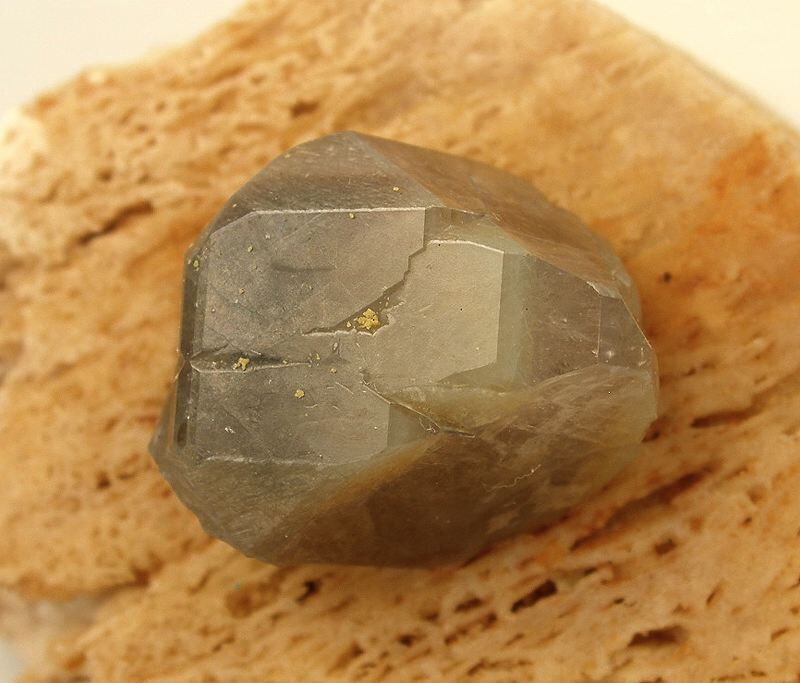 HydroxylherderiteCaBe(PO4)(OH)Mineral—
- Ishikawaite(U,Fe,Y)NbO4Mineral—
Literature, links & citation
- 1830Breithaupt, A. (1830): Ueber die Felsite und einige neue Specien ihres Geschlechts. Journal für Chemie und Physik, 60: 316-330
- 1968Wright, Thomas L., Stewart, David B. (1968) X-ray and optical study of alkali feldspar: I. Determination of composition and structural state from refined unit-cell parameters and 2V. American Mineralogist, 53 (1-2) 38-87
- 1968Wright, Thomas L. (1968) X-ray and optical study of alkali feldspar: II. An X-ray method for determining the composition and structural state from measurement of 2θ values for three reflections. American Mineralogist, 53 (1-2) 88-104
- 1971Bachinski, S.W., Müller, G. (1971) Experimental determinations of the microcline-low albite solvus. Journal of Petrology: 1(2): 329-356.
- 1979Ferguson, R.B. (1979) Whence orthoclase and microcline? A crystallographer's interpretation of potassium feldspar phase relations. The Canadian Mineralogist: 17: 515-525.
Entry last updated
@misc{mineral2026,
  author    = {Mineral Index editorial board},
  title     = {Microcline — Mineral Index},
  year      = {2026},
  url       = {https://mineralindex.org/minerals/microcline-2704}
}