History
Few minerals wear their crystal habit in their name as plainly as bournonite. To German-speaking miners at Kapnik — today Cavnic, in Romania — its repeated twins looked like the teeth of a cog. They called it Rädelerz, wheel ore. The English version, cogwheel ore, became the popular name across the 19th century.
The mineral was first mentioned in print in 1797 by the Cornish naturalist Philip Rashleigh, who treated it simply as an ore of antimony. A more complete description was published in 1804 by the French crystallographer Jacques-Louis, Comte de Bournon (1751–1825). De Bournon had fled the French Revolution for England and lived in exile there for a quarter of a century. He compiled detailed mineral catalogues organised by his own classification, researched the composition of meteorites, and helped found the Geological Society of London.
In 1805 the Scottish naturalist Robert Jameson named the mineral bournonite in his honour. De Bournon himself preferred a different name. In 1813 he proposed endellione, later endellionite, after the parish of St Endellion in Cornwall. That parish held the type locality — the place where the first described specimens were found — at the Wheal Boys mine, where bournonite occurred with jamesonite, sphalerite and siderite. The honorific stuck; Bournon's own choice did not. A handful of older 19th-century synonyms — axotomous antimony glance, berthonite, volchite, dystomic glance — appear in mineralogy textbooks of the period but have since fallen out of use.
Cornwall continued to supply the classic specimens through the 19th century. The richest came from Herodsfoot mine near Liskeard, a silver-bearing galena working where bournonite occurred as sharp, brilliant cogwheel groups. Those Herodsfoot crystals set the benchmark against which later finds at Neudorf in the Harz Mountains, at Cavnic in Romania, and in Bolivia and Peru have been measured.
Industrial & practical applications
Bournonite has no major industrial role today. Where it occurs in workable quantity, it can be processed as a minor local ore of lead, copper and antimony. The known occurrences span polymetallic vein deposits in Cornwall, the Harz, Romania, Bolivia and Peru. The mineral is rarely abundant enough to be a primary mining target. It turns up instead as an accessory in deposits worked for galena and other base-metal sulphides.
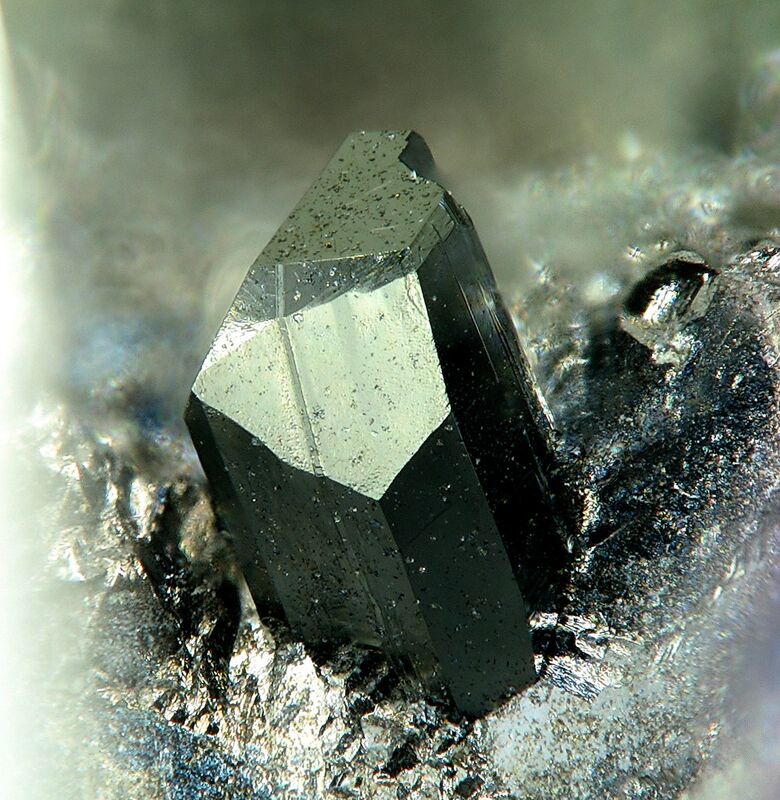
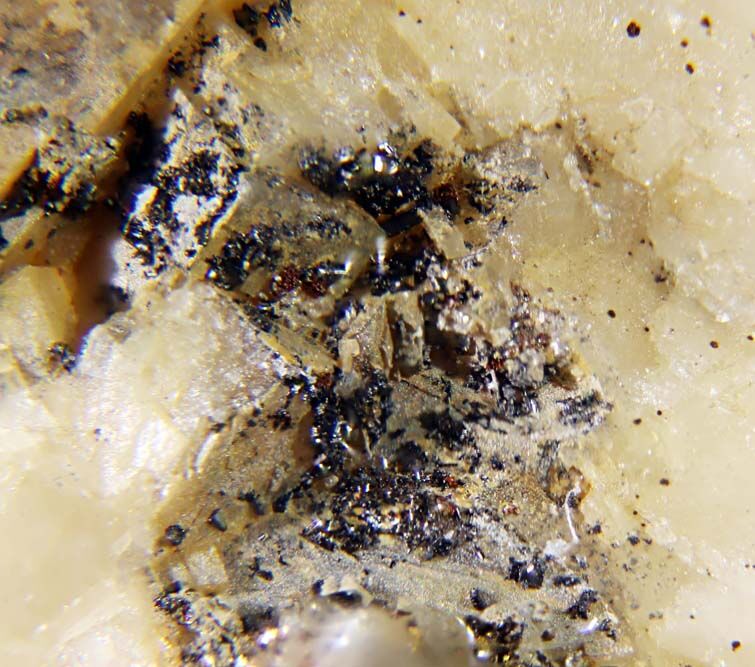
Its main present-day value is to collectors and museums. The sharp cogwheel twins — cyclic intergrowths on the prism face that produce a gear-toothed silhouette — make well-formed crystals prized cabinet pieces. The classic sources are Cornwall's Herodsfoot mine, Neudorf in the Harz, and Cavnic in Romania. From these workings come steel-grey to iron-black crystals with a brilliant metallic lustre. Specimens from the 19th-century mining era now circulate among private collections, dealer stocks and museum reserve drawers rather than ore concentrators.
Where it forms, where it's found
- Geological setting
Moderate temperature hydrothermal veins.
- Type locality
- Wheal Boys (Trewetha Mine
- Old Trewetha Mine)
- Port Isaac
- St Endellion
- Cornwall
- England
- UK
50.5850°, -4.8192°
Safety & handling
Physical
Optical
- Pleochroism
- Weak
Very weak.
- Optical colour
- White
- Anisotropism
- Weak
- Tropism
- Anisotropic
- Reflectance R%
- (37.0,37.4) 400, (36.8,37.3) 420, (36.5,37.2) 440, (36.1,37.0) 460, (35.6,36.8) 480, (35.2,36.6) 500, (34.8,36.4) 520, (34.3,36.2) 540, (33.8,35.8) 560, (33.4,35.5) 580, (33.0,35.1) 600, (32.7,34.7) 620, (32.3,34.0) 640, (32.0,33.4) 660, (31.4,32.7) 680, (30.8,32.1) 700
Crystallography
- Space group
- #34
- Cell parameters
- a = 8.153(1) Å · b = 8.692(3) Å · c = 7.793(2) Å
- Ratio a:b:c
- 1 : 1.066 : 0.956
- Z
- 4
- Morphology
Crystals usually short prismatic to tabular [001]. Crystals often form sub-parallel aggregates. Faces {hk0} striated [001], {h01} striated [010], (100) lustrous and striated [010], (010) usually smooth and lustrous.
- Twinning
On (110) very common often repeated, forming cruciform or wheel-like aggregates ("cogwheels"). Twin gliding: x1 (110), δ2 [110]. Usually exhibits polysynthetic twinning on (110), in part due to deformation.
Chemical composition
- Impurities
- As
- Ag
- Fe
- Zn
- Mn
- Ni
Synonyms
- Antimoine sulfuré plumbocuprifère
- Antimonbleiglanz
- Antimonbleikupferblende
- Antimonial Copper Glance
- Antimonial Lead Ore
- Antimonkupferbleiblende
- Antimonkupferglanz
- Berthonit
- Berthonita
- Berthonite
- Bournonite (of Jameson)
- Cañutillo
- Cog Wheel Ore
- endellinite
- Endellione
- Endellionit
- Endellionita
- Endellionite
- Plomb sulfuré antimonifère
- Rädelerz
- Rädlerz
- Schwarz Spiessglanzerz
- Schwarzspiessglanzerz
- Spiessglanzblei
- Tripelglanz
- Wheel Ore
- Wölchit
- Wölchite
In other languages
- French
- Berthonite · Bournonite · Endellionite · Wölchite
- German
- Bournonit · Rädelerz · Wölchit
- Spanish
- Bournonita
- Italian
- Bournonite · Endellionite
- Japanese
- 車骨鉱
- Chinese
- 車輪礦
- Russian
- Бурнонит
Classification
2.GA.50
- 2Sulfides and SulfosaltsClass
- 2.GSulfarsenites, sulfantimonites, sulfbismuthitesDivision
- 2.GANeso-sulfarsenites, etc. without additional SGroup
- 2.GA.50BournoniteSpecies
03.04.03.02
- 03SulfosaltsClass
- 03.04ø = 3Type
- 03.04.03Seligmannite GroupGroup
- 03.04.03.02BournoniteSpecies
5.7.2
- 5Sulphosalts - Sulpharsenites and Sulphobismuthites (those containing Sn, Ge,or V are in Section 6)Class
- 5.7Sulpharsenites etc. of Pb and other metalsGroup
- 5.7.2BournoniteSpecies
Group, growth & confusion
Literature, links & citation
- 1797Rashleigh (1797) 1: 34, pl. xix.
- 1804Bournon, J.L. (1804) Description of a triple sulpburet, of lead, antomony, and copper, from Cornwall; with some observations upon the various modes of attraction which influence the formation of mineral substances, and upon the different kinds of sulphuret of copper. Royal Society of London, Philosophical Transactions: 94: 30-62.
- 1804Hatchett, C. (1804) Analysis of a triple sulphuret, of lead, antimony, and copper, from Cornwall. Royal Society of London, Philosophical Transactions: 94: 63-69.
- 1805Jameson, R. (1805) Bournonite. System of Mineralogy II, Bell and Bradfute (Edinburgh, U.K.): 579-582.
- 1816Jameson (1816) 3: 372.
Entry last updated
@misc{mineral2026,
  author    = {Mineral Index editorial board},
  title     = {Bournonite — Mineral Index},
  year      = {2026},
  url       = {https://mineralindex.org/minerals/bournonite-741}
}