History
The name is a small chemistry lesson folded into a word. Cavansite packs together the three elements at the heart of the mineral — calcium, vanadium, and silicate, the silicon-and-oxygen framework most rock minerals are built on.
It is a young mineral by the standards of the field. The first specimens turned up in 1967 near the Owyhee Dam, in Malheur County, Oregon, and three American researchers — Lloyd W. Staples, Howard T. Evans Jr., and James R. Lindsay — described it as a species new to science. The same Oregon work turned up a near-twin, pentagonite. The two are dimorphous: identical in chemistry but built into two different crystal shapes, like the same bricks stacked two ways.
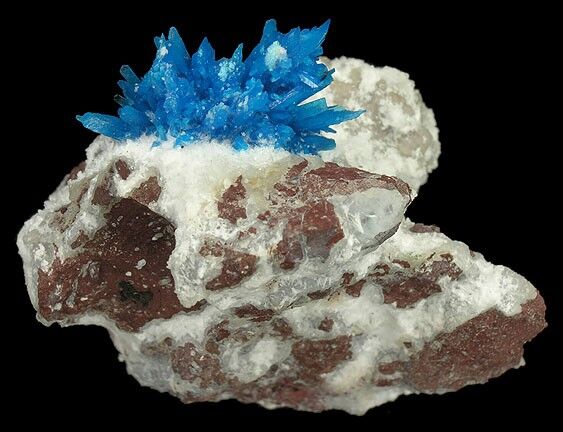
For its first decades cavansite was a rarity known mainly from that Oregon ground. Then the basalt quarries around Pune, in western India, began yielding it in quantity. These quarries cut into the Deccan Traps. That name covers vast stacked sheets of ancient volcanic basalt that blanket much of west-central India. The mineral grew best inside the cavities left by old gas bubbles in that rock. Specimens from the Wagholi quarries near Pune carry deep, almost electric blue crystals. They are now the ones most collectors picture when they hear the name.
Industrial & practical applications
Cavansite earns its keep on a shelf, not in a factory. The mineral carries vanadium, a metal industry does want, so in principle it could be an ore source for it. In practice it is not treated as one. It is too scarce and too scattered to mine for the metal, and is not generally considered an ore mineral.
What it does have is colour. Its rich, bright blue crystals, often gathered into small rounded sprays, make it a sought-after collector's mineral — prized for display rather than for any material it yields.
Where it forms, where it's found
- Geological setting
In brown tuff of late Miocene age and in basalt and breccia of Eocene age.
Basalt vesicular filling.
- Type locality
- Owyhee Dam
- Lake Owyhee State Park
- Malheur County
- Oregon
- USA
43.6248°, -117.2354°
Physical
Optical
- Optical type
- Biaxial (+) · 2V measured = 52° · 2V calc = 58°
- Refractive index
- 1.542 – 1.551
- Surface relief
- Moderate
- Principal indices
- nα 1.542 · nβ 1.544 · nγ 1.551
- Pleochroism
- Visible
X=Z= colorless Y= blue
- Dispersion
- r < v extreme. Dispersion opposite to that of pentagonite.
- Extinction
- Parallel. X = b; Y = a; Z = c.
Crystallography
- Cell parameters
- a = 9.792(2) Å · b = 13.644(3) Å · c = 9.629(2) Å
- Ratio a:b:c
- 1 : 1.393 : 0.983
- Z
- 4
- Morphology
Prismatic crystals, spherulitic rosettes.
- Twinning
No twinning observed.
- Type-locality form
Blue radiating clusters up to 25 mm in diameter and as single crystals up to 0.2 mm long.
- Comment
Space group Pcnm.
Chemical composition
Synonyms
- IMA1967-019
In other languages
- French
- cavansite
- German
- Cavansit · IMA 1967-019
- Spanish
- Cavansita
- Italian
- Cavansite
- Japanese
- カバンシ石
- Chinese
- 水矽釩鈣石
- Traditional Chinese
- 水矽釩鈣石
- Russian
- кавансит
Classification
9.EA.50
- 9SilicatesClass
- 9.EPhyllosilicatesDivision
- 9.EASingle nets of tetrahedra with 4-, 5-, (6-), and 8-membered ringsGroup
- 9.EA.50CavansiteSpecies
74.03.07.01
- 74Phyllosilicates Modulated LayersClass
- 74.03Modulated Layers with joined stripsType
- 74.03.07V phyllosilicatesGroup
- 74.03.07.01CavansiteSpecies
14.14.1
- 14Silicates not Containing AluminumClass
- 14.14Silicates of V and BiGroup
- 14.14.1CavansiteSpecies
Group, growth & confusion
Literature, links & citation
- 1967Staples, L.W., Evans, H.T Jr., Lindsay, J.R. (1967) Cavansite, a new calcium vanadium silicate mineral (abstr.). Geological Society of America, Program Annual Meeting: 211-212.
- 1968Fleischer, Michael (1968) New Mineral Names. American Mineralogist, 53 (3-4) 507-511
- 1973Staples, Lloyd W., Evans, Howard T., Lindsay, and James R. (1973) Cavansite and pentagonite, new dimorphous calcium vanadium silicate minerals from Oregon. American Mineralogist, 58 (5-6) 405-411
- 1973Evans, Howard T., Jr. (1973) The crystal structures of cavansite and pentagonite. American Mineralogist, 58 (5-6) 412-424
- 1989Wilke, Hans-Jürgen; Schnorrer-Köhler, Günther; Bahle, Arvind (1989) Cavansit aus Indien [Cavansite from India]. Lapis, 14 (1). 39-41; 50
Entry last updated
@misc{mineral2026,
  author    = {Mineral Index editorial board},
  title     = {Cavansite — Mineral Index},
  year      = {2026},
  url       = {https://mineralindex.org/minerals/cavansite-921}
}