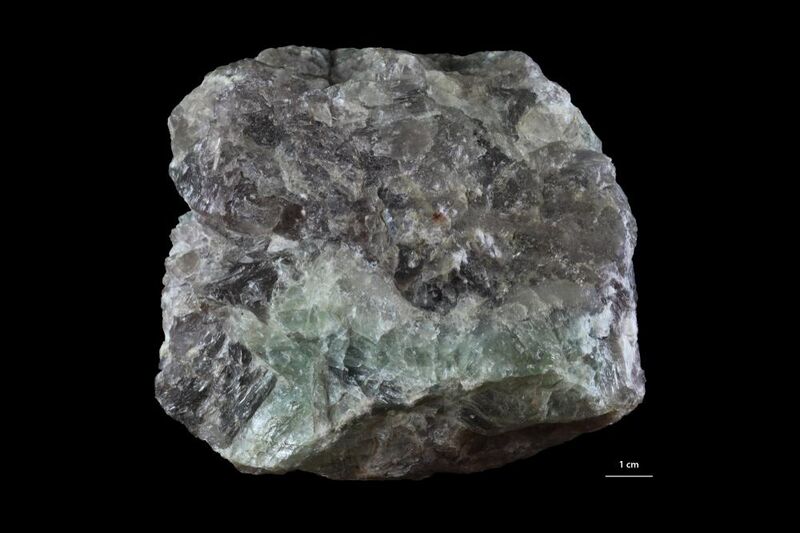
Where it forms, where it's found
- Geological setting
Rare-element pegmatites and hypothermal mineral veins.
25recorded occurrences
Physical
- Hardness
- 1Talc
- 2Gypsum
- 3Calcite
- 4Fluorite
- 5Apatite
- 6Orthoclase
- 7Quartz
- 8Topaz
- 9Corundum
- 10Diamond
- Transparency
- Transparent · Translucent
- Colour
- Reddish pink · red · red-brown · purple · green · smoky · colorless
Color fades upon prolonged exposure to light.
- Streak
- white
- Cleavage
- Perfect
Perfect on (111)
- Fracture
- Sub-Conchoidal
Optical
- UV response
- Grey-green, green to blue-green short-wave and medium-wave and afterglow, violet long-wave fluorescence (NOTE: prolonged exposure to light changes the green fluorescence to the same violet as shown under long-wave.)
PPL intrinsic colour; no change on stage rotation
XPL extinct at every orientation
Crystallography
- Morphology
Typically massive. Octahedral microcrystals and cubic macrocrystals are very rare.
Chemical composition
Synonyms
- Cobra Stone
- Pyroemerald
- Pyrosmaragd
Literature, links & citation
Citations
- 1794De Grotthaus. In: Delamétherie (1794), Journal Phys.: 45: 398.
- 1951Palache, Charles; Berman, Harry; Frondel, Clifford (1951) The System of Mineralogy (7th ed.) Vol. 2 - Halides, Nitrates, Borates, Carbonates, Sulfates, Phosphates, Arsenates, Tungstates, Molybdates, Etc. John Wiley and Sons.
- 1994Robbins, Manuel (1994) Fluorescence - Gems and Minerals under Ultraviolet Light. Geoscience Press, Inc.
Cite this entry
Entry last updated
@misc{mineral2026,
  author    = {Mineral Index editorial board},
  title     = {Chlorophane — Mineral Index},
  year      = {2026},
  url       = {https://mineralindex.org/minerals/chlorophane-948}
}