Where it forms, where it's found
- Geological setting
Secondary mineral formed by the alteration of uraninite
- Type locality
- Shinkolobwe Mine
- Shinkolobwe
- Kambove Territory
- Haut-Katanga
- DR Congo
-11.0486°, 26.5508°
53recorded occurrences
Varieties
Radioactivity
Physical
Optical
- Optical type
- Biaxial (-) · 2V measured = 70° · 2V calc = 80°
- Refractive index
- 2.06 – 2.15
- Surface relief
- Very high
- Principal indices
- nα 2.06 · nβ 2.11 · nγ 2.15
- Pleochroism
- Visible
X = b = pale yellow Y = a = light red-orange Z = c = dark red-orange
- Dispersion
- r < v strong
- Notes
Distinguished from other uranyl oxides by its higher refractive indices (Frondel 1958).
Δ = 0Δmax
PPLpleochroism per grain
XPLindependent extinctions · rotate the stage
PPLpleochroism only · colour blends on rotation
XPLinterference colour · extinct every 90°
Retardation900 nm
Order2nd order
XPL colour
Crystallography
- Space group
- Pnma
- Cell parameters
- a = 12.5510(10) Å · b = 8.3760(4) Å · c = 13.0107(9) Å
- Ratio a:b:c
- 1 : 0.667 : 1.037
- Unit cell volume
- 1367.78 ų
- Z
- 2
- Morphology
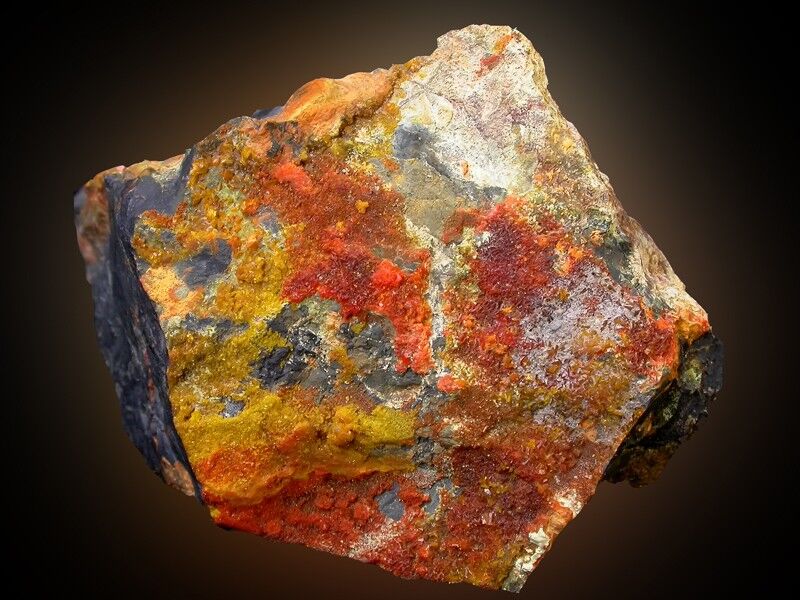
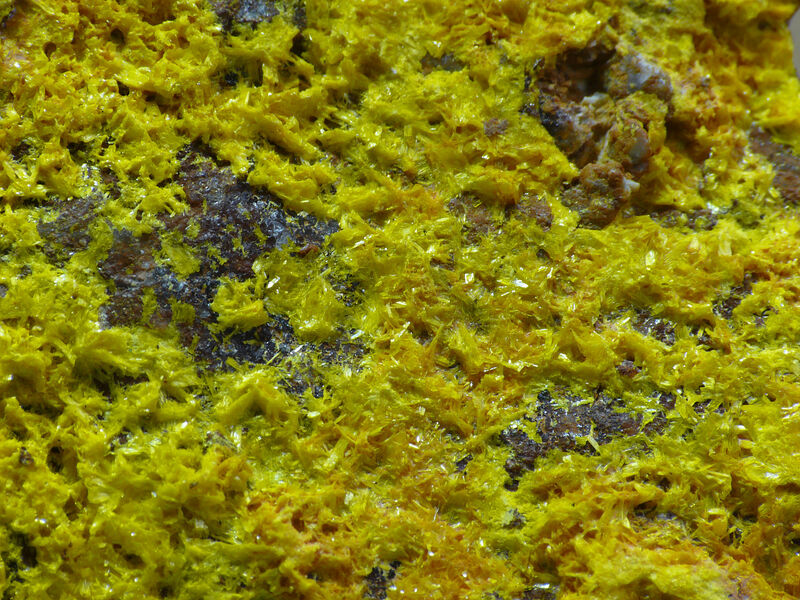
Crystals prismatic [001] and striated [001]. Massive. In aggregates of fine needles or saccharoidal. Compact earthy.
- Type-locality form
Cryptocrystalline, massive, minute needles.
- Comment
data from Ghazisaeed et al. (2019)
Crystal structure
In other languages
- French
- Curite
- German
- Curit
- Spanish
- Curita
- Italian
- Curite
- Chinese
- 板鉛鈾礦 · 板铅铀矿
- Traditional Chinese
- 板鉛鈾礦
- Russian
- Кюрит
- Arabic
- كوريت
Classification
Strunz
10th ed.4.GB.55
- 4OxidesClass
- 4.GUranyl HydroxidesDivision
- 4.GBWith additional cations (K, Ca, Ba, Pb, etc.); with mainly UO2(O,OH)5 pentagonal polyhedraGroup
- 4.GB.55CuriteSpecies
Dana
8th ed.05.09.03.01
- 05Oxides Containing Uranium or ThoriumClass
- 05.09MiscellaneousType
- 05.09.03— unnamed intermediate level —Group
- 05.09.03.01CuriteSpecies
CIM
—7.16.26
- 7Oxides and HydroxidesClass
- 7.16Oxides of UGroup
- 7.16.26CuriteSpecies
Group, growth & confusion
Literature, links & citation
Citations
- 1921Schoep, A. (1921) La curite, nouveau minéral radioactif. Comptes rendus hebdomadaires des séances de l'Académie des sciences de Paris: 173: 1186-1187 (in French). https://gallica.bnf.fr/ark:/12148/bpt6k31267/f1186.item
- 1922Wherry, E.T., Poitevin, E. (1922) New species. American Mineralogist: 7: 128-129.
- 1924Vernadsky, W., Chamié, C. (1924) Sur une pseudomorphose de la curite. Comptes Rendus, 178, 1726.
- 1926Billiet, Valère (1926) Détermination des indices de réfraction de la becquerélite, de la curite, de la kasolite, de la fourmariérite, de la parsonsite, de la dumontite, et de l'ianthinite. Bulletin de la Société française de Minéralogie, 49 (3). 136-140 doi:10.3406/bulmi.1926.4309DOI: 10.3406/bulmi.1926.4309
- 1930Schoep, A. (1930) Ann. us. Congo belge: 1(2), er. 1: 22.
Cite this entry
Entry last updated
@misc{mineral2026,
  author    = {Mineral Index editorial board},
  title     = {Curite — Mineral Index},
  year      = {2026},
  url       = {https://mineralindex.org/minerals/curite-1197}
}