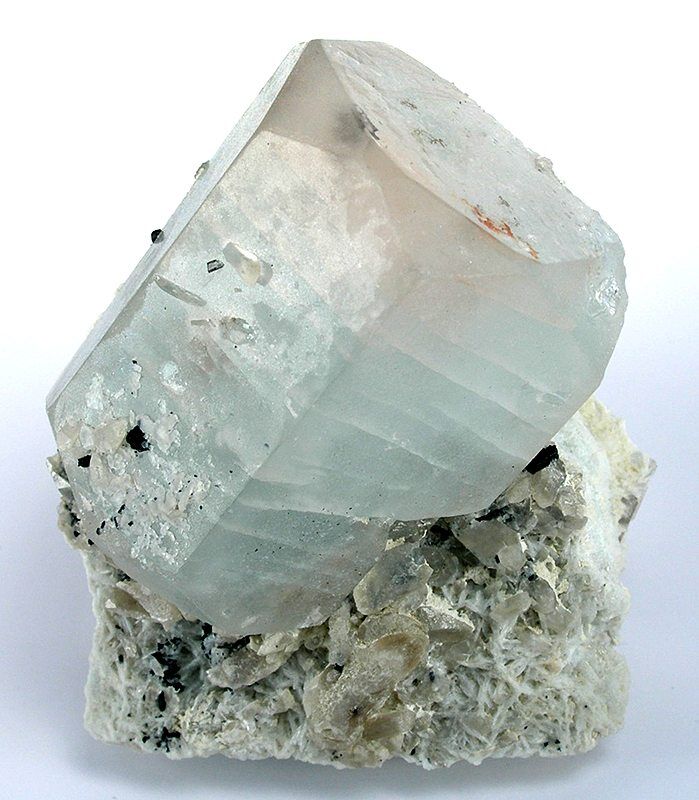
History
The name emerald comes from the Ancient Greek smáragdos — a word for green gemstones — by way of Latin smaragdus, Old French esmeraude, and Middle English emeraude. The Greek term itself may carry older Semitic, Sanskrit, or Persian roots; in English the word first appears in the 14th century.
Long before that name arrived, the green stone was being mined. The oldest known workings lie in the Eastern Desert of Egypt, at a site the Romans called Mons Smaragdus — emerald mountain — in the area now known as Wadi Sikait. The worker camp at Sikait has been securely dated to the 3rd century BCE, placing the start of exploitation in the Ptolemaic period (330–30 BCE). Most of the surviving mining infrastructure dates from the Roman and Byzantine periods that followed. For the whole of Roman antiquity, Sikait was the only emerald mine in the empire, and the gems carried by Cleopatra are likely to have come from there.
In the wider ancient world the stone was prized as a gem, not studied as a mineral. The Egyptian mines were exploited on an industrial scale by the Roman and Byzantine Empires, and later by Islamic conquerors. From at least the 14th century CE, emerald was also being mined in India and in Austria.
The centre of supply shifted in the 16th century. After the Spanish conquest of the Americas, Colombian deposits at Muzo, Coscuez, and Chivor displaced the Egyptian workings as the dominant source of fine green beryl.
Emerald, beryl, and chromium
For most of its history, emerald was treated as a species in its own right. The unification came in the 1790s, in Paris. The French chemist Louis-Nicolas Vauquelin — who had identified the element chromium shortly before — was asked to analyse emerald and beryl and reported them to be essentially the same chemical compound. He also found that emeralds, in the strict sense, contained chromium, and it was this trace element that gave the gem its green colour.
The old Egyptian workings themselves were not forgotten for long after that. In 1817 the French traveller Frédéric Cailliaud rediscovered the mines near Wadi Sikait, ending centuries during which their location had been lost. Emerald nonetheless kept its priority as the preferred species name for several more decades, and only began to be treated as a variety of beryl in the 1830s. Reports calling ordinary green or even blue beryl "emerald" persisted in the amateur literature into the twentieth century.
A late refinement came in the second half of the twentieth century, when analysts found that some emeralds contain more vanadium than chromium.
Industrial & practical applications
Emerald is, almost exclusively, a gemstone. Cut, polished, and set into jewellery, the green variety of beryl earns its value from colour alone — the chromium and vanadium traces that give it the saturated green of a fine stone. There is no industrial use of consequence; the entire economy of emerald sits in the lapidary and jewellery trades — the cutting and shaping of stones for ornamental setting.
Almost every emerald on the market has been treated. Most stones are oiled as part of the post-lapidary process, with cedar oil pressed into surface-reaching cracks to fill the fractures and improve apparent clarity. Cedar oil works because its refractive index is close to that of beryl, so the filled cracks disappear visually; synthetic resins are also used in the same role. The treatment is so universal that gemmological standards in many markets require sellers to disclose it.
Where the gems come from
Colombia has been the leading source since the Spanish opened the Muzo, Coscuez, and Chivor mines in the 16th century, and remained so into the present. For the decade leading up to 2005, Colombia accounted for 47 percent of global emerald output.
Zambia is the second largest producer. The Kafubu River area, about 45 km south-west of Kitwe, hosts the Kagem mines, which produced 20 percent of the world's gem-quality emeralds in 2004.
Synthetic emerald
Emerald has been grown in the laboratory since the early twentieth century. The first commercially successful synthesis was developed by the American grower Carroll Chatham, using a lithium vanadate flux — a molten salt that dissolves the beryl ingredients and lets crystals grow slowly from the solution. Pierre Gilson Sr. brought a second flux-grown product to market in 1964. Gilson's emeralds are grown on natural colourless beryl seeds at about 1 mm per month, yielding 7 mm crystals in a seven-month run.
A separate route — hydrothermal growth, in which beryl crystallises from a hot pressurised aqueous solution — was developed in the same decade. Johann Lechleitner of Innsbruck, Austria, brought the first satisfactory hydrothermal product to market in the 1960s, initially as a thin emerald overgrowth on a natural colourless beryl seed, sold under the names Emerita and Esmeralda. The largest producer of hydrothermal emerald today is the firm Tairus.
Synthetic stones reach the jewellery market mainly as low-cost alternatives to natural emerald; they are not commodity materials in any larger sense.
Where it forms, where it's found
Varieties
Safety & handling
Crystallography
Chemical composition
Synonyms
- Agee
- Émeraude
- Esmeralda
- Maragda
- Ngọc lục bảo
- Smaragd
- Smaragdas
- Smaragdi
- Smarald
- Smeraldo
- Szmaragd
- Zamrud
Literature, links & citation
- —Extra Lapis No. 22 (in German).
- 1797Klaproth, M. H. (1797) XXVIII. Chemische Untersuchung des peruvianischen Smaragds. In Beiträge zur chemischen Kenntniss der Mineralkörper Vol. 2. Rottmann. p.12-15.
- 1981Sinkankas, John (1981) Emerald and other beryls. Chilton Book Co, Pennsylvania. 665pp.
- 1993Cheilletz, A., Féraud, G., Giuliani, G., Ruffet, G. (1993) Emerald dating through 40Ar/39Ar step-heating and laser spot analysis of syngenetic phlogopite. Earth and Planetary Science Letters, 120 (3) 473-485 doi:10.1016/0012-821x(93)90258-bDOI: 10.1016/0012-821x(93)90258-b
- 1997Giuliani, G., France-Lanord, C., Zimmermann, J. L., Cheilletz, A., Arboleda, C., Charoy, B., Coget, P., Fontan, F., Giard, D. (1997) Fluid Composition, δD of Channel H2O, and δ18O of Lattice Oxygen in Beryls: Genetic Implications for Brazilian, Colombian, and Afghanistani Emerald Deposits. International Geology Review, 39 (5) 400-424 doi:10.1080/00206819709465280DOI: 10.1080/00206819709465280
Entry last updated
@misc{mineral2026,
  author    = {Mineral Index editorial board},
  title     = {Emerald — Mineral Index},
  year      = {2026},
  url       = {https://mineralindex.org/minerals/emerald-1375}
}