Where it forms, where it's found
- Geological setting
Granitic pegmatites. Placer deposits.
- Type locality
- Undisclosed pegmatite
- Jølster
- Sunnfjord
- Vestland
- Norway
526recorded occurrences
Radioactivity
Physical
Optical
- Optical type
- Isotropic
- Surface relief
- Very high
- Principal indices
- n 2.06 – 2.24
- Tropism
- Isotropic
Crystallography
- Space group
- Pbcn
- Cell parameters
- a = 5.5528(6) Å · b = 14.6432(20) Å · c = 5.1953(7) Å
- Ratio a:b:c
- 1 : 2.637 : 0.936
- Z
- 4
- Morphology
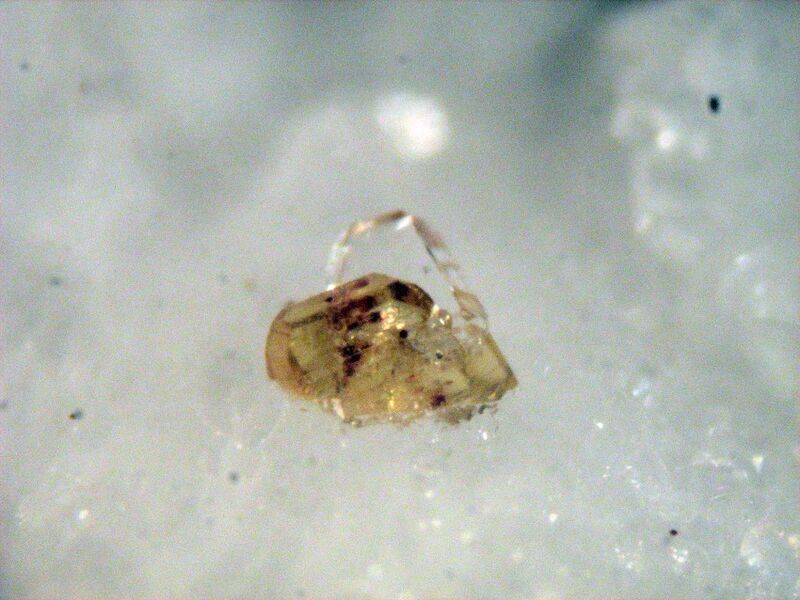
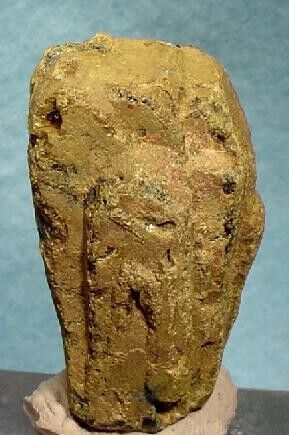
Stout prismatic [001]. The faces are striated parallel to their intersection with (010) Often in parallel or subparallel and slightly radial aggregates of crystals. Massive.
- Twinning
1. On (201), common. The twins are flattened (010) and striated [001] 2. Possibly on (101), rare. 3. Possibly on (013).
- Comment
Typically metamict; heating at high temperatures will restore crystallinity.
Crystal structure
Chemical composition
Synonyms
- Euxeniet-(Y)
- Euxenite
- Euxenite-Polycrase
- Euxenite-Polycrase Group
- Euxenite-Polycrase Series
- Guimaraesite (of Gagarin & Cuomo)
- Lyndochite
- Polycrase-(Y)
In other languages
- French
- Euxénite- · Euxénite-(Y)
- German
- Euxenit- · Euxenit-(Y)
- Spanish
- Euxenita · Euxenita-(Y)
- Italian
- Euxenite · Euxenite- · euxenite-(Y)
- Portuguese
- Euxenita · Euxenita-(Y) · Euxenite
- Japanese
- ユークセナイト · ユークセン石
- Chinese
- 黑稀金矿 · 黑稀金礦
- Simplified Chinese
- 黑稀金矿
- Russian
- Эвксенит
- Arabic
- يوكسينيت
Classification
Strunz
10th ed.4.DG.05
- 4OxidesClass
- 4.DMetal: Oxygen = 1:2 and similarDivision
- 4.DGWith large (+- medium-sized) cations; chains of edge-sharing octahedraGroup
- 4.DG.05Euxenite-(Y)Species
Dana
8th ed.08.03.08.02
- 08Multiple Oxides Containing Niobium, Tantalum or TitaniumClass
- 08.03AB2O6Type
- 08.03.08Polycrase GroupGroup
- 08.03.08.02Euxenite-(Y)Species
CIM
—18.4.5
- 18Niobates and TantalatesClass
- 18.4Niobates and tantalates containing both U and rare earthsGroup
- 18.4.5Euxenite-(Y)Species
Group, growth & confusion
Literature, links & citation
Citations
- 1840Scheerer, Th. (1840) Ueber den Euxenit, eine neue Mineralspecies. Annalen der Physik und Chemie, 126. 149-153 doi:10.1002/andp.18401260510DOI: 10.1002/andp.18401260510
- 1847Scheerer (1847) Ann. Phys.: 72: 566.
- 1927Ellsworth (1927) American Mineralogist: 12: 212.
- 1928Simpson E S (1928) Tanteuxenite (Sp.nov.) Pilbara Goldfield, N.W. Div.. Journal of the Royal Society of Western Australia 14, 45-48.
- 1944Palache, Charles, Berman, Harry, Frondel, Clifford (1944) The System of Mineralogy (7th ed.) Vol. 1 - Elements, Sulfides, Sulfosalts, Oxides. John Wiley and Sons, New York.
Cite this entry
Entry last updated
@misc{mineral2026,
  author    = {Mineral Index editorial board},
  title     = {Euxenite-(Y) — Mineral Index},
  year      = {2026},
  url       = {https://mineralindex.org/minerals/euxenite-y-1425}
}