Where it forms, where it's found
- Geological setting
Fumarole.
Sublimates around fumaroles.
- Type locality
- Great Fissure eruption (Main Fracture)
- Tolbachik Volcanic field
- Milkovsky District
- Kamchatka Krai
- Russia
55.8333°, 160.3333°
7recorded occurrences
Physical
Optical
- Optical type
- Biaxial (+) · 2V measured = 68° · 2V calc = 70°
- Refractive index
- 1.577 – 1.633
- Surface relief
- Moderate
- Principal indices
- nα 1.577 · nβ 1.594 · nγ 1.633
- Pleochroism
- Visible
X = greenish blue; Y = Z = yellow green.
- Dispersion
- very weak
- Extinction
- Z = b; Y ∧ c ≃ 0°.
- Notes
Absorption: Z > Y.
Δ = 0Δmax
PPLpleochroism per grain
XPLindependent extinctions · rotate the stage
PPLpleochroism only · colour blends on rotation
XPLinterference colour · extinct every 90°
Retardation560 nm
Order2nd order
XPL colour
Crystallography
- Space group
- #10
- Cell parameters
- a = 19.037(6) Å · b = 9.479(2) Å · c = 14.231(5) Å
- Cell angles
- β = 111.04 °
- Ratio a:b:c
- 1 : 0.498 : 0.748
- Z
- 8
- Morphology
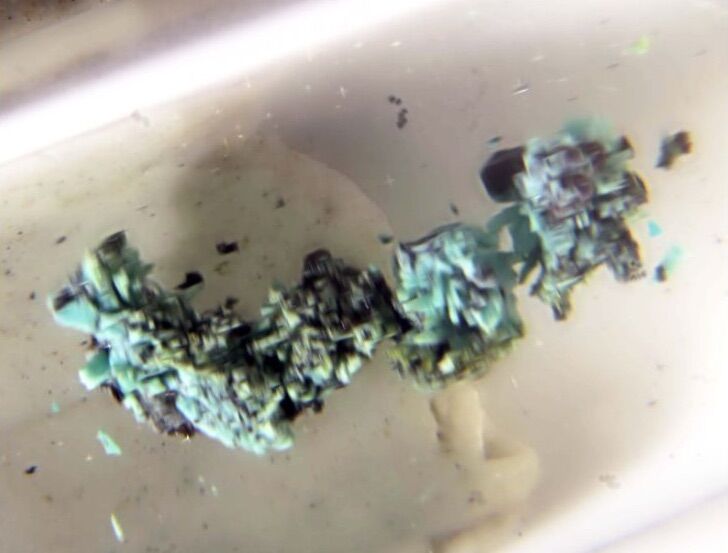
Crusts of pseudohexagonal flakes.
- Type-locality form
Aggregates of poorly developed platy to micaceous crystals and fine-grained crusts 1 to 2 mm thick. Crystals are up to 5 mm long x 0.1-1 mm thick, flattened on (100) and irregular in outline. Rarely rectangular or pseudohexagonal.
Crystal structure
Chemical composition
Synonyms
- Fedotoviet
- IMA1986-013
In other languages
- German
- Fedotovit · IMA 1986-013
- Italian
- Fedotovite
Classification
Strunz
10th ed.7.BC.30
- 7SulfatesClass
- 7.BSulfates (selenates, etc.) with additional anions, without H2ODivision
- 7.BCWith medium-sized and large cationsGroup
- 7.BC.30FedotoviteSpecies
Dana
8th ed.30.03.04.01
- 30Anhydrous Sulfates Containing Hydroxyl or HalogenClass
- 30.03(AB)5(XO4)3ZqType
- 30.03.04— unnamed intermediate level —Group
- 30.03.04.01FedotoviteSpecies
CIM
—25.2.14
- 25SulphatesClass
- 25.2Sulphates of Cu and AgGroup
- 25.2.14FedotoviteSpecies
Group, growth & confusion
Literature, links & citation
Citations
- —Transactions of the USSR Academy of Sciences, Earth Science Sections: 299: 196-199.
- 1988Vergasova, L.P., Filatov, S.K., Serafimova, Y.K., Starova, G.L. (1988) Fedotovite K2Cu3O(SO4)3 - a new mineral from volcanic sublimates. Doklady Akademii Nauk SSSR: 299: 961-964.
- 1990Jambor, John L., Grew, Edward S. (1990) New Mineral Names. American Mineralogist, 75 (1-2) 240-246
- 1991Starova, G.L., Filatov, S.K., Fundamenskii, V.S., Vergasova, L.P. (1991) The crystal structure of fedotovite, K2Cu3O(SO4)3. Mineralogical Magazine: 55: 613-616.
- 2005(2005) Fedotovite. Handbook of Mineralogy. Mineralogical Society of America
Cite this entry
Entry last updated
@misc{mineral2025,
  author    = {Mineral Index editorial board},
  title     = {Fedotovite — Mineral Index},
  year      = {2025},
  url       = {https://mineralindex.org/minerals/fedotovite-1469}
}