Where it forms, where it's found
- Geological setting
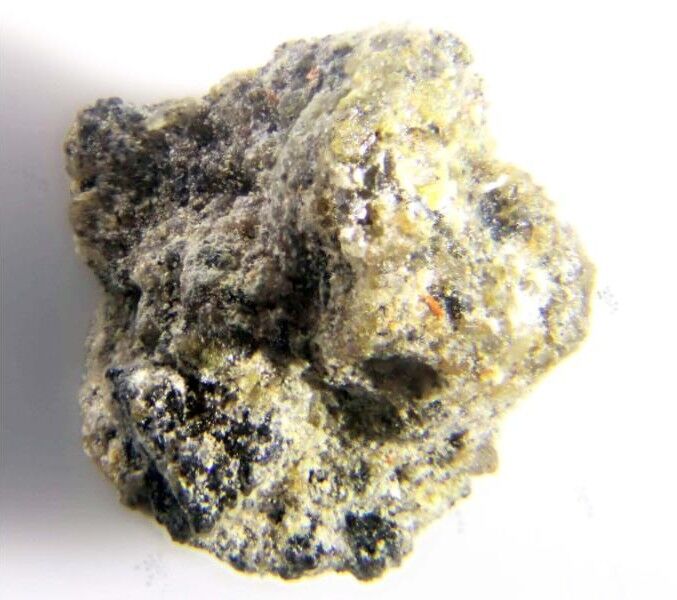
within a medium-grained skarn matrix and contiguous to jagoite. friisite likely crystallized after the main skarn-forming event (post-peak metamorphism) from the transformation of earlier-formed lead silicates, melanotekite (Mtk), or barysilite (Bsl).
- Type locality
- Långban Mine
- Långban Ore District
- Filipstad
- Värmland County
- Sweden
59.8554°, 14.2648°
1recorded occurrences
Safety & handling
Physical
Optical
- Optical type
- Uniaxial (-)
- Pleochroism
- Non-pleochroic
- UV response
- does not fluoresce under UV light
- Notes
with a calculated average refractive index of n=1.88 using Gladstone–Dale constants
Crystallography
- Space group
- #109
- Cell parameters
- a = 8.5955(1) Å · c = 23.4092(2) Å
- Z
- 2
- Parting
- none
- Type-locality form
subhedral, flaky grains up to 150 µm in size, forming aggregates
Chemical composition
Synonyms
- Friisiet
- IMA2024-047
In other languages
- German
- Friisit · IMA 2024-047
Classification
Strunz
10th ed.9.EG.50
- 9SilicatesClass
- 9.EPhyllosilicatesDivision
- 9.EGDouble nets with 6-membered and larger ringsGroup
- 9.EG.50FriisiteSpecies
Group, growth & confusion
Literature, links & citation
Citations
- 2026Holtstam, Dan; Cámara, Fernando; Karlsson, Andreas (2026) Friisite, Pb8Al3Si8O27Cl3, a new mineral with a polysomatic relation to jagoite, from Långban, Sweden. European Journal of Mineralogy, 38 (2). 169-177 doi:10.5194/ejm-38-169-2026DOI: 10.5194/ejm-38-169-2026
Cite this entry
Entry last updated
@misc{mineral2026,
  author    = {Mineral Index editorial board},
  title     = {Friisite — Mineral Index},
  year      = {2026},
  url       = {https://mineralindex.org/minerals/friisite-471483}
}