Where it forms, where it's found
- Geological setting
In cavities of marble clods, at a contact of sodalite-syenite and nepheline-syenite.
- Type locality
- Poudrette quarry (De-Mix quarry
- Demix quarry
- Uni-Mix quarry
- Carrière Mont Saint-Hilaire
- MSH)
- Mont Saint-Hilaire
- La Vallée-du-Richelieu RCM
- Montérégie
- Québec
- Canada
45.5628°, -73.1417°
1recorded occurrences
Physical
Optical
- Optical type
- Biaxial (+) · 2V measured = 38° · 2V calc = 41°
- Refractive index
- 1.599 – 1.696
- Surface relief
- Moderate
- Principal indices
- nα 1.599 · nβ 1.610 · nγ 1.696
- Pleochroism
- Non-pleochroic
- Dispersion
- None
- UV response
- weak yellowish under MW UV (as shown on <br /> https://www.mindat.org/photo-1243512.html
- Notes
X = b; Y = c; Z = a.
Δ = 0Δmax
PPLpleochroism per grain
XPLindependent extinctions · rotate the stage
PPLpleochroism only · colour blends on rotation
XPLinterference colour · extinct every 90°
Retardation970 nm
Order2nd order
XPL colour
Crystallography
- Space group
- #38
- Cell parameters
- a = 7.024 Å · b = 23.15 Å · c = 6.953 Å
- Ratio a:b:c
- 1 : 3.296 : 0.990
- Unit cell volume
- 1130.84 ų
- Z
- 1
- Morphology
Predominant pinacoidal faces (100), (010) and (001), minor prism faces (011).
- Type-locality form
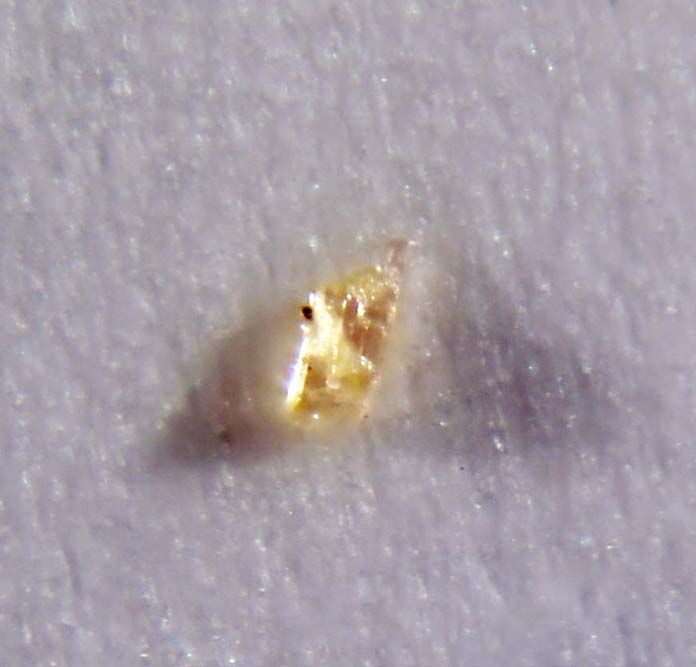
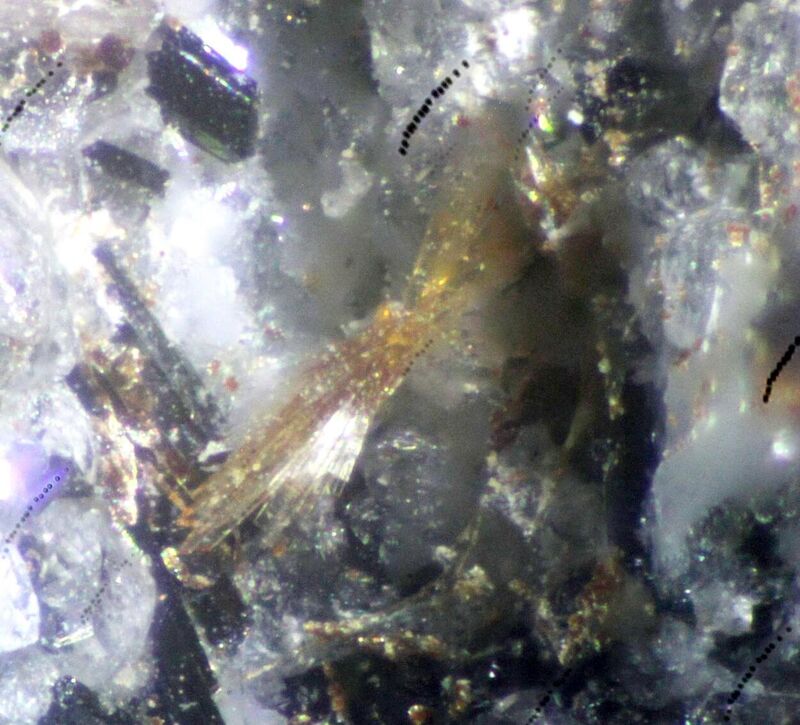
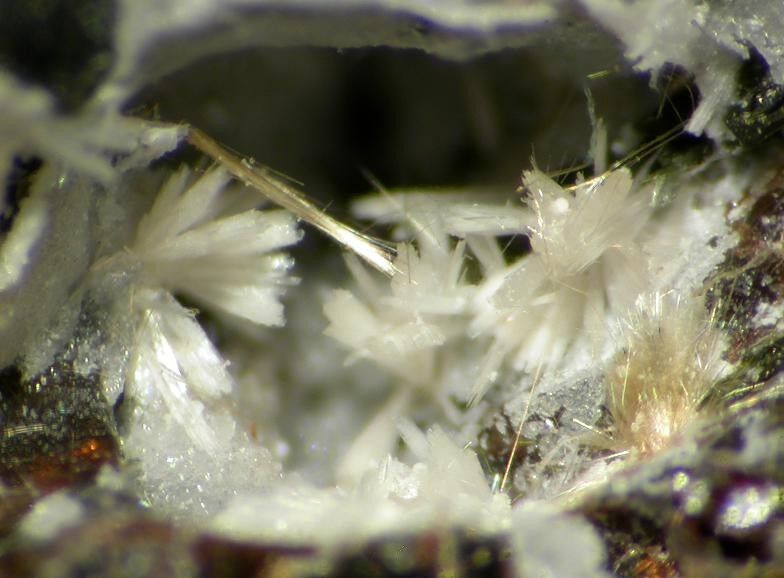
Prismatic crystals to 6 mm, isolated or in fan-shaped aggregates.
Crystal structure
Chemical composition
Synonyms
- Haineaultiet
- IMA1997-015
- Unnamed (MSH UK-61)
- Unnamed (MSH UK-61A)
In other languages
- German
- Haineaultit · IMA 1997-015
- Spanish
- Haineaultita
- Italian
- Haineaultite
Classification
Strunz
10th ed.9.DG.50
- 9SilicatesClass
- 9.DInosilicatesDivision
- 9.DGInosilicates with 3-periodic single and multiple chainsGroup
- 9.DG.50HaineaultiteSpecies
Group, growth & confusion
Literature, links & citation
Citations
- 2004McDonald, Andrew M., Chao, George Y. (2004) Haineauite, a new hydrated sodium calcium titanosilicate from Mont Saint-Hilaire, Quebec: description, structure determination and genetic implications. The Canadian Mineralogist, 42 (3) 769-780 doi:10.2113/gscanmin.42.3.769 DOI: 10.2113/gscanmin.42.3.769
- 2006Men'shikov, Y. P. (2006) Chivruaiite, Ca4(Ti,Nb)5[(Si6O17)2[(OH,O)5]·13-14H2O, a new mineral from hydrothermal veins of Khibiny and Lovozero alkaline massifs. American Mineralogist, 91 (5) 922-928 doi:10.2138/am.2006.2032 DOI: 10.2138/am.2006.2032
- 2013(2013) Haineaultite. Handbook of Mineralogy. Mineralogical Society of America
Cite this entry
Entry last updated
@misc{mineral2025,
  author    = {Mineral Index editorial board},
  title     = {Haineaultite — Mineral Index},
  year      = {2025},
  url       = {https://mineralindex.org/minerals/haineaultite-25707}
}