Where it forms, where it's found
- Geological setting
Active volcanic fumaroles.
- Type locality
- Mount Vesuvius
- Metropolitan City of Naples
- Campania
- Italy
12recorded occurrences
Physical
- Transparency
- Translucent
- Colour
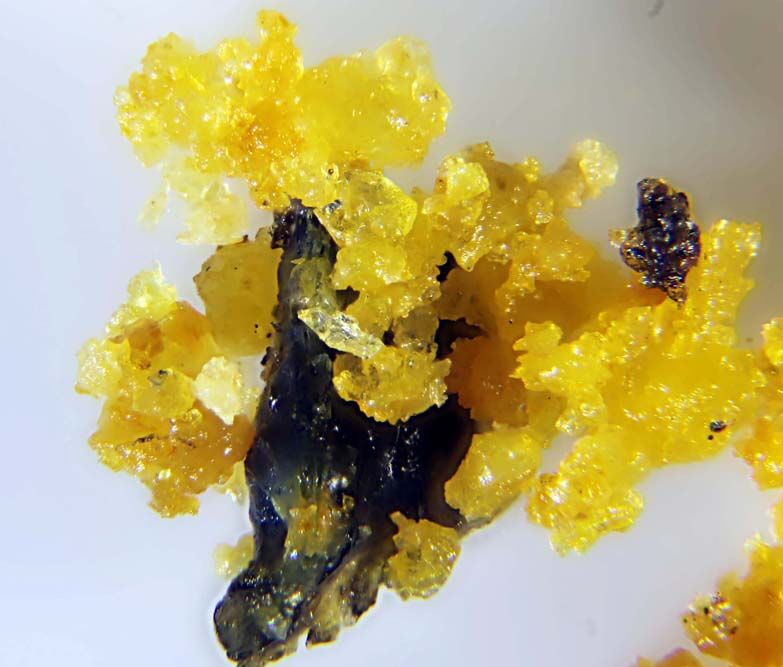
- Ruby-red to red · brownish red
- Cleavage
- Perfect
On (21) and (011).
- Density
- 2.175 g/cm³
Optical
- Optical type
- Biaxial (+) · 2V measured = 70° · 2V calc = 82°
- Refractive index
- 1.733 – 1.807
- Surface relief
- High
- Principal indices
- nα 1.733 · nβ 1.763 · nγ 1.807
- Dispersion
- r > v or r < v
Δ = 0Δmax
PPLpleochroism per grain
XPLindependent extinctions · rotate the stage
PPLpleochroism only · colour blends on rotation
XPLinterference colour · extinct every 90°
Retardation740 nm
Order2nd order
XPL colour
Crystallography
- Space group
- Pnma
- Cell parameters
- a = 13.78 Å · b = 9.85 Å · c = 7.09 Å
- Ratio a:b:c
- 1 : 0.715 : 0.515
- Z
- 4
- Morphology
Crystals pseudooctahedral with (011) and (210) in equal development.
- Twinning
On [21_1] and [20_1] (artificial material)
Crystal structure
Chemical composition
Synonyms
- Eisenchlorid mit Chlorkalium
- Kopeiskite
- Kopeyskite
In other languages
- French
- Kremersite
- German
- Kremersit
- Italian
- Kremersite
Classification
Strunz
10th ed.3.CJ.10
- 3HalidesClass
- 3.CComplex halidesDivision
- 3.CJWith MX6 complexes; M = Fe, Mn, CuGroup
- 3.CJ.10KremersiteSpecies
Dana
8th ed.11.04.01.02
- 11Halide ComplexesClass
- 11.04AmBX5·xH2OType
- 11.04.01— unnamed intermediate level —Group
- 11.04.01.02KremersiteSpecies
CIM
—8.11.7
- 8Halides - Fluorides, Chlorides, Bromides and Iodides; also Fluoborates and FluosilicatesClass
- 8.11Halides of Fe and NiGroup
- 8.11.7KremersiteSpecies
Group, growth & confusion
Literature, links & citation
Citations
- 1851Kremers P (1851) Ueber die aschenbestandtheile und die producte der trocknen destillation bei braun- und steinkohlen. Ueber das natürliche vorkommen des doppelsaizes von eisenchlorid mit den chloralkalien. Annalen der Physik und Chemie 84, 67-80
- 1853Kenngott A (1853) IV. Ordnung: Salze. Eisenchlorid mit chloralkalien. in Uebersicht der Resultate Mineralogischer Forschungen in den Jahren 1850 und 1851, K K Hof- und Staatsdruckerei (Wien) 24-24
- 1903Johnson (1903) Neues Jahrbuch für Mineralogie, Geologie und Paleontologie, Heidelberg, Stuttgart: II: 93 (artif. mat.).
- 1907Lacroix (1907) Bulletin de la Société française de Minéralogie: 30: 253.
- 1908Lacroix (1908) Comptes rendu de l’Académie des sciences de Paris: 147: 162.
Cite this entry
Entry last updated
@misc{mineral2025,
  author    = {Mineral Index editorial board},
  title     = {Kremersite — Mineral Index},
  year      = {2025},
  url       = {https://mineralindex.org/minerals/kremersite-2273}
}