History
Langite carries the name of a man who never found it. The crystallographer who first described it, Nevil Story-Maskelyne, named the mineral in 1864 after Viktor von Lang, a young Austrian physicist and crystallographer he knew.
Von Lang was working in London at the time. Born in Vienna in 1838, he spent the years 1862 to 1864 employed at the British Museum before returning home. He went on to become Professor of Physics at the University of Vienna and a pioneer of crystal physics — the study of how a crystal's internal structure shapes its physical behaviour. He died in Vienna in 1921.
The first specimens came from Cornwall, in the far southwest of England. Story-Maskelyne announced the find in a scientific journal the same year, naming two Cornish copper mines as its source: Fowey Consols, near the village of Tywardreath, and the mines around St Just. These two sites remain the mineral's type localities — the places whose specimens define the species. The original type material is kept at the Natural History Museum in Vienna, von Lang's own city.
Industrial & practical applications
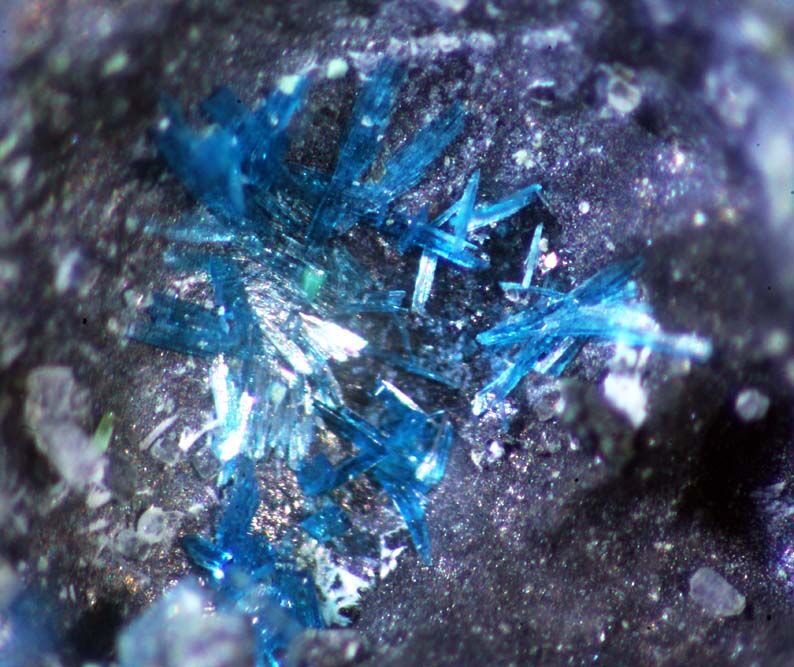
Langite has no industrial use. It is far too rare to mine for copper, and it occurs almost exclusively as druses of tiny crystals — clusters of small crystals lining a cavity — rather than in workable masses. It is a secondary mineral, forming where copper sulfide ores weather and oxidise, sometimes only after a mine has been opened. That makes it a mineral of collectors and museums rather than of factories. Its small, vivid blue-green crystals are sought as micromount specimens — samples mounted for viewing under a microscope — and as a representative of its species in reference collections.
Where it forms, where it's found
- Type locality
- Fowey Consols (incl. Wheal Treasure
- Wheal Fortune
- Wheal Chance)
- Tywardreath and Par
- Cornwall
- England
- UK
50.3700°, -4.6958°
Physical
Optical
- Optical type
- Biaxial (-) · 2V measured = 65° · 2V calc = 78°
- Refractive index
- 1.708 – 1.798
- Surface relief
- High
- Principal indices
- nα 1.708 · nβ 1.76 · nγ 1.798
- Pleochroism
- Visible
X = c = Light yellowish green Y = b = Blue-green Z = a = Sky-blue
- Dispersion
- r > v weak
Crystallography
- Cell parameters
- a = 7.118 Å · b = 6.031 Å · c = 11.209 Å
- Cell angles
- β = 90 °
- Ratio a:b:c
- 1 : 0.847 : 1.575
- Z
- 2
- Morphology
Crystals small; equant or elongated [100]; lath-like, scales; fibro-lamellar crusts; earthy.
- Twinning
Common on (110). Repeated in part as aggregates flattened (001) rendering star-shaped twins.
- Comment
Space group Pc; metrically pseudo-orthorhombic
Chemical composition
In other languages
- French
- Langite
- German
- Langit
- Spanish
- Langita
- Italian
- Langite
Classification
7.DD.10
- 7SulfatesClass
- 7.DSulfates (selenates, etc.) with additional anions, with H2ODivision
- 7.DDWith only medium-sized cations; sheets of edge-sharing octahedraGroup
- 7.DD.10LangiteSpecies
31.04.03.01
- 31Hydrated Sulfates Containing Hydroxyl or HalogenClass
- 31.04(AB)4(XO4)Zq·xH2OType
- 31.04.03— unnamed intermediate level —Group
- 31.04.03.01LangiteSpecies
25.2.9
- 25SulphatesClass
- 25.2Sulphates of Cu and AgGroup
- 25.2.9LangiteSpecies
Group, growth & confusion
Literature, links & citation
- 1862(1862) XVI. On some of the basic salts of copper. The London, Edinburgh, And Dublin Philosophical Magazine And Journal Of Science, S. 4 Vol. 24 (159) 123-126 doi:10.1080/14786446208643325DOI: 10.1080/14786446208643325
- 1864Maskelyne, N.S. (1864) Notices of recent discoveries. New Cornish mineral ('Langite'). The Geological Magazine: 1: 48-48.
- 1864Maskelyne, N.S. in: Pisani, M. (1864) Minéralogie. - Analyse de la langite, nouveau minéral du Cornouailles. Comptes Rendus Hebdomadaires des Séances de l’Académie des Sciences: 59: 633.
- 1864Maskelyne, N. S. (1864) New British mineral. The London, Edinburgh, And Dublin Philosophical Magazine And Journal Of Science, S. 4 Vol. 27 (182) 316 doi:10.1080/14786446408643673DOI: 10.1080/14786446408643673
- 1864(1864) Analysis of Langite, a new mineral from Cornwall. The London, Edinburgh, And Dublin Philosophical Magazine And Journal Of Science, S. 4 Vol. 28 (190) 403-404 doi:10.1080/14786446408643787DOI: 10.1080/14786446408643787
Entry last updated
@misc{mineral2026,
  author    = {Mineral Index editorial board},
  title     = {Langite — Mineral Index},
  year      = {2026},
  url       = {https://mineralindex.org/minerals/langite-2322}
}