Where it forms, where it's found
- Geological setting
hydration-oxidation weathering of uraninite
- Type locality
- Swambo Hill
- Kambove Territory
- Haut-Katanga
- DR Congo
-11.0953°, 26.2233°
2recorded occurrences
Radioactivity
Physical
- Hardness
- 1Talc
- 2Gypsum
- 3Calcite
- 4Fluorite
- 5Apatite
- 6Orthoclase
- 7Quartz
- 8Topaz
- 9Corundum
- 10Diamond
- Colour
- yellow
- Streak
- pale yellow
- Tenacity
- brittle
- Cleavage
- Distinct/Good
multiple cleavages have been observed, but it is hard to determine the crystallographic orientations due to the intergrown nature of crystal aggregates.
- Density
- 4.12 g/cm³
Optical
- Optical type
- Biaxial (-) · 2V measured = 68° · 2V calc = 72°
- Refractive index
- 1.621 – 1.677
- Surface relief
- Moderate
- Principal indices
- nα 1.621 · nβ 1.657 · nγ 1.677
- Pleochroism
- Visible
X = yellow, Y = yellow, Z = light yellow;
- Dispersion
- not observed
- UV response
- non-fluorescent in SW and LW ultraviolet light
Δ = 0Δmax
PPLpleochroism per grain
XPLindependent extinctions · rotate the stage
PPLpleochroism only · colour blends on rotation
XPLinterference colour · extinct every 90°
Retardation560 nm
Order2nd order
XPL colour
Crystallography
- Cell parameters
- a = 11.7189(7) Å · b = 17.1013(7) Å · c = 38.681(2) Å
- Ratio a:b:c
- 1 : 1.459 : 3.301
- Z
- 4
- Type-locality form
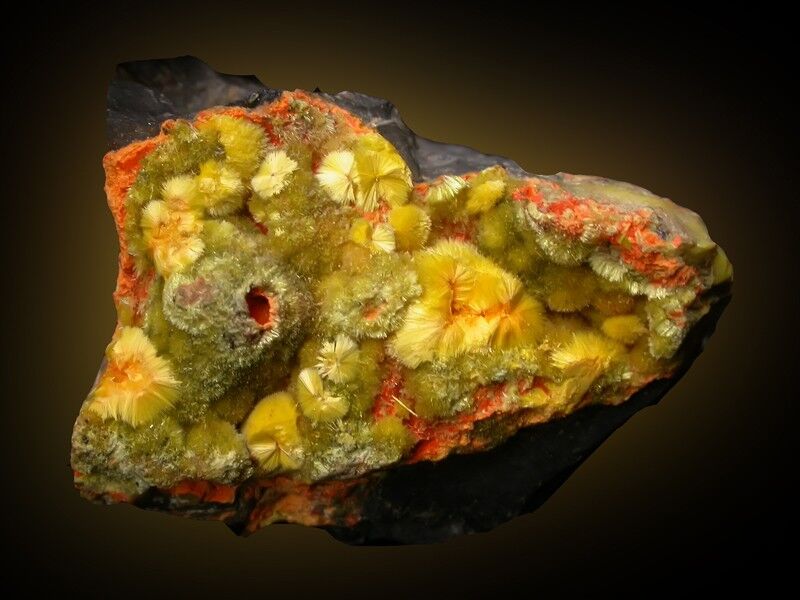
radial to acicular aggregates composed of long prismatic, thin crystals, as the products of hydration-oxidation weathering of uraninite.
- Comment
Space group is Pnnm or Pnn2 The small size, somewhat poor quality, and intergrown nature (see the discussion section) of lepersonnite-(Nd) crystals made structure determination through X-ray singlecrystal diffraction study impossible.
Chemical composition
Synonyms
- Lepersonniet-(Nd)
In other languages
- German
- IMA 2021-066 · Lepersonnit-(Nd)
Classification
Strunz
10th ed.5.EG.10
- 5CarbonatesClass
- 5.EUranyl CarbonatesDivision
- 5.EGWith SO4 or SiO4Group
- 5.EG.10Lepersonnite-(Nd)Species
Group, growth & confusion
Literature, links & citation
Citations
- 2022(2022) Lepersonnite-(Nd). Handbook of Mineralogy. Mineralogical Society of America
- 2025Plášil J, Steciuk G; Sejkora J, (2025) Extending the mineralogy of U6+ (I): Crystal structure of lepersonnite-(Gd) and a description of the new mineral lepersonnite-(Nd). Mineralogical Magazine, 89 (5). 549-565
Cite this entry
Entry last updated
@misc{mineral2025,
  author    = {Mineral Index editorial board},
  title     = {Lepersonnite-(Nd) — Mineral Index},
  year      = {2025},
  url       = {https://mineralindex.org/minerals/lepersonnite-nd-55684}
}