Where it forms, where it's found
- Geological setting
a secondary mineral believed to have formed through the evaporation process of fluids containing glycolic acid (C2H4O3) and (NH4) + derived from plants or bacterial activities
- Type locality
- Western end
- Pusch Ridge
- Pima County
- Arizona
- USA
32.3617°, -110.9583°
1recorded occurrences
Physical
Crystallography
- Space group
- P21/c
- Cell parameters
- a = 3.9130(1) Å · b = 18.7499(4) Å · c = 10.7214(2) Å
- Cell angles
- β = 107.444(2) °
- Ratio a:b:c
- 1 : 4.792 : 2.740
- Z
- 4
- Twinning
none
- Parting
- none
- Type-locality form
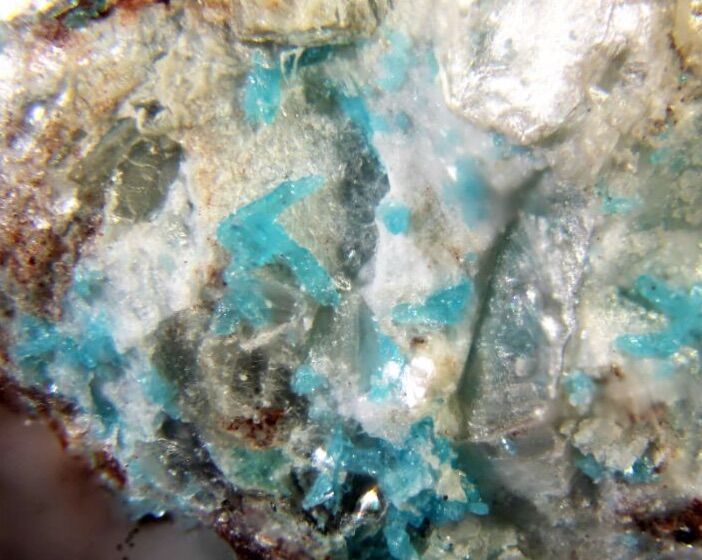
bladed or acicular crystals of lianbinite are up to 0.60 x 0.08 x 0.03 mm
Crystal structure
Chemical composition
Synonyms
- Lianbiniet
In other languages
- German
- IMA 2023-016 · Lianbinit
Classification
Strunz
10th ed.10.AA.40
- 10Organic CompoundsClass
- 10.ASalts of organic acidsDivision
- 10.AAFormates, Acetates, etc.Group
- 10.AA.40LianbiniteSpecies
Group, growth & confusion
Literature, links & citation
Citations
- 2023Bosi, Ferdinando; Hatert, Frédéric; Pasero, Marco; Mills, Stuart J. (2023) IMA Commission on New Minerals, Nomenclature and Classification (CNMNC) – Newsletter 73. European Journal of Mineralogy, 35 (3). 397-402 doi:10.5194/ejm-35-397-2023 DOI: 10.5194/ejm-35-397-2023
- 2025Yang, Hexiong; Gu, Xiangping; Lazar, Warren; Gibbs, Ronald B.; Downs, Robert T. (2025) Lianbinite, (NH4)(C2H3O3)(C2H4O3), a new glycolate mineral from the Santa Catalina Mountains, Tucson, Arizona, U.S.A. American Mineralogist, 110 (9). 1481-1487 doi:10.2138/am-2024-9587DOI: 10.2138/am-2024-9587
Cite this entry
Entry last updated
@misc{mineral2025,
  author    = {Mineral Index editorial board},
  title     = {Lianbinite — Mineral Index},
  year      = {2025},
  url       = {https://mineralindex.org/minerals/lianbinite-470784}
}