Where it forms, where it's found
- Type locality
- Western end
- Pusch Ridge
- Pima County
- Arizona
- USA
32.3617°, -110.9583°
1recorded occurrences
Physical
Optical
- Optical type
- Biaxial (+) · 2V measured = 62° · 2V calc = 69°
- Refractive index
- 1.539 – 1.558
- Surface relief
- Moderate
- Principal indices
- nα 1.539 · nβ 1.545 · nγ 1.558
Δ = 0Δmax
PPLpleochroism per grain
XPLindependent extinctions · rotate the stage
PPLpleochroism only · colour blends on rotation
XPLinterference colour · extinct every 90°
Retardation190 nm
Order1st order
XPL colour
Crystallography
- Space group
- P21/c
- Cell parameters
- a = 11.4927(2) Å · b = 5.8547(1) Å · c = 12.4711(2) Å
- Cell angles
- β = 91.161(1) °
- Ratio a:b:c
- 1 : 0.509 : 1.085
- Z
- 4
- Twinning
common on (100).
- Type-locality form
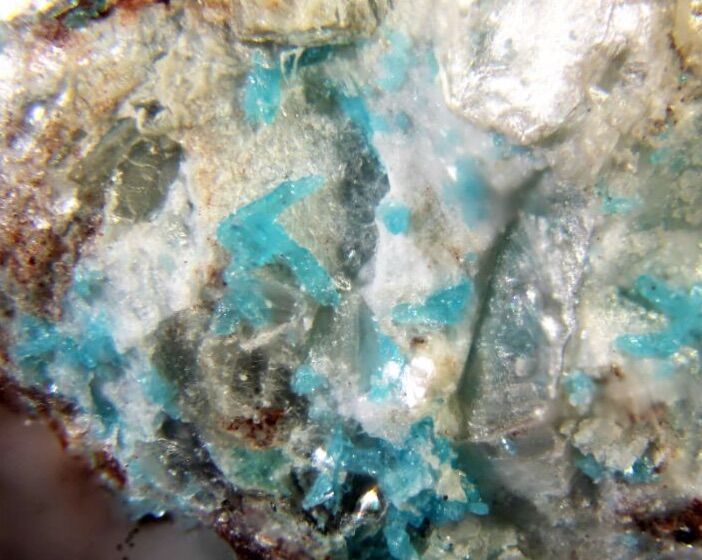
occurs as sprays of bladed crystals (up to 0.40 × 0.07 × 0.03 mm).
Chemical composition
Synonyms
- IMA2022-085
- Stanevansiet
In other languages
- German
- Stanevansit
Classification
Strunz
10th ed.10.AA.40
- 10Organic CompoundsClass
- 10.ASalts of organic acidsDivision
- 10.AAFormates, Acetates, etc.Group
- 10.AA.40StanevansiteSpecies
Group, growth & confusion
Literature, links & citation
Citations
- 2022Miyawaki, Ritsuro, Hatert, Frédéric, Pasero, Marco, Mills, Stuart J. (2022) IMA Commission on New Minerals, Nomenclature and Classification (CNMNC) – Newsletter 70. European Journal of Mineralogy, 34 (6) 591-601 doi:10.5194/ejm-34-591-2022 DOI: 10.5194/ejm-34-591-2022
- 2024Yang, Hexiong; Gu, Xiangping; Lazar, Warren; Gibbs, Ronald B.; Downs, Robert T. (2024) Stanevansite, Mg(C2H3O3)2·2H2O, a New Hydrous Glycolate Mineral, From The Santa Catalina Mountains, Tucson, Arizona, USA. The Canadian Journal of Mineralogy and Petrology, 62 (1). doi:10.3749/2300047DOI: 10.3749/2300047
Cite this entry
Entry last updated
@misc{mineral2025,
  author    = {Mineral Index editorial board},
  title     = {Stanevansite — Mineral Index},
  year      = {2025},
  url       = {https://mineralindex.org/minerals/stanevansite-470464}
}