Where it forms, where it's found
- Geological setting
Vugs in Seruci ignimbrites.
- Type locality
- Road SP 108
- Portoscuso
- South Sardinia Province
- Sardinia
- Italy
39.2443°, 8.3918°
2recorded occurrences
Physical
- Transparency
- Transparent
- Colour
- Dark brown
- Tenacity
- brittle
- Cleavage
- Perfect
(110)
- Density
- 3.315 g/cm³
Optical
- Optical type
- Biaxial (-) · 2V measured = 74° · 2V calc = 56°
- Refractive index
- 1.669 – 1.678
- Surface relief
- High
- Principal indices
- nα 1.669 · nβ 1.676 · nγ 1.678
- Pleochroism
- Visible
Pale grey (X), dark grey (Y), pale brownish grey (Z); X < Z < Y
- Extinction
- X ∧ a = 47.6° (β obtuse); Y = b; Z ∧ c = 33.4° (β acute).
- UV response
- None
Δ = 0Δmax
PPLpleochroism per grain
XPLindependent extinctions · rotate the stage
PPLpleochroism only · colour blends on rotation
XPLinterference colour · extinct every 90°
Retardation90 nm
Order1st order
XPL colour
Crystallography
- Space group
- C2/m
- Cell parameters
- a = 9.839(5) Å · b = 18.078(9) Å · c = 5.319(3) Å
- Cell angles
- β = 104.99(3) °
- Ratio a:b:c
- 1 : 1.837 : 0.541
- Unit cell volume
- 913.9 ų
- Z
- 2
- Morphology
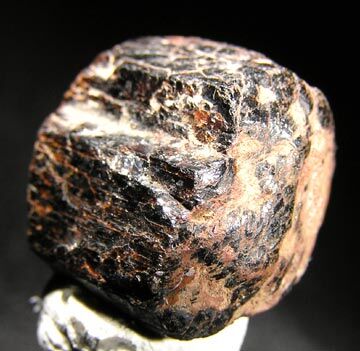
Prismatic crystals, commonly with striations on prism faces, oriented parallel to the direction of elongation.
- Type-locality form
Prismatic crystals, up to 3 mm in length, in vugs.
Chemical composition
- Impurities
- Fe(II)
- OH
- Cl
Synonyms
- IMA2014-091
- Magnesio-ferri-fluoro-hoornblende
In other languages
- German
- IMA 2014-091 · Magnesio-Ferri-Fluoro-Hornblende
- Italian
- magnesio-ferri-fluoro-hornblende · Magnesio-ferri-fluoro-orneblenda
Classification
Strunz
10th ed.9.DE.10
- 9SilicatesClass
- 9.DInosilicatesDivision
- 9.DEInosilicates with 2-periodic double chains, Si4O11; ClinoamphibolesGroup
- 9.DE.10Magnesio-ferri-fluoro-hornblendeSpecies
Group, growth & confusion
Literature, links & citation
Citations
- 2012Hawthorne, F. C., Oberti, R., Harlow, G. E., Maresch, W. V., Martin, R. F., Schumacher, J. C., Welch, M. D. (2012) Nomenclature of the amphibole supergroup. American Mineralogist, 97 (11) 2031-2048 doi:10.2138/am.2012.4276 DOI: 10.2138/am.2012.4276
- 2015Hålenius, U., Hatert, F., Pasero, M., Mills, S. J. (2015) New minerals and nomenclature modifications approved in 2015, CNMNC Newsletter No 24. Mineralogical Magazine, 79 (2) 247-251 doi:10.1180/minmag.2015.079.2.03DOI: 10.1180/minmag.2015.079.2.03
- 2016Oberti, Roberta, Boiocchi, Massimo, Hawthorne, Frank C., Ball, Neil A., Chiappino, Luigi (2016) Magnesio-ferri-fluoro-hornblende from Portoscuso, Sardinia, Italy: description of a newly approved member of the amphibole supergroup. Mineralogical Magazine, 80 (2) 269-275 doi:10.1180/minmag.2016.080.008DOI: 10.1180/minmag.2016.080.008
- 2017(2017) Magnesio-ferri-fluoro-hornblende. Handbook of Mineralogy. Mineralogical Society of America
Cite this entry
Entry last updated
@misc{mineral2025,
  author    = {Mineral Index editorial board},
  title     = {Magnesio-ferri-fluoro-hornblende — Mineral Index},
  year      = {2025},
  url       = {https://mineralindex.org/minerals/magnesio-ferri-fluoro-hornblende-43393}
}