Where it forms, where it's found
- Geological setting
Sand dunes
- Type locality
- Sand dunes of Lüderitz
- Lüderitz
- ǃNamiǂNûs Constituency
- ǁKaras Region
- Namibia
-26.6478°, 15.1578°
265recorded occurrences
Physical
Optical
- Optical type
- Biaxial (-) · 2V measured = 66 – 85° · 2V calc = 58 – 88°
- Refractive index
- 1.616 – 1.7
- Surface relief
- High
- Principal indices
- nα 1.616 – 1.68 · nβ 1.626 – 1.695 · nγ 1.636 – 1.7
- Pleochroism
- Visible
(X – pale yellow < Y – bluish green < Z – dark green
- Dispersion
- r > v or r < v
- Luminescence
- Nonfluorescent
Δ = 0Δmax
PPLpleochroism per grain
XPLindependent extinctions · rotate the stage
PPLpleochroism only · colour blends on rotation
XPLinterference colour · extinct every 90°
Retardation200 nm
Order1st order
XPL colour
Crystallography
- Space group
- C2/m
- Cell parameters
- a = 9.8307(7) Å · b = 18.0659(11) Å · c = 5.2968(4) Å
- Cell angles
- β = 104.771(6) °
- Ratio a:b:c
- 1 : 1.838 : 0.539
- Z
- 2
- Type-locality form
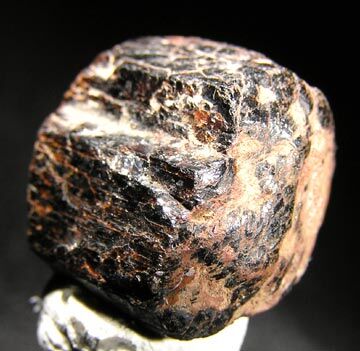
holotype specimen is a friable block of subhedral to anhedral magnesio hornblende crystals up to a few millimeters.
- Comment
Unit-cell parameters from the IMA approval of 2017.
Crystal structure
Chemical composition
- Impurities
- Ti
- Mn
- Na
- K
- Cl
- H2O
Synonyms
- Actinolitic hornblende
- Alumino-magnesio-hornblende
- IMA2017-059
- Magnesio-hoornblende
- Tremolitic hornblende
In other languages
- German
- IMA 2017-059 · Magnesio-Hornblende
- Italian
- magnesio-hornblende · magnesio-orneblenda · magnesiohornblende
Classification
Strunz
10th ed.9.DE.10
- 9SilicatesClass
- 9.DInosilicatesDivision
- 9.DEInosilicates with 2-periodic double chains, Si4O11; ClinoamphibolesGroup
- 9.DE.10Magnesio-hornblendeSpecies
CIM
—16.23.6
- 16Silicates Containing Aluminum and other MetalsClass
- 16.23Aluminosilicates of Fe, Ca, and MgGroup
- 16.23.6Magnesio-hornblendeSpecies
Group, growth & confusion
Literature, links & citation
Citations
- 1981Spear, F.S. (1981) An experimental study of hornblende stability and compositional variability in amphibolite. American Journal of Science: 281: 697-734.
- 1989Makino, Kuniaki, Tomita, Katsutoshi (1989) Cation distribution in the octahedral sites of hornblendes. American Mineralogist, 74 (9-10) 1097-1105
- 1998Mandarino, Joseph A. (1998) The Second List of Additions and Corrections to the Glossary of Mineral Species (1995) - The Amphibole Group. The Mineralogical Record, 29 (3) 169-174
- 2006Hawthorne, F. C., Oberti, R. (2006) On the classification of amphiboles. The Canadian Mineralogist, 44 (1) 1-21 doi:10.2113/gscanmin.44.1.1DOI: 10.2113/gscanmin.44.1.1
- 2006Ishida, K. (2006) Assignment of infrared OH-stretching bands in calcic amphiboles through deuteration and heat treatment. American Mineralogist, 91 (5) 871-879 doi:10.2138/am.2006.1774DOI: 10.2138/am.2006.1774
Cite this entry
Entry last updated
@misc{mineral2025,
  author    = {Mineral Index editorial board},
  title     = {Magnesio-hornblende — Mineral Index},
  year      = {2025},
  url       = {https://mineralindex.org/minerals/magnesio-hornblende-2524}
}