Where it forms, where it's found
- Geological setting
granitic pegmatite
- Type locality
- White Rock No. 2 pegmatite
- White Rock Feldspar Mine
- Old Boolcoomata Station
- Bimbowrie Conservation Park
- Pastoral Unincorporated Area
- South Australia
- Australia
-32.0811°, 140.3292°
1recorded occurrences
Physical
- Hardness
- 1Talc
- 2Gypsum
- 3Calcite
- 4Fluorite
- 5Apatite
- 6Orthoclase
- 7Quartz
- 8Topaz
- 9Corundum
- 10Diamond
- Transparency
- Translucent
- Colour
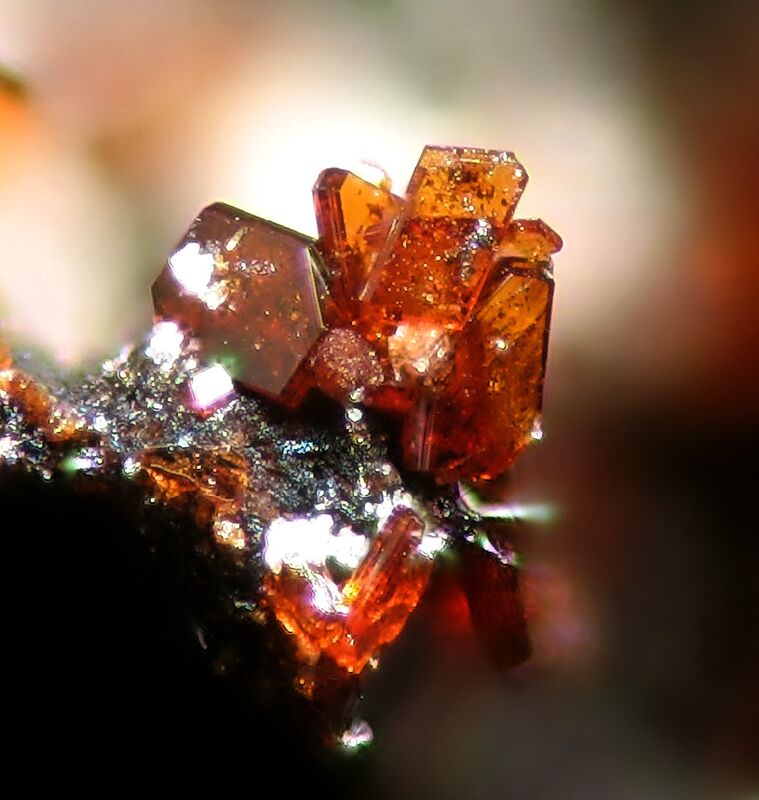
- orange-red to brownish red
- Streak
- salmon pink
- Tenacity
- brittle
- Cleavage
- Perfect
Good on (100) (mentioned in abstract) Perfect on (001) (mentioned in article)
- Fracture
- Conchoidal
- Density
- 2.75 g/cm³
Optical
- Optical type
- Biaxial (-) · 2V calc = 70.4°
- Refractive index
- 1.69 – 1.734
- Surface relief
- High
- Principal indices
- nα 1.690 · nβ 1.719 · nγ 1.734
- Pleochroism
- Strong
X = pale orange red, Y = pale yellow, Z = dark orange red; Z > X>Y.
- UV response
- does not fluoresce under ultraviolet light
Δ = 0Δmax
PPLpleochroism per grain
XPLindependent extinctions · rotate the stage
PPLpleochroism only · colour blends on rotation
XPLinterference colour · extinct every 90°
Retardation440 nm
Order1st order
XPL colour
Crystallography
- Space group
- P21
- Cell parameters
- a = 5.421(1) Å · b = 19.072(4) Å · c = 5.389(1) Å
- Cell angles
- β = 110.21(3) °
- Ratio a:b:c
- 1 : 3.518 : 0.994
- Unit cell volume
- 522.89 ų
- Z
- 2
- Morphology
The observed crystal forms are (010), (100), (001), (101) and (111)
- Type-locality form
as twinned, bladed to tabular crystals, up to 0.3 mm long, forming aggregates up to 1.2 mm across. Magnesiobermanite occurs in cavities in a matrix comprising quartz and hydrothermally altered dark brown to black dufrénite-group minerals (dufrénite–natrodufrénite–gayite–bimbowrieite) that have nearly completely replaced earlier triplite.
Chemical composition
Synonyms
- IMA2018-115
- Magnesiobermaniet
In other languages
- German
- IMA 2018-115 · Magnesiobermanit
Classification
Strunz
10th ed.8.DC.20
- 8Phosphates, Arsenates, VanadatesClass
- 8.DPhosphates, etc. with additional anions, with H2ODivision
- 8.DCWith only medium-sized cations, (OH, etc.):RO4 = 1:1 and < 2:1Group
- 8.DC.20MagnesiobermaniteSpecies
Group, growth & confusion
Literature, links & citation
Citations
- 2019Miyawaki, Ritsuro, Hålenius, Ulf, Hatert, Frédéric, Pasero, Marco, Mills, Stuart J. (2019) IMA Commission on New Minerals, Nomenclature and Classification (CNMNC) NEWSLETTER 47. European Journal of Mineralogy, 31 (1) 197-202 doi:10.1127/ejm/2019/0031-2839DOI: 10.1127/ejm/2019/0031-2839
- 2022(2022) Magnesiobermanite. Handbook of Mineralogy. Mineralogical Society of America
- 2022Elliott, Peter (2022) Magnesiobermanite, MgMn3+2(PO4)2(OH)2⋅4H2O, the Mg analogue of bermanite: Description and crystal structure. Mineralogical Magazine, 86 (1) 127-133 doi:10.1180/mgm.2021.87DOI: 10.1180/mgm.2021.87
Cite this entry
Entry last updated
@misc{mineral2025,
  author    = {Mineral Index editorial board},
  title     = {Magnesiobermanite — Mineral Index},
  year      = {2025},
  url       = {https://mineralindex.org/minerals/magnesiobermanite-53350}
}