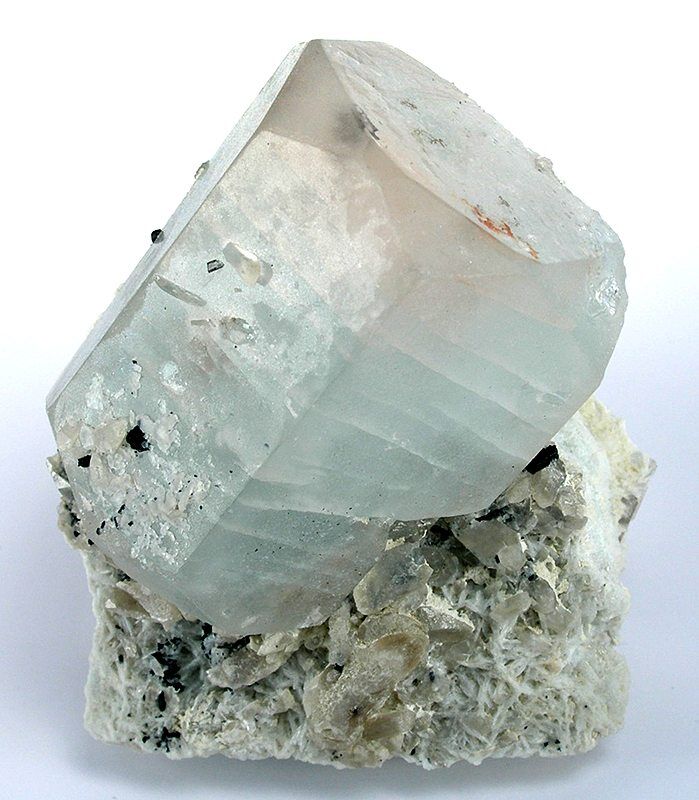
Where it forms, where it's found
140recorded occurrences
Safety & handling
Optical
- UV response
- blue shortwave-excited luminescence excited by SW UV caused by titanate groups (TiO<sub>6</sub>)
Chemical composition
Synonyms
- Cesian Beryl
- Morganit
- Morganita
- Rose Beryl
Literature, links & citation
Citations
- 1911Kunz, George Frederick (1911), Morganite, a rose-colored beryl: Am. Jour. Sci., 4th. series: 31: 81-82.
- 2003Hänni, H.A., Krzemnicki, M.S. (2003) Caesium-rich morganite from Afghanistan and Madagascar. The Journal of Gemmology, 28 (7) 417-429 doi:10.15506/jog.2003.28.7.417DOI: 10.15506/jog.2003.28.7.417
- 2023Vigier, Maxence, Fritsch, Emmanuel, Cavignac, Théo, Latouche, Camille, Jobic, Stéphane (2023) Shortwave UV Blue Luminescence of Some Minerals and Gems Due to Titanate Groups. Minerals, 13 (1) 104 doi:10.3390/min13010104 DOI: 10.3390/min13010104
Cite this entry
Entry last updated
@misc{mineral2025,
  author    = {Mineral Index editorial board},
  title     = {Morganite — Mineral Index},
  year      = {2025},
  url       = {https://mineralindex.org/minerals/morganite-2783}
}