Where it forms, where it's found
- Geological setting
Anthracite coal deposit.
Near-surface conditions. As coal mine efflorescences, cave deposits, around springs, in serpentinite fractures.
- Type locality
- Nesquehoning Coal Mine
- Nesquehoning
- Carbon County
- Pennsylvania
- USA
40.8625°, -75.8125°
76recorded occurrences
Physical
Optical
- Optical type
- Biaxial (-)
- Refractive index
- 1.412 – 1.526
- Principal indices
- nα 1.412 · nβ 1.501 · nγ 1.526
- Dispersion
- relatively strong
- UV response
- Green (SW UV).
Δ = 0Δmax
PPLpleochroism per grain
XPLindependent extinctions · rotate the stage
PPLpleochroism only · colour blends on rotation
XPLinterference colour · extinct every 90°
Retardation1140 nm
Order3rd order
XPL colour
Crystallography
- Space group
- #15
- Cell parameters
- a = 7.705 Å · b = 5.367 Å · c = 12.121 Å
- Cell angles
- β = 90.451 °
- Ratio a:b:c
- 1 : 0.697 : 1.573
- Z
- 4
- Morphology
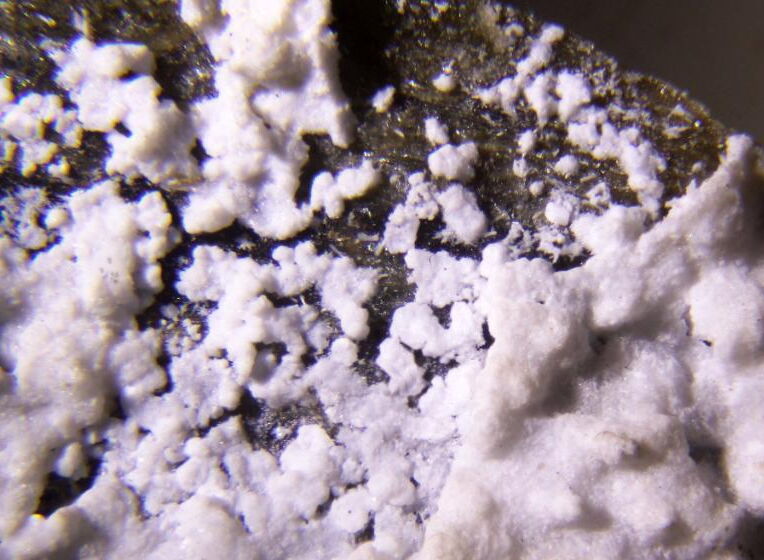
Crystals prismatic, elongated along [010], (001), (010), (011), (101). (110) deeply striated parallel to [010]. Forms radial sprays and coatings, also botryoidal.
- Twinning
Twinned on (001) (artificial material).
- Type-locality form
Bases of stalactites and incrustations, the remainder of which consisted of lansfordite.
Crystal structure
Chemical composition
In other languages
- French
- nesquehonite
- German
- Nesquehonit
- Italian
- Nesquehonite
Classification
Strunz
10th ed.5.CA.05
- 5CarbonatesClass
- 5.CCarbonates without additional anions, with H2ODivision
- 5.CAWith medium-sized cationsGroup
- 5.CA.05NesquehoniteSpecies
Dana
8th ed.13.01.05.01
- 13Acid CarbonatesClass
- 13.01MiscellaneousType
- 13.01.05— unnamed intermediate level —Group
- 13.01.05.01NesquehoniteSpecies
CIM
—11.3.3
- 11CarbonatesClass
- 11.3Carbonates of MgGroup
- 11.3.3NesquehoniteSpecies
Group, growth & confusion
Literature, links & citation
Citations
- 1890Genth, F.A., Penfield, S.L. (1890) On lansfordite, nesquehonite, a new mineral, and pseudomorphs of nesquehonite after lansfordite. American Journal of Science: 39: 121-137.
- 1890Genth and Penfield (1890) Zeitschrift für Kristallographie, Mineralogie und Petrographie, Leipzig: 17: 561.
- 1891Friedel, Charles (1891) Sur la nesquehonite. Bulletin de la Société Française de Minéralogie, 14 (2) 60-63 doi:10.3406/bulmi.1891.2206 DOI: 10.3406/bulmi.1891.2206
- 1906Davis (1906) J. Soc. Chem. Ind.: 25: 788.
- 1910Leitmeier (1910) Zeitschrift für Kristallographie, Mineralogie und Petrographie, Leipzig: 47: 108.
Cite this entry
Entry last updated
@misc{mineral2026,
  author    = {Mineral Index editorial board},
  title     = {Nesquehonite — Mineral Index},
  year      = {2026},
  url       = {https://mineralindex.org/minerals/nesquehonite-2885}
}