Where it forms, where it's found
- Geological setting
Cavities of grossular rodingite within a chrysotile asbestos deposit.
- Type locality
- Southern open pit
- Bazhenovskoye deposit
- Asbest
- Sverdlovsk Oblast
- Russia
Physical
Optical
- Optical type
- Biaxial (+) · 2V measured = 25° · 2V calc = 32°
- Refractive index
- 1.565 – 1.578
- Surface relief
- Moderate
- Principal indices
- nα 1.565 · nβ 1.566 · nγ 1.578
- Extinction
- Extinction is parallel and elongation is negative.
- UV response
- Not fluorescent.
- Notes
Optical orientation: X = c, Y = b, Z = a.
Δ = 0Δmax
PPLpleochroism per grain
XPLindependent extinctions · rotate the stage
PPLpleochroism only · colour blends on rotation
XPLinterference colour · extinct every 90°
Retardation130 nm
Order1st order
XPL colour
Crystallography
- Cell parameters
- a = 11.2220(4) Å · b = 7.3777(2) Å · c = 22.9425(8) Å
- Cell angles
- γ = 89.990(3) °
- Ratio a:b:c
- 1 : 0.657 : 2.044
- Type-locality form
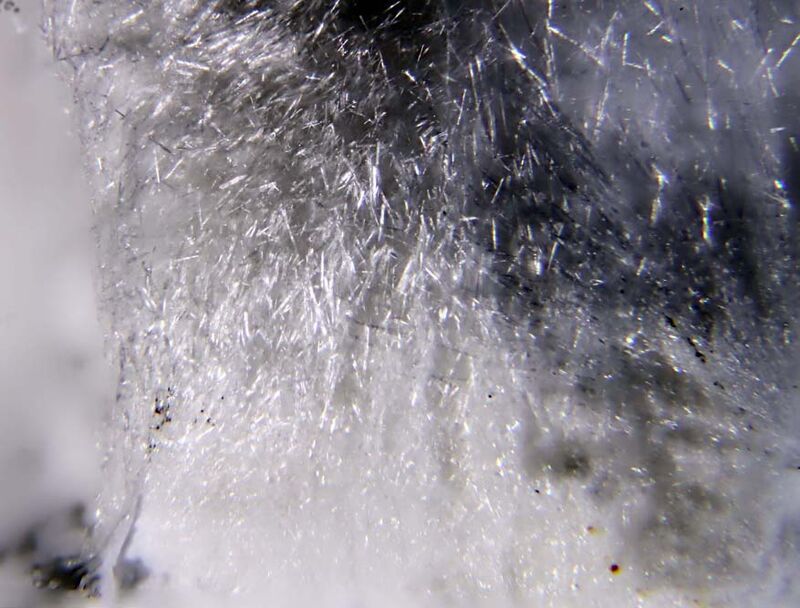
Well-shaped, prismatic to acicular crystals, up to 1 x 1.5 x 8 mm, usually forming spray- bush-like or open-work aggregates, up to 1.5 cm across; the latter comprise interrupted crusts, up to 3 x 5 cm.
- Comment
The space group is C1121/m (non-standard setting).
Synonyms
- IMA2020-100
- Paratobermoriet
In other languages
- German
- IMA 2020-100 · Paratobermorit
- Italian
- IMA2020-100 · paratobermorite
Classification
Strunz
10th ed.9.DG
- 9SilicatesClass
- 9.DInosilicatesDivision
- 9.DGInosilicates with 3-periodic single and multiple chainsGroup
- 9.DGParatobermoriteSpecies
Group, growth & confusion
Literature, links & citation
Citations
- —doi.org (n.d.) https://doi.org/10.2138/am-2022-8284
- 2021Miyawaki, Ritsuro, Hatert, Frédéric, Pasero, Marco, Mills, Stuart J. (2021) IMA Commission on New Minerals, Nomenclature and Classification (CNMNC) – Newsletter 61. European Journal of Mineralogy, 33 (3) 299-304 doi:10.5194/ejm-33-299-2021 DOI: 10.5194/ejm-33-299-2021
- 2022Pekov, Igor V., Zubkova, Natalia V., Chukanov, Nikita V., Merlino, Stefano, Yapaskurt, Vasiliy O., Belakovskiy, Dmitry I., Loskutov, Alexander B., Novgorodova, Elena A., Vozchikova, Svetlana A., Britvin, Sergey N., Pushcharovsky, Dmitry Yu (2022) Paratobermorite, Ca4(Al0.5Si0.5)2Si4O16(OH)·2H2O·(Ca·3H2O), a new tobermorite-supergroup mineral with a novel topological type of the microporous crystal structure. American Mineralogist, 107 (12) 2272-2281 doi:10.2138/am-2022-8284DOI: 10.2138/am-2022-8284
- 2023(2023) Paratobermorite. Handbook of Mineralogy. Mineralogical Society of America
Cite this entry
Entry last updated
@misc{mineral2025,
  author    = {Mineral Index editorial board},
  title     = {Paratobermorite — Mineral Index},
  year      = {2025},
  url       = {https://mineralindex.org/minerals/paratobermorite-55441}
}