Where it forms, where it's found
- Type locality
- Crestmore quarries
- Crestmore
- Jurupa Valley
- Riverside County
- California
- USA
34.0248°, -117.3836°
5recorded occurrences
Physical
- Hardness
- 1Talc
- 2Gypsum
- 3Calcite
- 4Fluorite
- 5Apatite
- 6Orthoclase
- 7Quartz
- 8Topaz
- 9Corundum
- 10Diamond
- Transparency
- Translucent · Opaque
- Colour
- White
- Cleavage
- Perfect
(001), perfect; (100), secondary
- Density
- 2.65 g/cm³
Optical
- Optical type
- Biaxial (+)
- Refractive index
- 1.6 – 1.605
- Surface relief
- Moderate
- Principal indices
- nα 1.600 · nβ 1.601 · nγ 1.605
- Dispersion
- r < v weak
- Notes
2V(meas.) = Small.
Δ = 0Δmax
PPLpleochroism per grain
XPLindependent extinctions · rotate the stage
PPLpleochroism only · colour blends on rotation
XPLinterference colour · extinct every 90°
Retardation50 nm
Order1st order
XPL colour
Crystallography
- Cell parameters
- a = 11.3 Å · b = 7.30 Å · c = 18.79 Å
- Ratio a:b:c
- 1 : 0.646 : 1.663
- Z
- 4
- Type-locality form
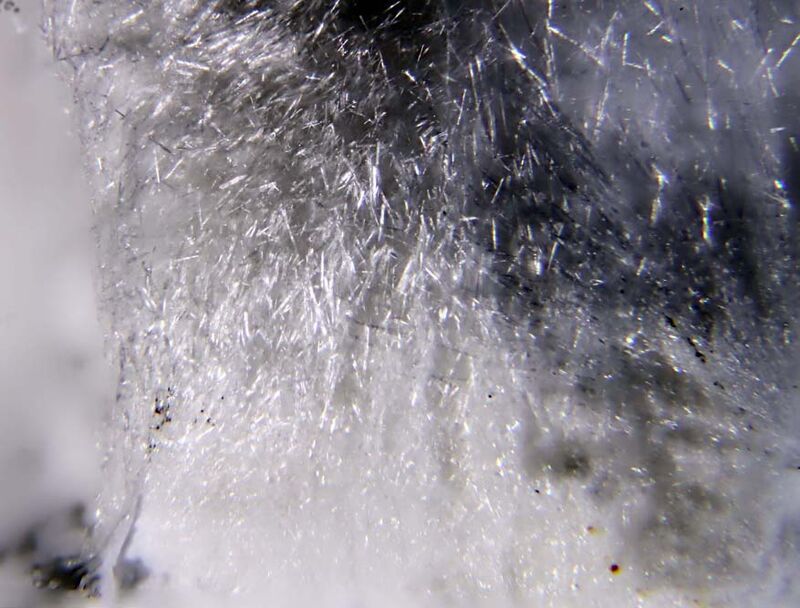
Cross-veinlet fibrous
- Comment
Point Group: n.d.; Space Group: n.d.
Chemical composition
- Impurities
- Ti
- Al
- Fe
- Mg
Synonyms
- Riversideiet
- Tobermorite-9Å
In other languages
- German
- Riversideit
- Italian
- riversideite
Classification
Strunz
10th ed.9.DG.10
- 9SilicatesClass
- 9.DInosilicatesDivision
- 9.DGInosilicates with 3-periodic single and multiple chainsGroup
- 9.DG.10RiversideiteSpecies
Dana
8th ed.72.03.02.04
- 72Phyllosilicates Two-dimensional Infinite Sheets with Other Than Six-membered RingsClass
- 72.03Two-Dimensional Infinite Sheets with Other Than Six-Membered Rings with 3-, 4-, or 5-membered rings and 8-membered ringsType
- 72.03.02Tobermorite group (5- & 8-membered rings)Group
- 72.03.02.04RiversideiteSpecies
CIM
—14.5.19
- 14Silicates not Containing AluminumClass
- 14.5Silicates of CaGroup
- 14.5.19RiversideiteSpecies
Group, growth & confusion
Literature, links & citation
Citations
- 1917Eakle, A.S. (1917) Minerals associated with the crystalline limestone at Crestmore, Riverside County, California. University of California Publications. Bulletin of the Department of Geology, 10, 327-360.
- 1953Taylor, H. F. W. (1953) Crestmoreite and Riversideite. Clay Minerals, 30 (222) 155-165 doi:10.1180/minmag.1953.030.222.01DOI: 10.1180/minmag.1953.030.222.01
- 1954Fleischer, M. (1954) New mineral names. American Mineralogist, 39 (11-12). 1037-1040
- 1954McConnell, J. D. C. (1954) The hydrated calcium silicates riversideite, tobermorite, and plombierite. Mineralogical Magazine and Journal of the Mineralogical Society, 30 (224) 293-305 doi:10.1180/minmag.1954.030.224.02 DOI: 10.1180/minmag.1954.030.224.02
- 1999Merlino, Stefano, Bonaccorsi, Elena, Armbruster, Thomas (1999) Tobermorites; their real structure and order-disorder (OD) character. American Mineralogist, 84 (10) 1613-1621 doi:10.2138/am-1999-1015 DOI: 10.2138/am-1999-1015
Cite this entry
Entry last updated
@misc{mineral2025,
  author    = {Mineral Index editorial board},
  title     = {Riversideite — Mineral Index},
  year      = {2025},
  url       = {https://mineralindex.org/minerals/riversideite-3427}
}