Where it forms, where it's found
- Geological setting
Sandstone
- Type locality
- Blue Lizard Mine
- Red Canyon Mining District
- San Juan County
- Utah
- USA
37.5572°, -110.2968°
5recorded occurrences
Radioactivity
Physical
Optical
- Optical type
- Biaxial (+) · 2V measured = 88° · 2V calc = 89°
- Refractive index
- 1.556 – 1.608
- Surface relief
- Moderate
- Principal indices
- nα 1.556 · nβ 1.581 · nγ 1.608
- Pleochroism
- Visible
X = nearly colourless, Y = very pale yellow, Z = pale yellow; X < Y < Z.
- Dispersion
- Dispersion is moderate, r < v.
- UV response
- Fluoresces bluish white under both long-wave and short-wave UV
Δ = 0Δmax
PPLpleochroism per grain
XPLindependent extinctions · rotate the stage
PPLpleochroism only · colour blends on rotation
XPLinterference colour · extinct every 90°
Retardation520 nm
Order1st order
XPL colour
Crystallography
- Space group
- P21/c
- Cell parameters
- a = 8.7122(6) Å · b = 13.8368(4) Å · c = 7.0465(2) Å
- Cell angles
- β = 112.126(8) °
- Ratio a:b:c
- 1 : 1.588 : 0.809
- Unit cell volume
- 786.89 ų
- Z
- 4
- Morphology
As long, thin blades, elongated on [001] and flattened on (100); rarely as prisms, also elongated on [001]. Forms observed : (100), (010) and (011).
- Twinning
Commonly twinned on (100).
- Type-locality form
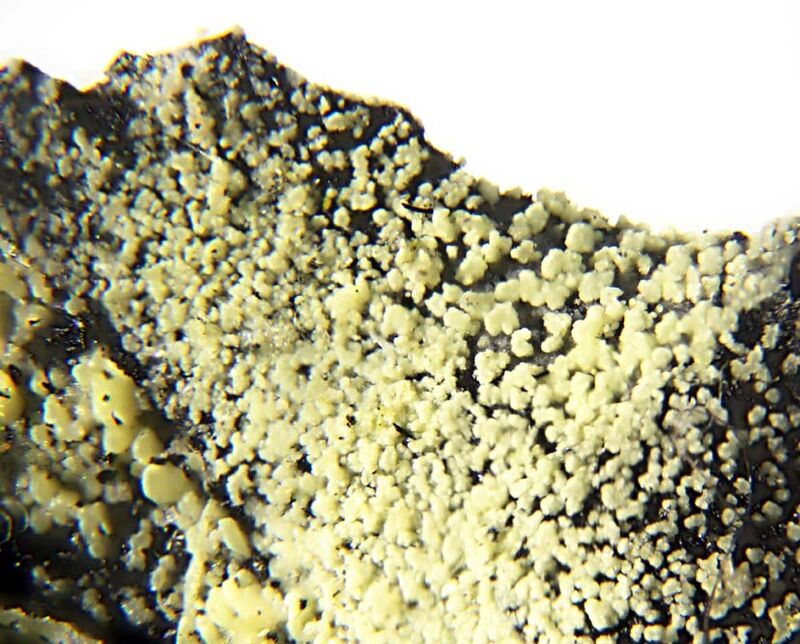
In and on sandstone. A low-temperature, secondary mineral formed by the post-mining weathering of uraninite.
Chemical composition
Synonyms
- IMA2014-021
- Plášiliet
In other languages
- German
- IMA 2014-021 · Plášilit
- Italian
- plášilite
Classification
Strunz
10th ed.7.EC.50
- 7SulfatesClass
- 7.EUranyl sulfatesDivision
- 7.ECWith medium-sized and large cationsGroup
- 7.EC.50PlášiliteSpecies
Group, growth & confusion
Literature, links & citation
Citations
- 2014Williams, P. A., Hatert, F., Pasero, M., Mills, S. J. (2014) New minerals and nomenclature modifications approved in 2014, CNMNC Newsletter No 21. Mineralogical Magazine, 78 (4) 797-804 doi:10.1180/minmag.2014.078.4.03DOI: 10.1180/minmag.2014.078.4.03
- 2015Kampf, A. R., Kasatkin, A. V., Čejka, J., Marty, J. (2015) Plášilite, Na(UO2)(SO4)(OH)•2H2O, a new uranyl sulfate mineral from the Blue Lizard mine, San Juan County, Utah, USA. Journal of GEOsciences, 60 (1) 1-10
- 2017(2017) Plášilite. Handbook of Mineralogy. Mineralogical Society of America
Cite this entry
Entry last updated
@misc{mineral2025,
  author    = {Mineral Index editorial board},
  title     = {Plášilite — Mineral Index},
  year      = {2025},
  url       = {https://mineralindex.org/minerals/plasilite-46145}
}