Where it forms, where it's found
- Geological setting
Amphibole skarns, making up more than 95% of the skarn in places.
- Type locality
- Dashkesan Co-Fe deposit
- Dashkasan
- Dashkasan District
- Azerbaijan
40.5113°, 46.0739°
10recorded occurrences
Physical
Optical
- Optical type
- Biaxial (-) · 2V measured = 15°
- Refractive index
- 1.669 – 1.705
- Surface relief
- High
- Principal indices
- nα 1.669 – 1.68 · nβ 1.682 – 1.695 · nγ 1.684 – 1.705
- Pleochroism
- Strong
α = pale orange-yellow; β = dark blue-green; γ = dark green-blue.
- Dispersion
- r > v distinct
- Extinction
- Y = b; Z ∧ c = 11°.
- Notes
Pekov et al. (2005) give the RIs as: α = 1.728(2); β = 1.749(5); γ = 1.751(2).
Δ = 0Δmax
PPLpleochroism per grain
XPLindependent extinctions · rotate the stage
PPLpleochroism only · colour blends on rotation
XPLinterference colour · extinct every 90°
Retardation200 nm
Order1st order
XPL colour
Crystallography
- Space group
- #11
- Cell parameters
- a = 9.964 Å · b = 18.31 Å · c = 5.351 Å
- Cell angles
- β = 105 °
- Ratio a:b:c
- 1 : 1.838 : 0.537
Chemical composition
Synonyms
- Chloro-Kaliumhastingsit
- Dashkesanite
- IMA2005-007
- Potassic-chloro-hastingsiet
- Potassic-Chloro-Hastingsit
In other languages
- German
- Chloro-Kaliumhastingsit · IMA 2005-007 · Kalium-Chloro-Hastingsit
- Italian
- chloro-potassichastingsite · dashkesanite · potassic-chloro-hastingsite · Potassic-cloro-hastingsite
Classification
Strunz
10th ed.9.DE.15
- 9SilicatesClass
- 9.DInosilicatesDivision
- 9.DEInosilicates with 2-periodic double chains, Si4O11; ClinoamphibolesGroup
- 9.DE.15Potassic-chloro-hastingsiteSpecies
Group, growth & confusion
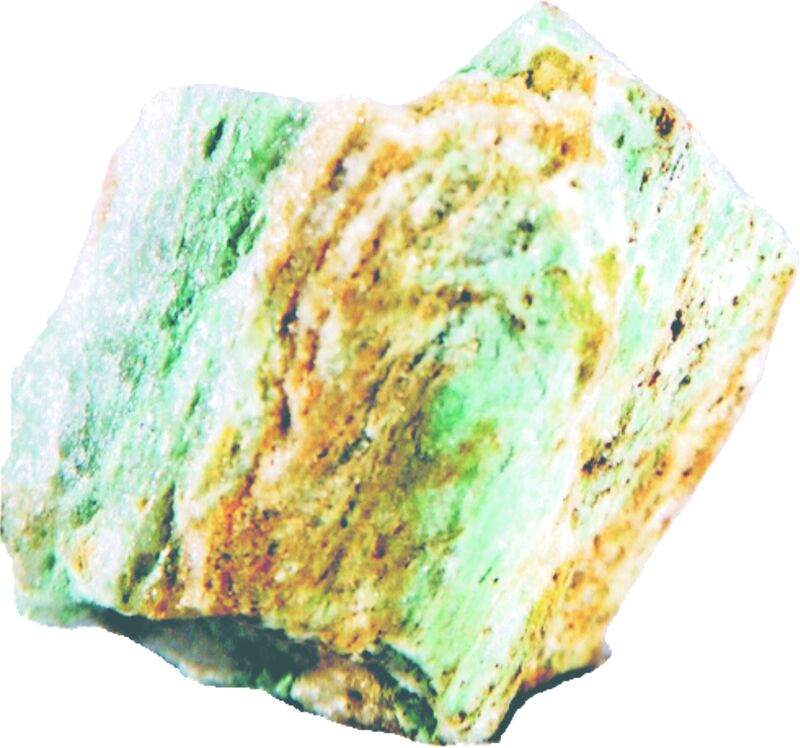 HastingsiteNaCa2(Fe2+4Fe3+)(Si6Al2)O22(OH)2Mineral—
- Magnesio-fluoro-hastingsiteNaCa2(Mg4Fe3+)(Si6Al2)O22F2Mineral—
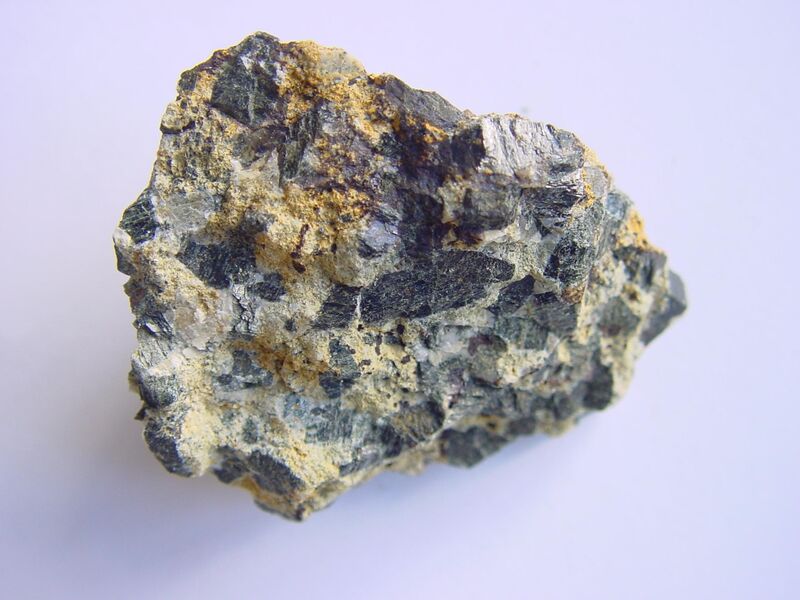 Magnesio-hastingsiteNaCa2(Mg4Fe3+)(Si6Al2)O22(OH)2Mineral—
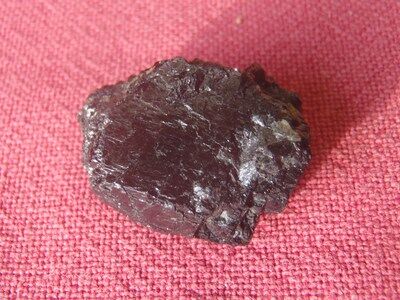 Potassic-fluoro-hastingsiteKCa2(Fe2+4Fe3+)(Si6Al2)O22F2Mineral—
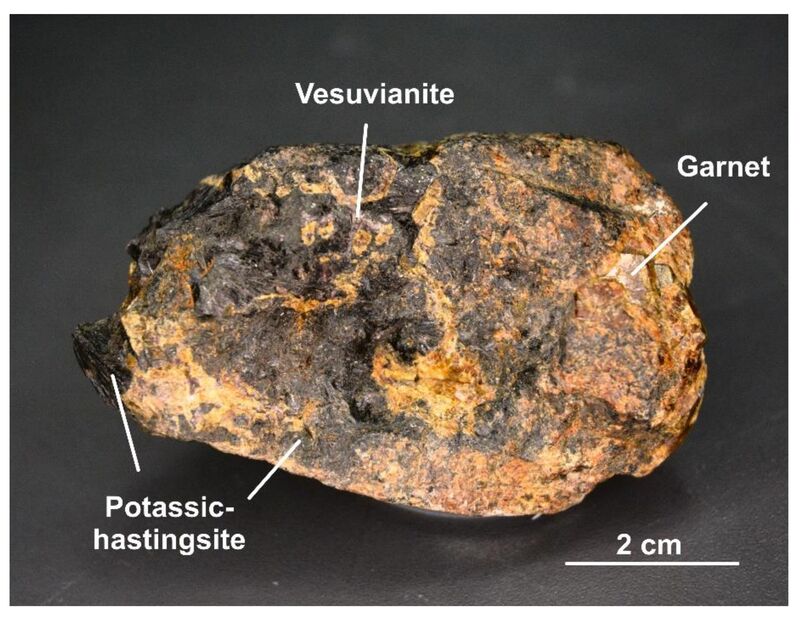 Potassic-hastingsiteKCa2(Fe2+4Fe3+)(Si6Al2)O22(OH)2Mineral—
- Potassic-magnesio-hastingsiteKCa2(Mg4Fe3+)(Si6Al2)O22(OH)2Mineral—
Literature, links & citation
Citations
- 1936Krutov, G.A. (1936) Bull. Acad. Sci. URSS Cl. Sci. Mat. Nat. Ser. Geol., 341-374.
- 1978Leake, Bernard E. (1978) Nomenclature of amphiboles. American Mineralogist, 63 (11-12) 1023-1052
- 1993Makino, K., Tomita, K. (1993) Effect of chlorine on the crystal structure of a chlorine-rich hastingsite. Mineralogical Magazine, 57, 677-685.
- 1996Rastsvetaeva, R.K.; Pushcharovskii, D.Yu.; Vinogradova, R.A.; Pekov, I.V. (1996). Crystal structure of dashkesanite. Kristallografiya, 41, 65–69. (as dashkesanite).
- 2005Pekov, I.V., Chukanov, N.V., Nefedova, M.E., Pushcharovsky, D.Yu., Rastsvetaeva, R.K. (2005) Chloro-potassichastingsite (K.Na)Ca2(Fe2+,Mg)4Fe3+[Si6Al2O22](Cl,OH)2: revalidation and the new name of dashkesanite. Zapiski Rossiyskogo Mineralogicheskogo Obshchestva, 134(6), 31-35. (in Russian, English abstract)
Cite this entry
Entry last updated
@misc{mineral2025,
  author    = {Mineral Index editorial board},
  title     = {Potassic-chloro-hastingsite — Mineral Index},
  year      = {2025},
  url       = {https://mineralindex.org/minerals/potassic-chloro-hastingsite-27445}
}