Where it forms, where it's found
- Type locality
- Sant'Olga tunnel
- Monte Arsiccio Mine
- Sant'Anna di Stazzema
- Stazzema
- Lucca Province
- Tuscany
- Italy
43.9667°, 10.2833°
3recorded occurrences
Safety & handling
Physical
Optical
- Pleochroism
- Weak
Very weak, very pale yellow to very pale blue
- Optical colour
- White
- Anisotropism
- Distinct, blue green to brown
- Bireflectance
- Distinct
- Internal reflections
- Scarce, dark red along fractures
- Tropism
- Anisotropic
- Reflectance R%
- (35.9,42.1) 400, (37.1,40.2) 420, (36.9,40.2) 440, (36.5,39.5) 460, (36.4,39.5) 470, (36.5,39.3) 480, (35.4,37.8) 500, (34.8,37.2) 520, (34.4,36.8) 540, (34.2,36.7) 546, (34.1,36.4) 560, (33.4,35.7) 580, (33.0,35.4) 589, (32.8,35.1) 600, (32.1,34.4) 620, (31.5,33.7) 640, (31.2,33.4) 650, (30.7,33.2) 660, (30.3,32.6) 680, (29.6,31.8) 700
Reflected-light panel
R̄ 33.8 %anisotropic · dual curve
Specimen
White reference
R₁ R₂
Mode
Crystallography
- Cell parameters
- a = 8.150(2) Å · b = 8.716(2) Å · c = 21.579(4) Å
- Cell angles
- α = 85.18(1) ° · β = 96.94(1) ° · γ = 88.60(1) °
- Ratio a:b:c
- 1 : 1.069 : 2.648
- Z
- 2
- Type-locality form
Compact masses.
Crystal structure
Synonyms
- IMA2011-054
- Protochabournéiet
In other languages
- German
- IMA 2011-054 · Protochabournéit
- Italian
- protochabournéite
Classification
Strunz
10th ed.2.HD.45
- 2Sulfides and SulfosaltsClass
- 2.HSulfosalts of SnS archetypeDivision
- 2.HDWith TlGroup
- 2.HD.45ProtochabournéiteSpecies
Group, growth & confusion
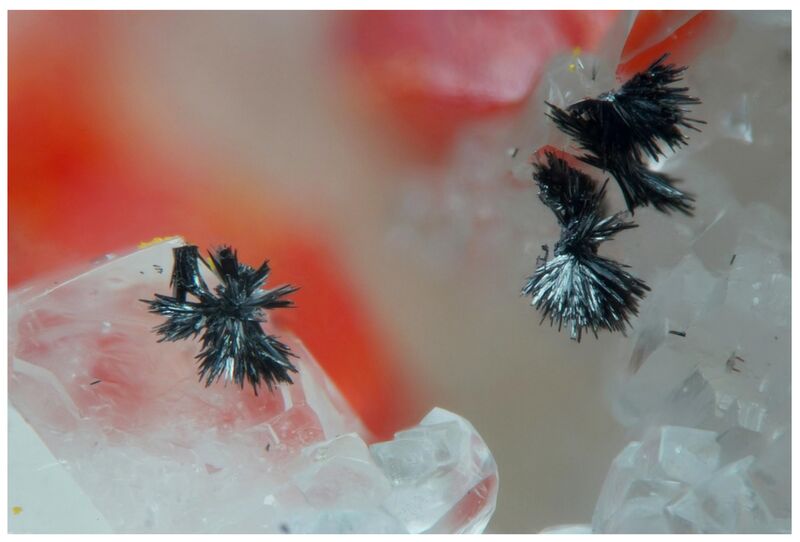 ChabournéiteAgzTl8-x-zPb4+2xSb40-x-yAsyS68 (with 0.00 ≤ x ≤ 0.40, 16.15 ≤ y ≤ 19.11, 0.04 ≤ z ≤ 0.11)Mineral—
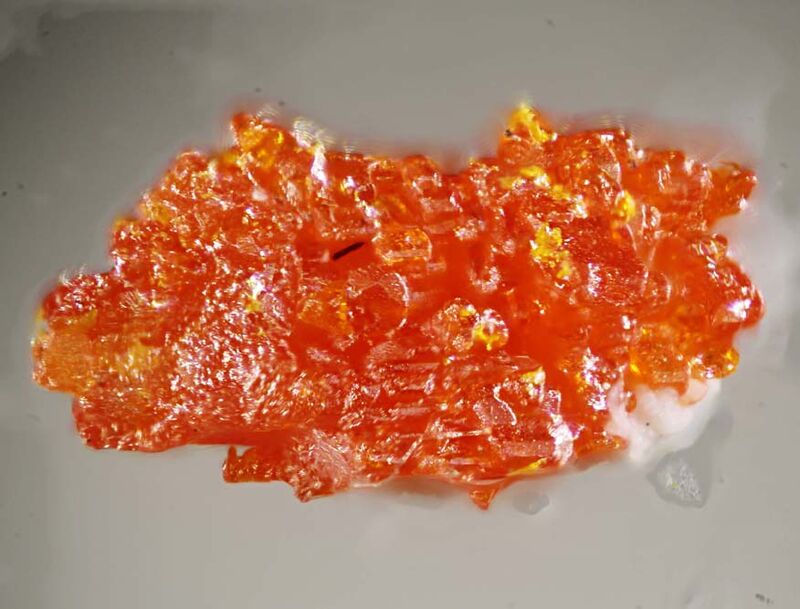 DalnegroiteTl4Pb2(As,Sb)20S34Mineral—
- DewititeAgzTl10-x-zPb2xSb42-x-yAsyS68 (0.09 ≤ x ≤ 2.13, 13.99 ≤ y ≤ 19.79, 0.10 ≤ z ≤ 0.50)Mineral—
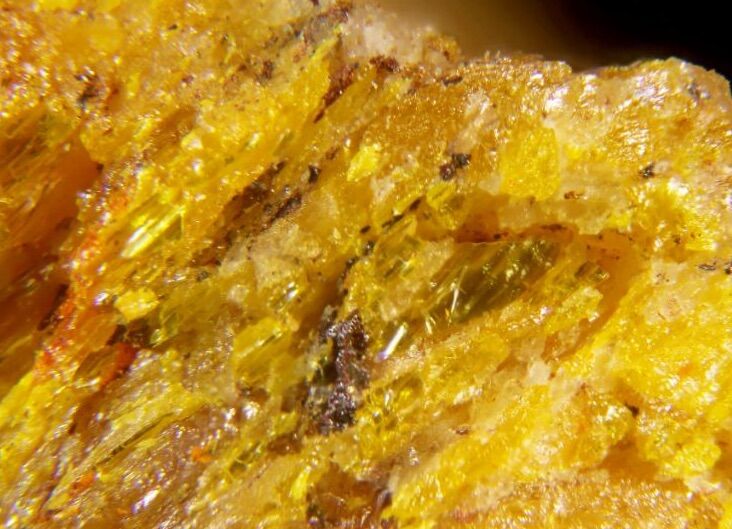 ShimeniteTl5Sb21-yAsyS34 (9 ≤ y ≤ 10)Mineral—
- VallouiseiteAg3Tl21.5PbSb63As41.5S170Mineral—
Literature, links & citation
Citations
- 2011Williams, P. A., Hatert, F., Pasero, M., Mills, S. J. (2011) New minerals and nomenclature modifications approved in 2011. CNMNC Newsletter No 11. Mineralogical Magazine, 75 (6) 2887-2893 doi:10.1180/minmag.2011.075.6.2887 DOI: 10.1180/minmag.2011.075.6.2887
- 2013Orlandi, P., Biagioni, C., Moëlo, Y., Bonaccorsi, E., Paar, W. H. (2013) Lead-antimony sulfosalts from Tuscany (Italy) XIII. Protochabournéite, ~Tl2Pb(Sb9–8As1–2)∑10S17, from the Monte Arsiccio mine: Occurrence, crystal structure and relationship with chabournéite. The Canadian Mineralogist, 51 (3) 475-494 doi:10.3749/canmin.51.3.475 DOI: 10.3749/canmin.51.3.475
- 2016(2016) Protochabournéite. Handbook of Mineralogy. Mineralogical Society of America
- 2021Miyawaki, Ritsuro, Hatert, Frédéric, Pasero, Marco, Mills, Stuart J. (2021) IMA Commission on New Minerals, Nomenclature and Classification (CNMNC) CNMNC Newsletter No 63. Mineralogical Magazine, 85 (6) 910-915 doi:10.1180/mgm.2021.74 DOI: 10.1180/mgm.2021.74
- 2022Kasatkin, A.V.; Stepanov, S.Yu.; Tsyganko, M.V.; Škoda, R.; Nestola, F.; Plàšil, J.; Makovicky, E.; Agakhanov, A.A.; Palamarchuk, R.S. (2022) Mineralogy of the Vorontsovskoe gold deposit (Northern Urals). МИНЕРАЛОГИЯ (MINERALOGY), 8 (1). 5-93 doi:10.35597/2313-545x-2022-8-1-1 DOI: 10.35597/2313-545x-2022-8-1-1
Cite this entry
Entry last updated
@misc{mineral2025,
  author    = {Mineral Index editorial board},
  title     = {Protochabournéite — Mineral Index},
  year      = {2025},
  url       = {https://mineralindex.org/minerals/protochabourneite-42840}
}