Where it forms, where it's found
- Geological setting
Fumarole. Likely deposited at a temperature ranging from 200 to 300 °C.
- Type locality
- Tolbachik Volcanic field
- Milkovsky District
- Kamchatka Krai
- Russia
1recorded occurrences
Physical
Optical
- Pleochroism
- Non-pleochroic
- Optical colour
- Grey with a weak bluish tint.
- Anisotropism
- Distinct
- Internal reflections
- Ubiquitous, red to orange.
- Tropism
- Anisotropic
- Reflectance R%
- (19,21.75) 400, (18.55,21.1) 420, (17.9,20.55) 440, (17.25,19.95) 460, (17.05,19.6) 470, (16.9,19.3) 480, (16.6,18.9) 500, (16.35,18.5) 520, (16.15,18.25) 540, (16.1,18.15) 546, (16,17.95) 560, (15.9,17.75) 580, (15.85,17.7) 589, (15.8,17.6) 600, (15.7,17.45) 620, (15.6,17.4) 640, (15.55,17.4) 650, (15.5,17.4) 660, (15.5,17.4) 680, (15.5,17.4) 700
Reflected-light panel
R̄ 16.4 %anisotropic · dual curve
Specimen
White reference
R₁ R₂
Mode
Crystallography
- Space group
- P1 21/c 1
- Cell parameters
- a = 6.2695(4) Å · b = 8.0195(3) Å · c = 6.3620(3) Å
- Cell angles
- β = 111.96(1) °
- Ratio a:b:c
- 1 : 1.279 : 1.015
- Unit cell volume
- 296.66 ų
- Z
- 2
- Type-locality form
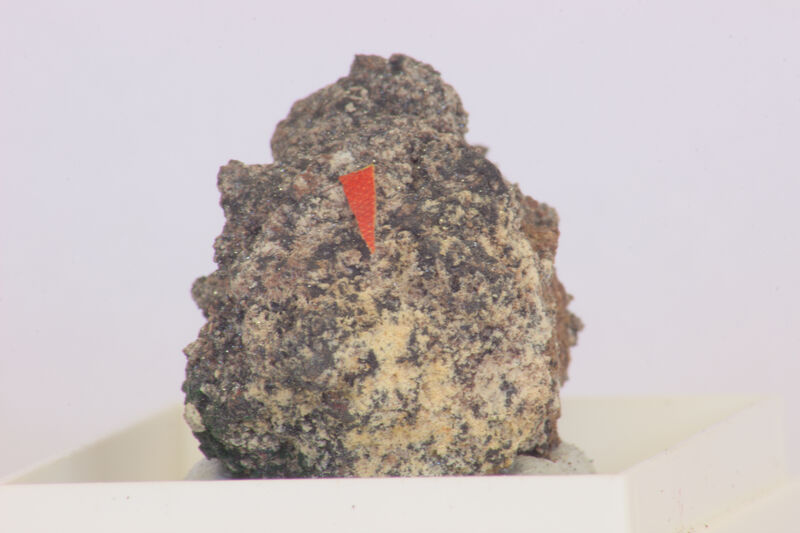
Needles that are 5–20 µm across and up to 0.5 mm in the length, which sometimes produce parallel intergrowths, sprays or openwork clusters up to 2 mm.
Crystal structure
Chemical composition
Synonyms
- IMA2009-062
- Pseudolyonsiet
In other languages
- German
- IMA 2009-062 · Pseudolyonsit
- Italian
- pseudolyonsite
Classification
Strunz
10th ed.8.AB.35
- 8Phosphates, Arsenates, VanadatesClass
- 8.APhosphates, etc. without additional anions, without H2ODivision
- 8.ABWith medium-sized cationsGroup
- 8.AB.35PseudolyonsiteSpecies
Dana
8th ed.38.03.08.04
- 38Anhydrous Normal Phosphates, Arsenates, and VanadatesClass
- 38.03(AB)3(XO4)2Type
- 38.03.08— unnamed intermediate level —Group
- 38.03.08.04PseudolyonsiteSpecies
Group, growth & confusion
Literature, links & citation
Citations
- 2011Zelenski, Michael E., Zubkova, Natalia V., Pekov, Igor V., Boldyreva, Maya M., Yu. Pushcharovsky, Dmitry, Nekrasov, Aleksey N. (2011) Pseudolyonsite, Cu3(VO4)2, a new mineral species from the Tolbachik volcano, Kamchatka Peninsula, Russia. European Journal of Mineralogy, 23 (3) 475-481 doi:10.1127/0935-1221/2011/0023-2101 DOI: 10.1127/0935-1221/2011/0023-2101
- 2015(2015) Pseudolyonsite. Handbook of Mineralogy. Mineralogical Society of America
Cite this entry
Entry last updated
@misc{mineral2025,
  author    = {Mineral Index editorial board},
  title     = {Pseudolyonsite — Mineral Index},
  year      = {2025},
  url       = {https://mineralindex.org/minerals/pseudolyonsite-40571}
}