Where it forms, where it's found
- Geological setting
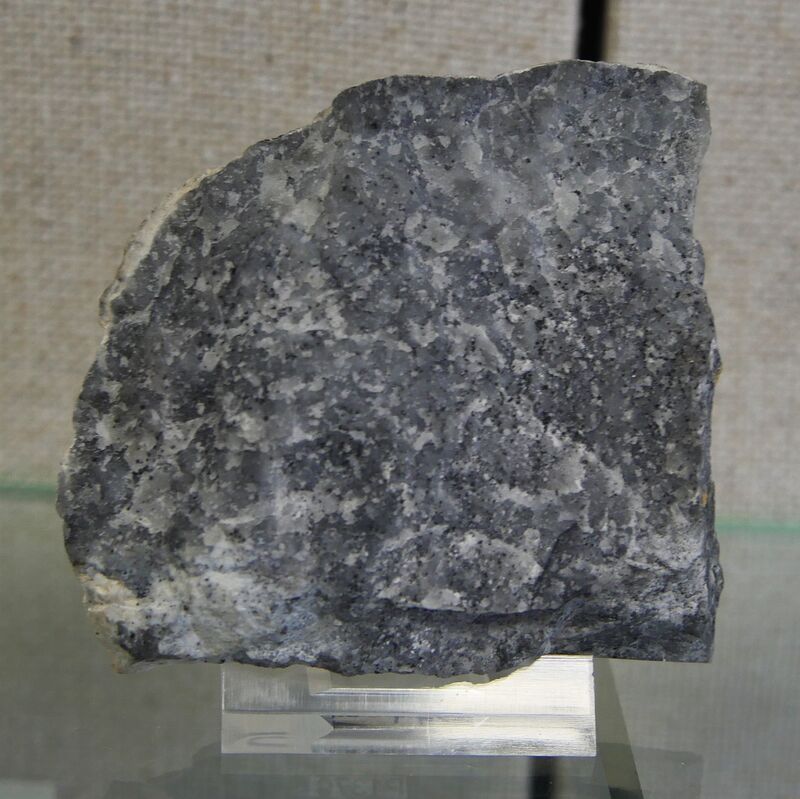
High temperature metamorphism at contact between limestone and flint.
High temperature contact metamorphism of impure limestones.
- Type locality
- Scawt Hill
- Larne
- County Antrim
- Northern Ireland
- UK
54.9105°, -5.9154°
34recorded occurrences
Physical
- Hardness
- 1Talc
- 2Gypsum
- 3Calcite
- 4Fluorite
- 5Apatite
- 6Orthoclase
- 7Quartz
- 8Topaz
- 9Corundum
- 10Diamond
- Transparency
- Transparent · Translucent
- Colour
- Colourless
- Cleavage
- Perfect
(100)
- Density
- 2.96 g/cm³
Optical
- Optical type
- Biaxial (+) · 2V measured = 62 – 69° · 2V calc = 72 – 80°
- Refractive index
- 1.64 – 1.652
- Surface relief
- Moderate
- Principal indices
- nα 1.640 – 1.643 · nβ 1.643 – 1.646 · nγ 1.650 – 1.652
- Dispersion
- relatively weak r > v
- Notes
Y = b; X^a = 15 deg
Δ = 0Δmax
PPLpleochroism per grain
XPLindependent extinctions · rotate the stage
PPLpleochroism only · colour blends on rotation
XPLinterference colour · extinct every 90°
Retardation95 nm
Order1st order
XPL colour
Crystallography
- Space group
- P21/a
- Cell parameters
- a = 10.557(1) Å · b = 8.885(3) Å · c = 7.858(1) Å
- Cell angles
- β = 119.586(6) °
- Ratio a:b:c
- 1 : 0.842 : 0.744
- Z
- 4
- Morphology
Rarely as prismatic crystals, to 8 mm
- Type-locality form
rounded or irregular grains.
Crystal structure
Chemical composition
Synonyms
- Rankiniet
In other languages
- German
- Rankinit
- Italian
- Rankinite
Classification
Strunz
10th ed.9.BC.15
- 9SilicatesClass
- 9.BSorosilicatesDivision
- 9.BCSi2O7 groups, without non-tetrahedral anions; cations in octahedral [6] and greater coordinationGroup
- 9.BC.15RankiniteSpecies
Dana
8th ed.55.03.01.01
- 55Sorosilicates Si2o7 Groups, Generally with No Additional AnionsClass
- 55.03Si2O7 Groups, Generally with no Additional Anions with cations in [7] coordinationType
- 55.03.01— unnamed intermediate level —Group
- 55.03.01.01RankiniteSpecies
CIM
—14.5.4
- 14Silicates not Containing AluminumClass
- 14.5Silicates of CaGroup
- 14.5.4RankiniteSpecies
Group, growth & confusion
Literature, links & citation
Citations
- 1942Fleischer, M. (1942) New mineral names. American Mineralogist, 27 (10). 720
- 1942Tilley, C. E. (1942) Tricalcium disilicate (rankinite), a new mineral from Scawt Hill, Co. Antrim (With Plate V) Mineralogical Magazine and Journal of the Mineralogical Society, 26 (176) 190-196 doi:10.1180/minmag.1942.026.176.06 DOI: 10.1180/minmag.1942.026.176.06
- 1953Moody, K. M. (1953) The space-group and cell-dimensions of rankinite. Mineralogical Magazine and Journal of the Mineralogical Society, 30 (220) 79 doi:10.1180/minmag.1953.030.220.09 DOI: 10.1180/minmag.1953.030.220.09
- 1969Black, Philippa M. (1969) Rankinite and kilehoanite from Tokatoka, New Zealand. Mineralogical Magazine, 37 (288) 517-519 doi:10.1180/minmag.1969.037.288.13 DOI: 10.1180/minmag.1969.037.288.13
- 1974Koroliuk, V., Lavrentiev, Y., Palchyk, N., Reverdatto, V. (1974) The first occurrence of rankinite in SSSR. Zapiski Vserossiskogo Mineralogicheskogo Obshchetstva: 103: 136-139.
Cite this entry
Entry last updated
@misc{mineral2025,
  author    = {Mineral Index editorial board},
  title     = {Rankinite — Mineral Index},
  year      = {2025},
  url       = {https://mineralindex.org/minerals/rankinite-3363}
}