Where it forms, where it's found
- Geological setting
Low temperature hydrothermal deposit
- Type locality
- Red Bird Mine
- Antelope Springs Mining District
- Pershing County
- Nevada
- USA
40.1694°, -118.1722°
56recorded occurrences
Safety & handling
Physical
Optical
- Anisotropism
- Strong; in blue-gray, cream-white, and brown-gray
- Tropism
- Anisotropic
- Reflectance R%
- 38.6-47.0% 546nm
- UV response
- Not fluorescent in UV
Crystallography
- Space group
- P21/m
- Cell parameters
- a = 23.642(4) Å · b = 3.9761(6) Å · c = 24.420(4) Å
- Cell angles
- β = 93.808(3) °
- Ratio a:b:c
- 1 : 0.168 : 1.033
- Z
- 4
- Type-locality form
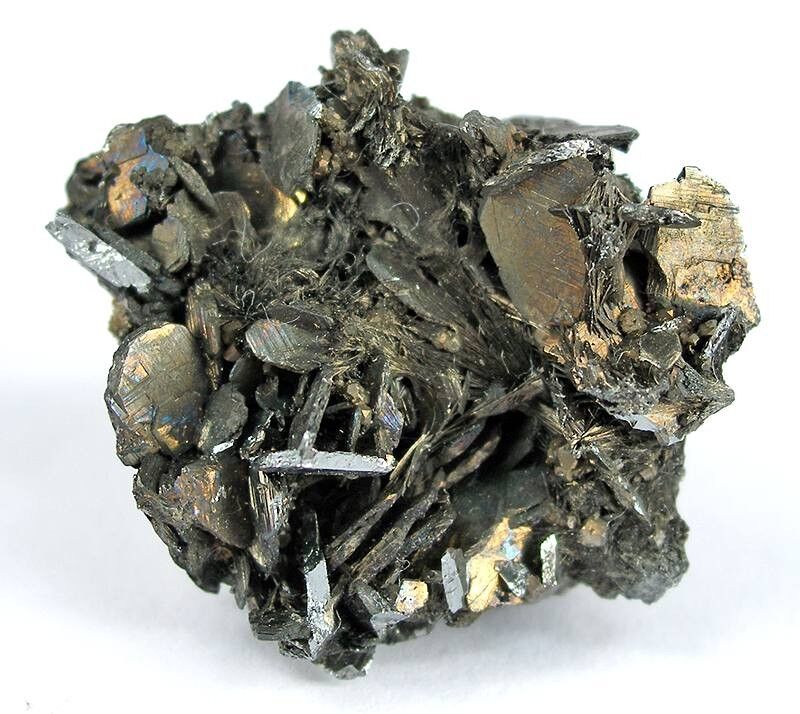
Slender prismatic and striated; also massive, fibrous to compact.
- Comment
Non-standard space-group setting I2/m.
Crystal structure
Chemical composition
Synonyms
- Robinsoniet
In other languages
- German
- Robinsonit
- Italian
- Robinsonite
Classification
Strunz
10th ed.2.HC.20
- 2Sulfides and SulfosaltsClass
- 2.HSulfosalts of SnS archetypeDivision
- 2.HCWith only PbGroup
- 2.HC.20RobinsoniteSpecies
Dana
8th ed.03.06.16.01
- 03SulfosaltsClass
- 03.062 < ø < 2.49Type
- 03.06.16— unnamed intermediate level —Group
- 03.06.16.01RobinsoniteSpecies
CIM
—5.6.17
- 5Sulphosalts - Sulpharsenites and Sulphobismuthites (those containing Sn, Ge,or V are in Section 6)Class
- 5.6Sulpharsenites etc. of Pb aloneGroup
- 5.6.17RobinsoniteSpecies
Group, growth & confusion
Literature, links & citation
Citations
- 1948Robinson, S.C. (1948): Studies of mineral sulphosalts, XIV - artificial sulphantimonides of lead. Contributions to Canadian Mineralogy, University of Toronto Studies, Geological Series No. 42, 54-70.
- 1952Berry, L. G., Fahey, Joseph J., Bailey, Edgar H. (1952) Robinsonite, a new lead antimony sulphide. American Mineralogist, 37 (5-6) 438-446
- 1967Jambor, John Leslie (1967) New lead sulfantimonides from Madoc, Ontario. Part 2 - mineral descriptions. The Canadian Mineralogist, 9 (2) 191-213
- 1968Jambor, J.L., Lachance, G.R. (1968): Bismuthian robinsonite. Canadian Mineralogist: 9: 426-428.
- 1972Petrova, I.V., Kaplunnik, L.N., Bortnikov, N.S., Pobedimskaya, E.A., Belov, N.V. (1972) Crystal structure of synthetic robinsonite. Doklady Akademii Nauk SSSR: 241: 88-90.
Cite this entry
Entry last updated
@misc{mineral2025,
  author    = {Mineral Index editorial board},
  title     = {Robinsonite — Mineral Index},
  year      = {2025},
  url       = {https://mineralindex.org/minerals/robinsonite-3432}
}