Where it forms, where it's found
- Geological setting
In hydrothermal antimony ore deposit.
Monte Arsiccio mine (vugs in metadolostones)
- Type locality
- Dúbrava Sb deposit
- Dúbrava
- Liptovský Mikuláš District
- Žilina Region
- Slovakia
48.9869°, 19.5050°
Safety & handling
Physical
Optical
- Pleochroism
- Visible
From white with a yellowish green tint (darkest position) to white with a faint bluish tint (lightest position).
- Optical colour
- White
- Anisotropism
- Moderate to strong both in air and oil.
- Bireflectance
- Distinct in air, and further enhanced in oil.
- Internal reflections
- Absent
- Tropism
- Anisotropic
- Reflectance R%
- (42.7, 44.0) 400, (39.5, 45.0) 420, (39.3, 44.5) 440, (38.2, 44.1) 460, (37.8, 43.5) 480, (37.8, 43.5) 500, (37.4, 43.4) 520, (36.7, 43.2) 540, (36.6, 42.6) 560, (35.7, 41.5) 580, (35.1, 40.9) 600, (34.8, 40.2) 620, (34.3, 39.4) 640, (33.6, 38.7) 660, (33.0, 37.5) 680, (32.6, 37.1) 700
- Notes
The optical properties are very similar to <M>boulangerite</M>.
Crystallography
- Space group
- C2/m
- Cell parameters
- a = 48.189(48) Å · b = 4.1104(40) Å · c = 34.235(35) Å
- Cell angles
- β = 106.059(15) °
- Ratio a:b:c
- 1 : 0.085 : 0.710
- Unit cell volume
- 6517 ų
- Z
- 4
- Morphology
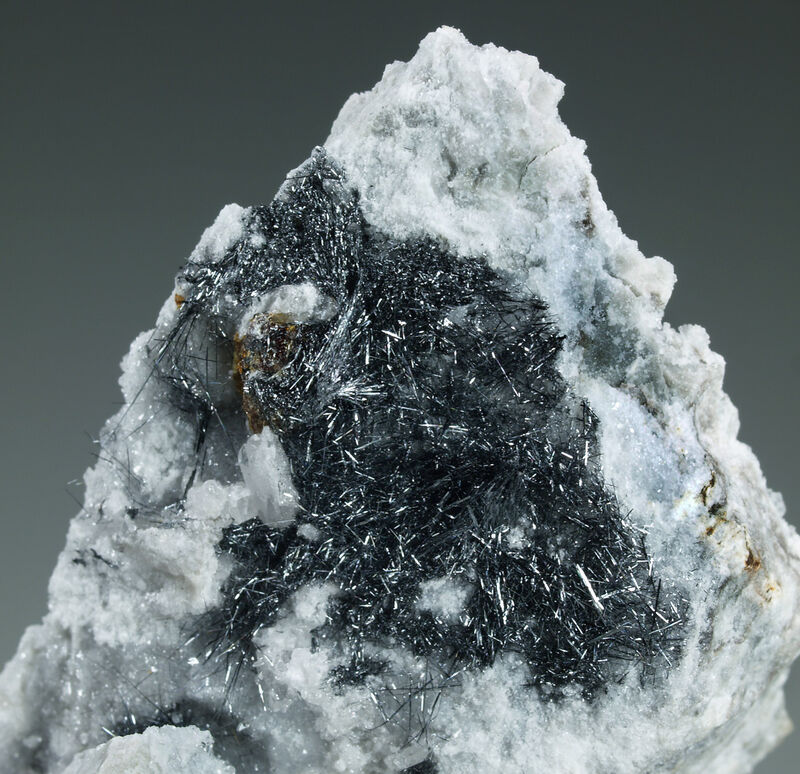
Acicular crystals from Monte Arsiccio are up to 5 mm in length; thick acicular crystals from the Pollone mine are up to 1 cm in length.
- Type-locality form
Irregular aggregates up to 1 cm in size. Irregular or short prismatic grains up to 0.1 mm in length, intergrown with lamellae, needles and irregular patches of other Pb-Sb sulphosalts
- Comment
Pollone mine material parameters: a = 48.38(5), b = 4.11(4), c = 34.18(4) Å, β = 106.26°; the 8 Å structural type has the space group P21/a and the unit-cell parameters a = 34.052(3), b = 8.2027(7), c = 48.078(4) Å, β = 106.258(4)°.
Synonyms
- Chovaniet
- IMA2009-055
- UM2009-21-S:OPbSb
In other languages
- German
- Chovanit · IMA 2009-055
- Italian
- chovanite
Classification
2.JB.35e
- 2Sulfides and SulfosaltsClass
- 2.JSulfosalts of PbS archetypeDivision
- 2.JBGalena derivatives, with PbGroup
- 2.JB.35eChovaniteSpecies
03.10.04
- 03SulfosaltsClass
- 03.10— unnamed intermediate level —Type
- 03.10.04— unnamed intermediate level —Group
- 03.10.04ChovaniteSpecies
Group, growth & confusion
Literature, links & citation
- 2009Williams, P.A., Hatert, F., Pasero, M. (2009) New minerals approved in 2009. in International Mineralogical Association, 1-34.
- 2009Makovicky, E.; Topa, D. (2009) The crystal structure of sulfosalts with the boxwork architecture and their new representative, Pb15-2xSb14+2xS36Ox. The Canadian Mineralogist, 47 (1). 3-24 doi:10.3749/canmin.47.1.3 DOI: 10.3749/canmin.47.1.3
- 2012Topa, Dan, Sejkora, Jiří, Makovicky, Emil, Pršek, Jaroslav, Ozdín, Daniel, Putz, Hubert, Dittrich, Herbert, Karup-Møller, Sven (2012) Chovanite, Pb15-2xSb14+2xS36Ox (x ∼ 0.2), a new sulphosalt species from the Low Tatra Mountains, Western Carpathians, Slovakia. European Journal of Mineralogy, 24 (4) 727-740 doi:10.1127/0935-1221/2012/0024-2189DOI: 10.1127/0935-1221/2012/0024-2189
- 2015(2015) Chovanite. Handbook of Mineralogy. Mineralogical Society of America
- 2015Cámara, Fernando, Gagné, Olivier C., Belakovskiy, Dmitriy I., Uvarova, Yulia (2015) New Mineral Names. American Mineralogist, 100 (5) 1319-1332 doi:10.2138/am-2015-nmn1005-616DOI: 10.2138/am-2015-nmn1005-616
Entry last updated
@misc{mineral2025,
  author    = {Mineral Index editorial board},
  title     = {Chovanite — Mineral Index},
  year      = {2025},
  url       = {https://mineralindex.org/minerals/chovanite-39970}
}