History
The word crystal comes from this stone. The Ancient Greeks called it krustallos — icy cold — because they believed it was ice that had frozen permanently deep in the earth. The application of crystal to fine glassware derives from the carved rock-crystal vessels of antiquity. Its wider scientific sense, for solids of every species, came later.
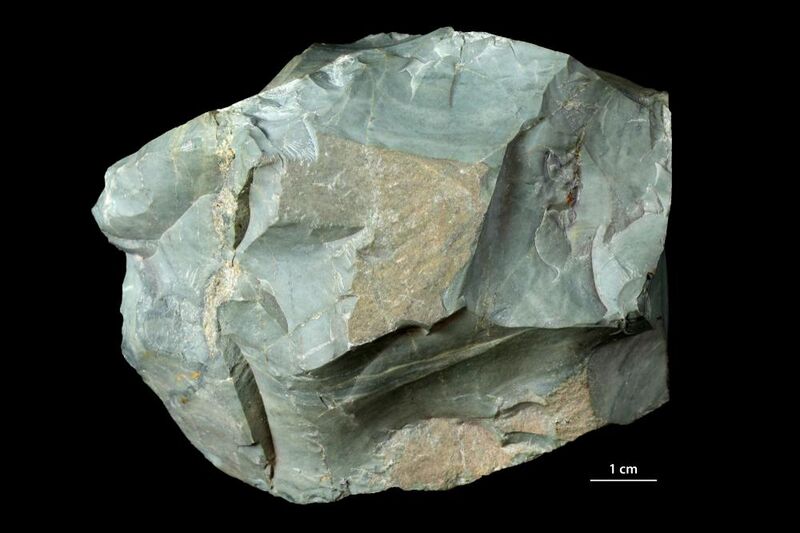
Long before the Greeks named it, prehistoric peoples were already working it. In prehistoric Ireland, as in many other countries, both vein quartz and clear rock crystal were knapped into stone tools. Knapping means flaking sharp blades off a parent block with controlled blows.
The Greek philosopher Theophrastus defended the supercooled-ice theory in writing. The Roman naturalist Pliny the Elder repeated it generations later. He pointed out that rock crystal was found near the Alpine glaciers and not in warm climates. The theory persisted until at least the 17th century.
In carved vessels and reliquaries
Across Europe and the Middle East, rock crystal became the prized medium for hardstone carving — engraved gems, cameo gems, vases, and extravagant vessels. The Fatimid caliphate, which ruled Egypt and North Africa from 909 to 1171, produced the most celebrated of these. Their craftsmen carved ewers from a single block of rock crystal, with decoration so shallow and delicate that only a handful survive today. The translucency of the stone earned it the Arabic name Busaq al-qamar — Spirit of the Moon.
Most of the surviving Fatimid ewers ended up in European cathedral treasuries, rededicated as Christian reliquaries after being captured from their original Islamic settings. One now in the Louvre travelled from King Roger II of Sicily to Count Theobald IV of Blois. Theobald in turn gave it to Abbot Suger of the Abbey of Saint-Denis in Paris. Others reside at the Victoria and Albert Museum in London, in the Basilica of San Marco in Venice, and in the Palazzo Pitti in Florence.
Renaissance Europe inherited the taste. Milan, Prague and Florence became the principal centres for crystal cutting. Their workshops produced the cut-festoon jugs and ornamental vessels that fill the cabinets of period collections.
Crystal gazing
A parallel tradition treated rock crystal as a window onto the unseen. The mathematician John Dee — adviser to Queen Elizabeth I — used a small rock crystal ball to commune with what he believed were angels. The ball was only 5.2 centimetres across. With his medium Edward Kelley, Dee held sessions between 1582 and 1589, claiming to receive an entire angelic language he called Enochian. The crystal ball now sits in the British Museum.
The same century brought the first scientific reading of the stone. The Danish anatomist Nicolas Steno examined quartz crystals in 1669 and noticed something the ice-philosophers had missed. Regardless of a crystal's size or shape, the long prism faces always met at the same 60° angle. He had stumbled into the law of constancy of interfacial angles — the foundation of modern crystallography.
Two centuries later, the brothers Jacques and Pierre Curie discovered, in 1880, that quartz crystals develop an electric charge under mechanical stress. The property is called piezoelectricity, and it would matter enormously in the next century. By the 1930s the electronics industry depended on natural rock crystal for radio oscillators, and the sole world source was Brazil. The Second World War disrupted supply, and nations began trying to grow quartz in the laboratory. By the 1950s, hydrothermal synthesis was producing crystals on an industrial scale. From then on virtually all industrial quartz has been synthetic rather than natural rock crystal.
Industrial & practical applications
Most of what rock crystal does today, it does as ornament. The stone is carved into spheres, polished into points, cut into cabochons, and faceted for jewellery and sculpture. As a clear-stone gemstone, it was formerly used extensively in brilliant-cut form. Glass and plastic have since replaced it for that purpose. Carved vessels and decorative cabinet pieces continue as a luxury lapidary craft.
Quartz's piezoelectric properties are still used to control the oscillation of electrical circuits. But the stone supplying that property is almost never natural rock crystal. Today virtually all the quartz crystal used in the modern electronics industry is grown in the laboratory by hydrothermal synthesis. Natural rock crystal has no measurable share of this market.
Optical applications follow the same pattern. The clarity and refractive properties of the stone once made it the material of choice for lenses and prisms. It is still used for specialist optics that need ultraviolet transmittance, but bulk optical glass draws on engineered substitutes.
A more visible modern market has nothing to do with industry. The popularity of crystal healing has increased the demand for natural quartz crystals. These are now often mined in developing countries using primitive mining methods, sometimes involving child labour. The metaphysical claims around these stones lie outside the scope of this encyclopaedia. The supply chain they have created, however, is real — and is now the dominant source of contemporary demand for natural transparent quartz.
Where it forms, where it's found
Chemical composition
Synonyms
- Alaska Diamond
- Alencon Diamond
- Berg-Crystal
- Bergkristall
- Bergkrystall
- Cristal de Roca
- Cristal de Rocha
- Cristallo di rocca
- Mountain Crystal
- Unripe Diamond
- Vallum Diamond
Literature, links & citation
- —Mullis, J. (1996): P-T-t path of quartz formation in extensional veins of the Central Alps. Schweizerische Mineralogische und Petrographische Mitteilungen, 76, 159-164.
- 1977Rykart, R. (1977) Bergkristall: Form und Schönheit alpiner Quarze. 2. Auflage, Ott Verlag, 248 pp.
Entry last updated
@misc{mineral2026,
  author    = {Mineral Index editorial board},
  title     = {Rock Crystal — Mineral Index},
  year      = {2026},
  url       = {https://mineralindex.org/minerals/rock-crystal-6128}
}