History
The name is the colour. Ruby comes from ruber, the Latin word for red. The stone is the red variety of corundum, a crystal of aluminium oxide — aluminium bonded to oxygen. A trace of chromium replacing some of the aluminium turns it red. Every other gem colour the same mineral can take is called sapphire instead.
Not all reds are equal. The brightest and most valued shade — a deep blood-red called pigeon's blood — has long commanded a large premium over paler stones.
For centuries, the finest of those reds came from one place. The Mogok Valley in Upper Myanmar, northeast of Mandalay, was the world's main source for rubies. The deep Burmese reds set the standard against which other rubies were judged.
The name has fooled people. Several famous "rubies" are not rubies at all. The Black Prince's Ruby, a large red stone in the British Imperial State Crown, is a spinel — a different mineral entirely. Red spinels still mislead anyone without practiced eyes for gems.
The map of supply has since shifted. Rubies were long mined in Thailand and across the border in Cambodia. More recently, Mozambique has become the world's most productive source of gem-quality ruby.
Industrial & practical applications
Ruby is, first and last, a gemstone. Its red is the whole point, and the deepest blood-red — pigeon's blood — fetches the steepest prices. The stone backs that value with toughness: at 9 on the Mohs scale, the standard ten-point ranking of scratch resistance, ruby is among the hardest of all gem materials.
Not every ruby on the market grew underground. Synthetic ruby is chemically identical to the natural stone. It is grown in the laboratory by the flame-fusion process, which has produced rubies on a commercial scale since 1903. The method scaled fast: output reached 1,000 kilograms a year by 1907, from a 30-furnace facility. Synthetic ruby remains the cheap, abundant counterpart to the rare natural gem.
That same lab-grown crystal sits at the root of the laser. The first working laser was built in 1960 and used a rod of synthetic ruby to produce red light at a wavelength of 694 nanometres. Ruby lasers are still used today where that specific red pulse is wanted.
Ruby's hardness earns it a quieter job too. Tiny ruby pieces serve as bearings at the wear-exposed pivot points inside mechanical clockworks, where a softer material would grind away.
Most stones reach the buyer altered. Lower-grade rubies are routinely heat-treated to improve their colour and to clear the fine internal needles jewellers call silk. Heavily fractured stones get a further step: their cracks are filled with lead glass, which dramatically improves the transparency of the gem.
Where it forms, where it's found
Varieties
Physical
- Hardness
- 1Talc
- 2Gypsum
- 3Calcite
- 4Fluorite
- 5Apatite
- 6Orthoclase
- 7Quartz
- 8Topaz
- 9Corundum
- 10Diamond
- Colour
- Red
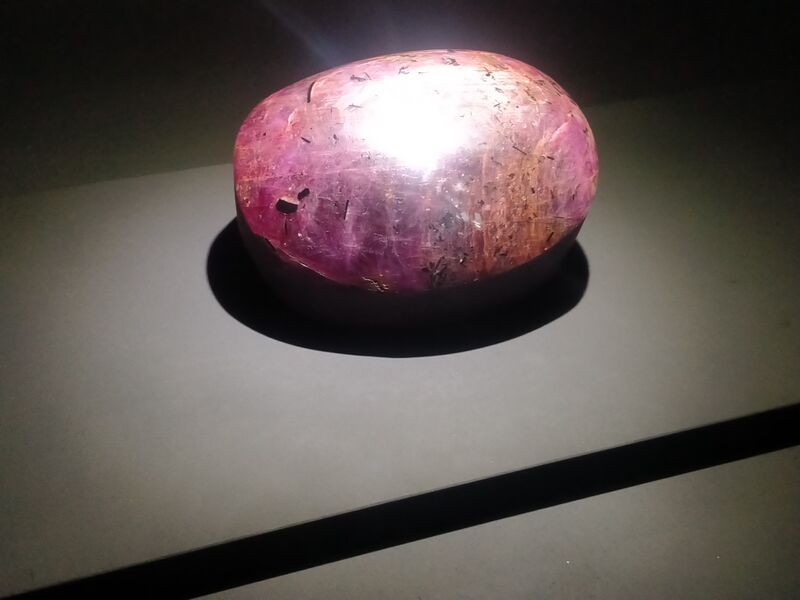
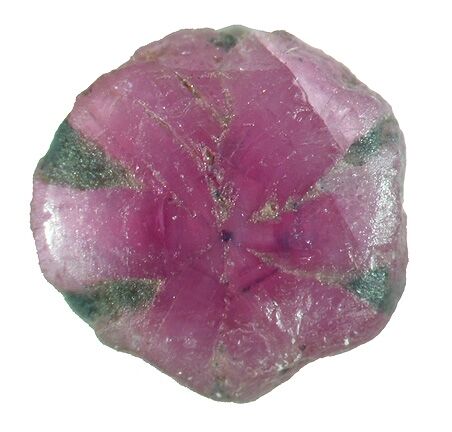
The substitution of Al3+ by Cr3+ results in pink to red colours, depending on the Cr content. The pink corundum variety is called “pink sapphire” or “pink ruby”, and the red variety, with higher Cr contents (0.1 < Cr2O3 < 3.0 wt %; [5]), is called “ruby”. Concentrations of 9.4 wt % Cr2O3 were measured in ruby from Karelia in Russia and up to 13 and 13.4 wt % respectively, in ruby from Westland in New Zealand, and in ruby inclusions in diamond from placers associated with the Juina kimberlite.
Optical
- UV response
- The intensity of fluorescence is a function of Cr concentration and the Cr/Fe ratio, because the presence of Fe or an excess of Cr tends to eliminate or quench the fluorescence in ruby.
Crystallography
Chemical composition
Synonyms
- Errubi
- Hồng ngọc
- Oriental Ruby
- Robijn
- Rubeno
- Rubi
- Rubí
- Rubiin
- Rubiini
- Rubin
- Rubín
- Rubinas
- Rubino
- Rubīns
- Rubis
- Yakut
- కెంపు
Literature, links & citation
- 1891Edmond Frémy (1891): Synthèse du rubis. Vve. Ch. Dunod, France. [https://archive.org/details/SyntheseDuRubis]
- 1960Graham, J. (1960) Lattice spacings and colour in the system alumina-chromic oxide. Journal of Physics and Chemistry of Solids, 17. 18-25 doi:10.1016/0022-3697(60)90170-0DOI: 10.1016/0022-3697(60)90170-0
- 1964Saalfeld, H. (1964) Strukturuntersuchungen im System Al2O3–Cr2O3. Zeitschrift für Kristallographie, 120 (4-5). 342-348 doi:10.1524/zkri.1964.120.4-5.342 DOI: 10.1524/zkri.1964.120.4-5.342
- 1967Steinwehr, Η. E. v. (1967) Gitterkonstanten im System α-(Al, Fe, Cr)2O3 und ihr Abweichen von der Vegardregel. Zeitschrift für Kristallographie, 125 (1-6). 377-403 doi:10.1524/zkri.1967.125.16.377DOI: 10.1524/zkri.1967.125.16.377
- 1987Schmetzer, Karl (1987) On twinning in natural and synthetic flux-grown ruby. The Journal of Gemmology, 20 (5) 294-305 doi:10.15506/jog.1987.20.5.294DOI: 10.15506/jog.1987.20.5.294
Entry last updated
@misc{mineral2026,
  author    = {Mineral Index editorial board},
  title     = {Ruby — Mineral Index},
  year      = {2026},
  url       = {https://mineralindex.org/minerals/ruby-3473}
}