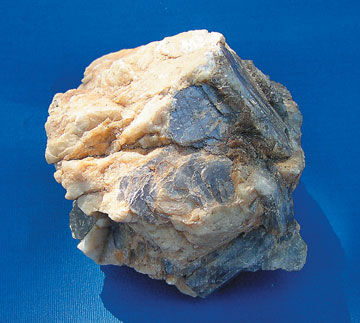
History
The word sapphire once named a different stone entirely. It comes through Old French saphir and Latin sapphirus from the Greek sappheiros. That word traces back through Hebrew sapir to a Semitic root. In antiquity all of these words pointed not at the blue gem we know today but at lapis lazuli — the deep-blue rock prized for ornament and pigment. True sapphires reached the Mediterranean only in Roman times, so the older texts that praise "sapphire" almost always mean lapis. One reading of the root traces it to a verb meaning to score or mark a surface, a nod to how hard gemstones scratch softer stone.
Sapphire is not a mineral in its own right but a gem variety of corundum, a crystalline form of aluminium oxide (Al₂O₃). Corundum yields two named gems. Red corundum is called ruby; corundum of every other color — blue above all, but also yellow, green, pink and violet — is called sapphire. The familiar blue is not caused by a single colouring metal. It arises when iron and titanium atoms sit side by side in the crystal and an electron hops between them, a process that paints the stone blue.
The Romans wore corundum gems, but sapphire's place in the medieval imagination was firmer still. Pope Innocent III decreed that a bishop's ring should be made of pure gold and set with an unengraved sapphire, a stone he judged fit for the dignity of the office.
Famous sources
The map of where fine sapphires come from has shifted over the centuries. The deposits of Kashmir, in the Himalayan foothills, gave the gem trade its most celebrated blue — but their peak lasted only a short span at the end of the nineteenth and start of the twentieth centuries. Sri Lanka, long known to gem dealers as Ceylon, has yielded some of the largest named stones, among them the Logan sapphire and the Star of India. In Myanmar's Mogok Stone Tract, sapphire grows in granite pegmatites and corundum syenites. Ruby forms nearby in marble — the same element, two rocks, two gems.
Newer sources reshaped the market again. The blue Yogo sapphires of Yogo Gulch, west of Lewistown in Montana, gave the United States its own celebrated deposit. Australia led world production by the late 1980s. Then the mines around the town of Ilakaka opened, and by 2007 Madagascar had become the world's leading source of sapphire.
A rare colour earned its own name. The padparadscha is a delicately toned pink-orange to orange-pink sapphire, first found in Sri Lanka.
Industrial & practical applications
Sapphire's first use is the one everyone pictures: a cut gemstone. Blue is the prized colour, but jewellers also set the yellow, pink, green and violet stones, along with the rare pink-orange padparadscha. Most blue sapphires on the market have been heated to deepen their colour. The stones are held in furnaces between 800 and 1,800 °C, for hours and sometimes weeks. The heat dissolves internal needles and lets iron and titanium bring out the blue.
Colour can also be added rather than coaxed. In lattice diffusion treatment, impurities are baked into the stone from the outside to enhance its colour — a method first developed by the Linde division of Union Carbide, which diffused titanium into synthetic sapphire.
Beyond jewellery, sapphire is valued for being almost impossible to scratch. Corundum scores 9 on the Mohs scale of hardness, behind only diamond and moissanite, which makes synthetic sapphire ideal where a clear surface must survive years of abuse. Grown in factories and sometimes sold as sapphire glass, it covers wristwatch faces and forms the tiny jewel bearings inside mechanical movements. Because it stays transparent from ultraviolet through to infrared light, it also serves as scratch-resistant windows for instruments and sensors. Apple used it at scale: in 2014 the company took roughly a quarter of the world's sapphire supply to cover the iPhone's camera lens and fingerprint reader.
Synthetic sapphire is just as important to electronics. Thin wafers of it were the first insulating base for depositing silicon to build integrated circuits. That arrangement is known as silicon on sapphire. Today its largest electronic role is as a substrate: a layer of gallium nitride grown on sapphire is the standard foundation for blue light-emitting diodes.
Most of this synthetic sapphire is pulled from a melt of molten aluminium oxide. The dominant methods are variants of the Czochralski process, including the Kyropoulos method, which has the advantage of consuming all of its feedstock.
Where it forms, where it's found
Varieties
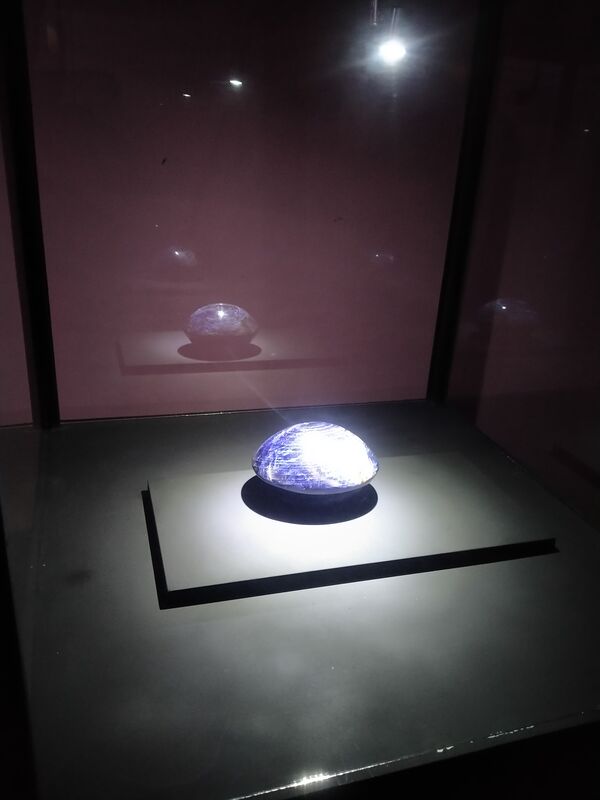
Physical
- Colour
- blue · yellow · green · brown · pink · purple
The color of sapphire is highly varied. The color origin analysis reveals that the absorption peaks of the ultraviolet spec trum caused by Cr3+ in the yellow-green and blue-purple regions account for the pink color of the Vietnamese and Madagascan samples. The lower UV wavelength position of the two main peaks in the Madagascan samples, as compared to the Vietnamese ones, indicates that Fe3+ d–d transitions, as well as transitions between Fe2+—Ti4+ and Fe3+—Ti3+ ions, enhance blue light transmission and cause the samples to tend towards a purple hue. Compared with the pink-red corundum of the same marble type (Myanmar and Yunnan, China), the Vietnamese samples have lower V, Mg, and Ga contents and a higher Fe content. Compared with the pink-red corundum of the high-iron type (Thailand, Cambodia, and Tanzania), the Madagascan samples have lower Fe and higher Ga contents overall. [[3]]
Chemical composition
Synonyms
- Azulinhas
- Bengal Amethyst
- Corindon hyalin
- Hyacinthos
- Jacut
- Orientalisk Rubin
- Saffier
- Safiir
- Safiiri
- Safir
- Safír
- Safira
- Safiro
- Safīrs
- Safyras
- Salamstein
- Saphir
- Sapphirus
- Szafir
- Télésie
- Ultralit
- Ultralita
- Ultralite
- Xa-phia
- Zaffiro
- Zafír
- Zafiro
- Ζαφείρι
- నీలమణి
Literature, links & citation
- 1795Klaproth, M. H. (1795) IV. Untersuchung des orientalischen Sapphirs. In Beiträge zur chemischen Kenntniss der Mineralkörper Vol. 1. Rottmann. p.81-89.
- 1969WIEDERHORN, S. M. (1969) Fracture of Sapphire. Journal of the American Ceramic Society, 52 (9). 485-491 doi:10.1111/j.1151-2916.1969.tb09199.xDOI: 10.1111/j.1151-2916.1969.tb09199.x
- 1994Webster, R. & Read, P.G. (1994): Gems: Their Sources, Descriptions and Identification. 5th edition, Butterworth-Heinemann, Oxford, 1026 pp.
- 1997Hughes, Richard W. (1997) Ruby & Sapphire. RWH Publishing.
- 1998Ward, F. (1998): Rubies and sapphires. Gem Book Publishers, Bethesda, Maryland, USA, 64 pp.
Entry last updated
@misc{mineral2026,
  author    = {Mineral Index editorial board},
  title     = {Sapphire — Mineral Index},
  year      = {2026},
  url       = {https://mineralindex.org/minerals/sapphire-3529}
}