History
The name selenite comes from the Greek selēnítēs líthos — moon stone. Early observers thought the pale, pearly sheen of these clear gypsum crystals waxed and waned with the Moon, and the name stuck. It is worth clearing up one thing the spelling invites: selenite holds no selenium. Both words simply trace back to the same Greek root selḗnē, the Moon.
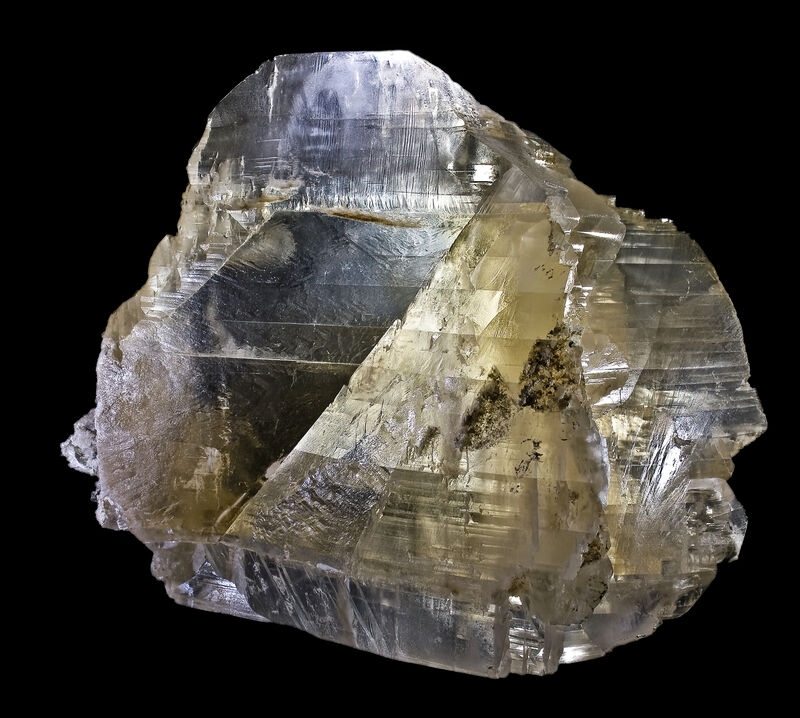
Selenite is the clear, glassy variety of gypsum, a soft calcium sulfate mineral. Long before window glass was common, that transparency made it useful. Roman builders split the crystals along their natural layers into thin, see-through sheets and set them into walls to let light through — a material they called lapis specularis, the mirror stone. The sheets glazed openings that would otherwise have needed wooden shutters or cloth.
The Romans began using it this way in the first century AD. Pliny the Elder, in his Natural History, recorded that the finest came from one stretch of Hispania — within a hundred thousand paces of the city of Segóbriga, in what is now Spain. The mineral lit the windows of wealthy villas and the bathhouses of emperors. The emperor Tiberius is said to have roofed greenhouses with it to grow cucumbers out of season. Sheets of selenite were still glazing windows centuries later, among them those of the basilica of Santa Sabina in Rome.
The mineral's most spectacular chapter is recent. In April 2000, miners digging a tunnel for the Industrias Peñoles company at the Naica mine in Chihuahua, Mexico, broke into a chamber roughly 300 metres underground. Inside stood selenite crystals among the largest ever found in nature — the biggest measuring 11.40 metres long and weighing an estimated 12 tonnes. Hot, mineral-rich water seeping up from a magma chamber far below had let the crystals grow, almost unimaginably slowly, over at least 500,000 years.
Industrial & practical applications
Selenite has little industrial use today. As the clear, well-formed variety of gypsum, it is valued mostly as a mineral specimen — the giant crystals of the Naica mine in Mexico, among the largest ever found in nature, are the headline example of the collector and museum demand it draws.
It also turns up in ornamental work. Satin spar, a fibrous, silky-sheened form often sold under the selenite name, is cut into rounded, polished stones to show off its shifting band of light, an effect called chatoyance. The bulk industrial value of gypsum — plaster, wallboard, cement — rests on the massive, fine-grained rock, not on these clear crystals.
Where it forms, where it's found
Physical
- Transparency
- Transparent
- Colour
- Colourless · light tints due to included matter
- Fracture
- Micaceous
Chemical composition
Synonyms
- Fraueneis
- Glacies Mariæ
- Maria-Glass
- Marieneis
- Marienglas
- Selenit
- Selenita
- Selenites
Literature, links & citation
- 1747Wallerius, J.G. (1747) Mineralogia, eller Mineralriket. Stockholm: 50.
- 1758Cronstedt, Axel Fredrik (1758) Försök till en Mineralogie eller Mineral Rikets Upställning. J. A. Carlbohm, Stockholm.
- 1951Palache, Charles; Berman, Harry; Frondel, Clifford (1951) The System of Mineralogy (7th ed.) Vol. 2 - Halides, Nitrates, Borates, Carbonates, Sulfates, Phosphates, Arsenates, Tungstates, Molybdates, Etc. John Wiley and Sons.
Entry last updated
@misc{mineral2026,
  author    = {Mineral Index editorial board},
  title     = {Selenite — Mineral Index},
  year      = {2026},
  url       = {https://mineralindex.org/minerals/selenite-5527}
}