Where it forms, where it's found
- Geological setting
Playas in a desert region.
Arid regions. In salt playas and desiccated saline lakes.
- Type locality
- Iquique Province
- Tarapacá
- Chile
Physical
- Hardness
- 1Talc
- 2Gypsum
- 3Calcite
- 4Fluorite
- 5Apatite
- 6Orthoclase
- 7Quartz
- 8Topaz
- 9Corundum
- 10Diamond
- Lustre
- Silky · Vitreous
- Transparency
- Transparent
- Colour
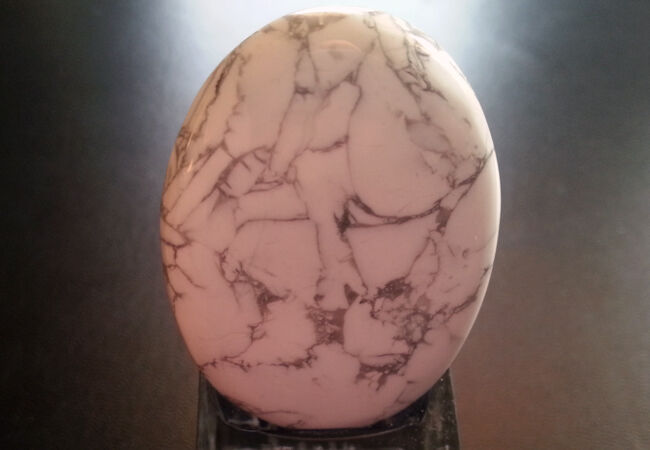
- Colourless · white · grey with included clays.
- Tenacity
- brittle
- Cleavage
- Perfect
Perfect on (010); on (11) good; on (110) poor.
Fracture uneven across fibers.
- Fracture
- Irregular/Uneven
- Density
- 1.955 g/cm³
Optical
- Optical type
- Biaxial (+) · 2V measured = 73 – 78° · 2V calc = 68°
- Refractive index
- 1.491 – 1.52
- Surface relief
- Moderate
- Principal indices
- nα 1.491 – 1.496 · nβ 1.504 – 1.506 · nγ 1.519 – 1.52
- Dispersion
- none
- Extinction
- X (11.5°,81°); Y (100°,21.5°); Z (107°,70°) [with c (0°,0°) and b* (0°,90°) using (φ,ρ)].
- UV response
- Yellow, greenish yellow, cream, white.
Crystallography
- Cell parameters
- a = 8.816(3) Å · b = 12.87 Å · c = 6.678(1) Å
- Cell angles
- α = 90.25 ° · β = 109.12 ° · γ = 105.1 °
- Ratio a:b:c
- 1 : 1.460 : 0.757
- Z
- 2
- Morphology
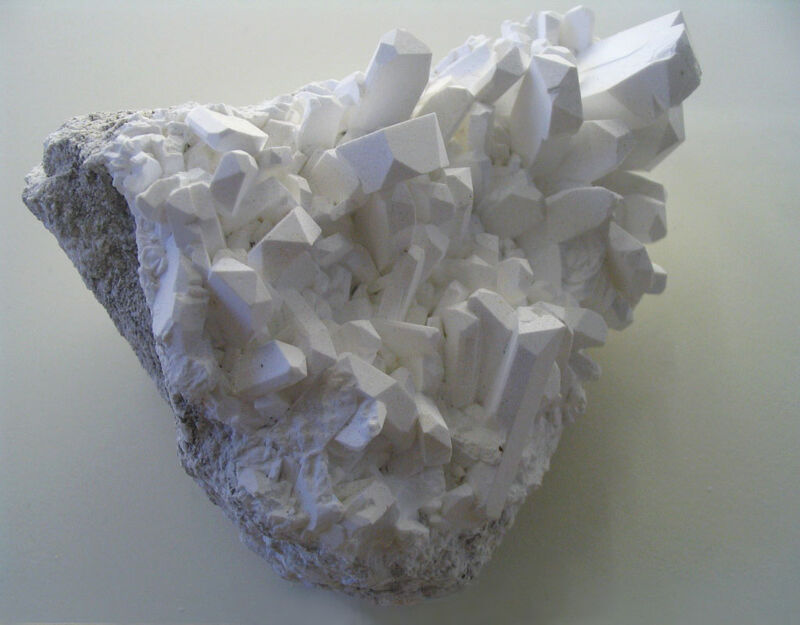
Small nodular, rounded, or lens-like masses; loose at times (termed "cotton balls"), comprised of acicular crystals. Fibers may be radially arranged or randomly oriented towards the centers of the masses and arranged in parallel position at the periphery. Botryoidal crusts or randomly oriented fibers. Compact veins with a parallel fibrous structure. Distinct crystals rare, greatly elongated [001] (Palache et al (1951) Dana's System of Min.: 345).
- Twinning
Polysynthetic, common in massive aggregates and crushed fragments. Several twin laws apply: 1. Polysynthetic on (010) and (100); 2. (34) or (23) less certain, and others of a more complex nature. The twinning distinguishes ulexite from probertite.
Chemical composition
Synonyms
- Boronatro-calcite
- Boronatrocalcit
- Boronatrocalcita
- boronitrocalcite
- Cotton-ball Borax
- Fernsehstein
- Franklandit
- Franklandita
- Franklandite
- Hayesine (of Forbes)
- Hayesit
- Hayesita
- Hayesite
- Natroborocalcit
- Natroborocalcita
- Natroborocalcite
- Natronborocalcite
- Natronkalk-borat
- Raphit
- Raphita
- Raphite
- Stiberit
- Stiberita
- Stiberite
- Television Stone
- Tinkalzit
- Tiza
- TV stone
In other languages
- French
- Uléxite
- German
- Fernsehstein · Televisionsstein · TV-Stein · Ulexit
- Spanish
- ulexita
- Italian
- Ulexite
- Portuguese
- ulexita · Ulexite
- Japanese
- ウレキサイト · ウレックス石 · テレビ石 · 曹灰硼石
- Chinese
- 冰硼钠石 · 硼钠解石 · 鈉硼解石 · 钠硼解石
- Simplified Chinese
- 冰硼钠石
- Traditional Chinese
- 冰硼鈉石
- Russian
- боронатрокальцит · телевизионный камень · улексит
- Arabic
- أوليكسيت
Classification
6.EA.25
- 6BoratesClass
- 6.EPentaboratesDivision
- 6.EANeso-pentaboratesGroup
- 6.EA.25UlexiteSpecies
26.05.11.01
- 26Hydrated Borates Containing Hydroxyl or HalogenClass
- 26.05PentaboratesType
- 26.05.11— unnamed intermediate level —Group
- 26.05.11.01UlexiteSpecies
9.3.21
- 9BoratesClass
- 9.3Borates of Ca and SrGroup
- 9.3.21UlexiteSpecies
Group, growth & confusion
Literature, links & citation
- —Currier, Rock (n.d.) Best of.. Ulexite. https://www.mindat.org/a/best_ulexite
- 1844Hayes, A.A. (1844) Borate of Lime. Borocalcius obliquus. American Journal of Science: 46: 377-377. (as Hydrous borate of lime).
- 1844Hayes, A.A. (1844) Hydrous borate of lime. American Journal of Science: 47: 215-215.
- 1847Hausmann, J.F.L. (1847) Handbuch der Mineralogie 3 volumes, Göttingen. Second edition, vol. 2, in two parts: 1429 (as Hydroborocalcite)
- 1849Ulex, G.L. (1849) Ueber eine natürliche borsaure Verbindung. Annalen der Chemie und Pharmacie: 70(1): 49-52. (as Boronatro-calcite)
Entry last updated
@misc{mineral2026,
  author    = {Mineral Index editorial board},
  title     = {Ulexite — Mineral Index},
  year      = {2026},
  url       = {https://mineralindex.org/minerals/ulexite-4085}
}